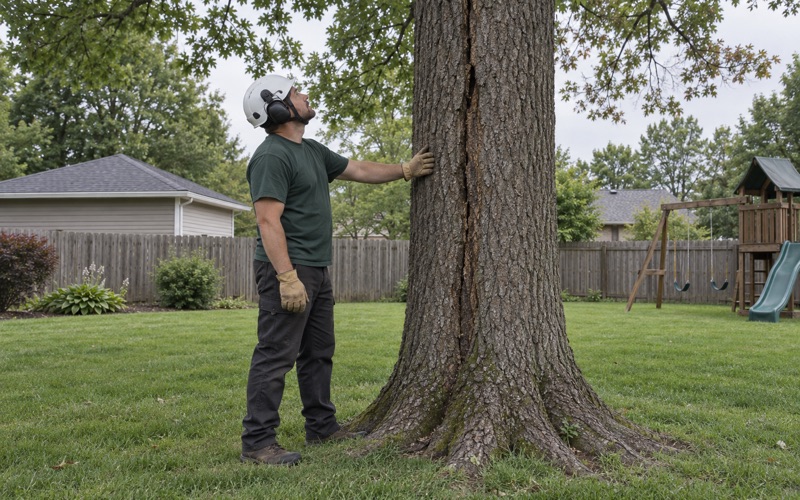
Shawnee Tree Removal has been handling tree removal in Belton for more than twenty years, and the call that brings our trucks south into Cass County most often is not a storm failure. It is a pine that looked fine in July, went off-color in September, and stood completely brown by the time the leaves came down around it.
That tree is dead, it did not die slowly, and unlike almost everything else we cut it arrives with a date attached. Most removal work is scheduled by the customer; pine wilt is scheduled by the disease, and the deadline belongs to the insect that spreads it.
We give a free on-site assessment, put the figure in writing, and tell you where the wood and the grindings are going before a saw comes out of the truck. On a pine wilt removal that last part is not a courtesy, it is half the job.
When a pine dies in weeks instead of seasons
What is actually killing it
Pine wilt is caused by the pinewood nematode, a microscopic roundworm that cannot travel on its own. It moves tree to tree inside the pine sawyer beetle, which feeds on healthy pines and leaves the nematodes behind in the feeding wounds. Once they are in, they multiply through the resin canals and shut down the tree’s ability to move water.
The visible sequence is fast and it runs the same way every time. Needles turn gray-green, then yellow, then brown, and they hang on the tree instead of dropping. A mature pine can go from apparently healthy to entirely dead in a matter of weeks, and once the crown has browned the tree is finished. There is no partial save and nothing to spray.
Which pines, and when you will see it
The trees at risk in this market are Scotch pine and Austrian pine. K-State Research and Extension states it plainly in its pine wilt publication: Scots pine plantings in eastern Kansas have been devastated by this disease, and the same planting history sits on the Missouri side of the metro. Symptoms show up August through December, which is why this work starts arriving in late summer and does not let up until the holidays.
We do not diagnose a browning conifer over the phone. A dying evergreen in a Belton yard gets a site visit, because the species answer changes both what has to happen and how fast it has to happen.
Looking for tree-removal closer to Bucyrus? See Tree-Removal in Bucyrus.
The removal with a deadline on it
The control instruction here is a calendar rather than a technique. K-State’s direction is to cut the tree as soon as possible once it is confirmed, and by May 1 at the very latest, with April 1 better. The reason is the beetle: it overwinters in the dead wood as larvae and emerges in spring carrying nematodes to the next pine within flying distance.
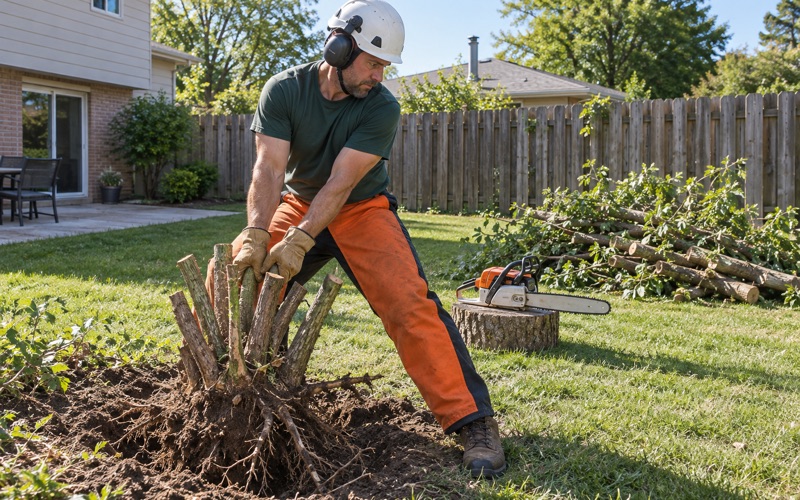
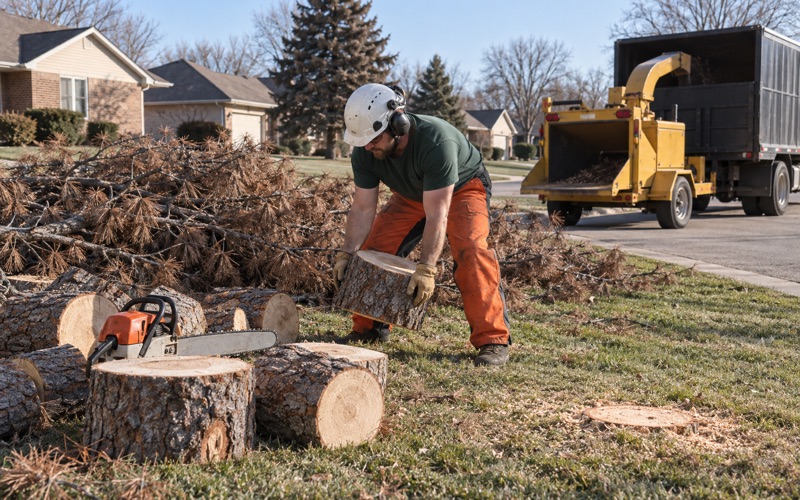
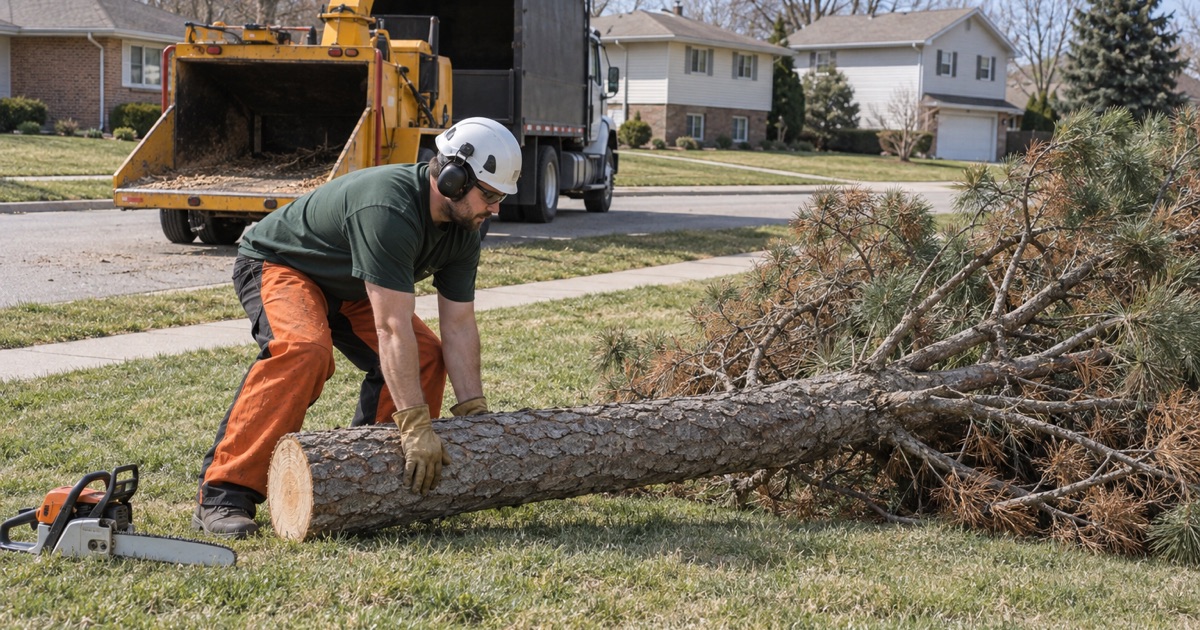
Two further parts of that instruction get skipped by people trying to save money, and both matter more than the felling itself. Cut the tree to the ground rather than leaving a stump, because a stump is still infested wood standing in the yard. And chip or burn the wood immediately.
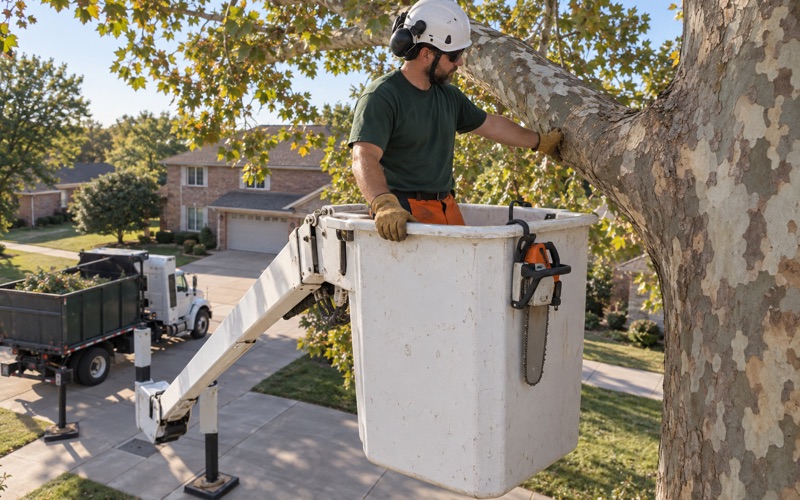
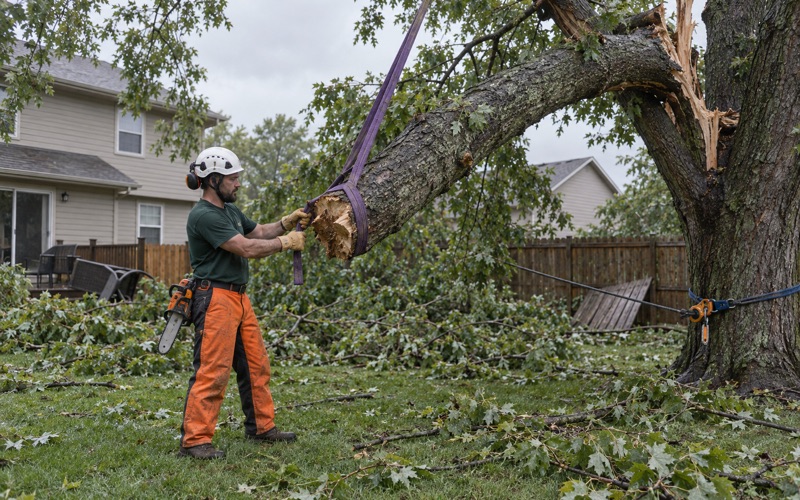
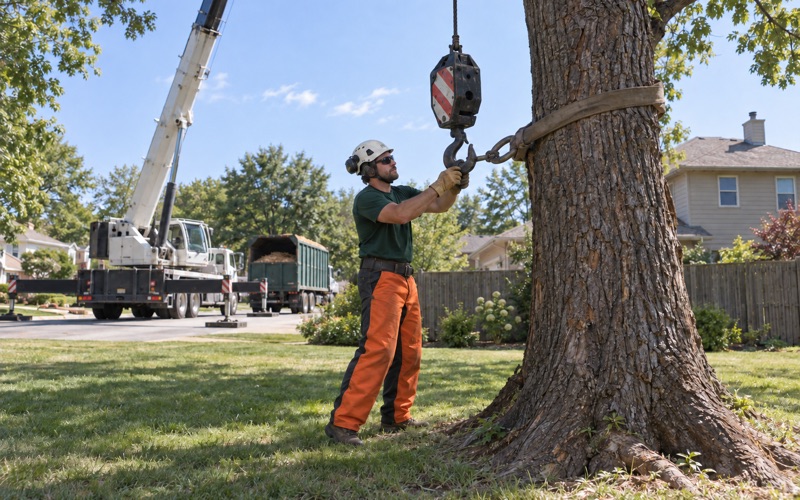
A dead pine is also not a routine felling. Wilt-killed wood dries and loses strength quickly, so the rigging plan changes with it. We take more of these apart from the top with a bull rope and a Port-a-Wrap friction device instead of trusting a dead spar to hold a heavy piece, and where the drop zone is a driveway and a roof, crane-assisted removal costs less than the repair it prevents.
Why you cannot keep it for firewood
The instruction on that point is explicit: do not save the wood for firewood. A stack of infested pine seasoning against a garage over the winter is a beetle nursery with a spring release date, and it makes no difference that the tree it came from is already gone.
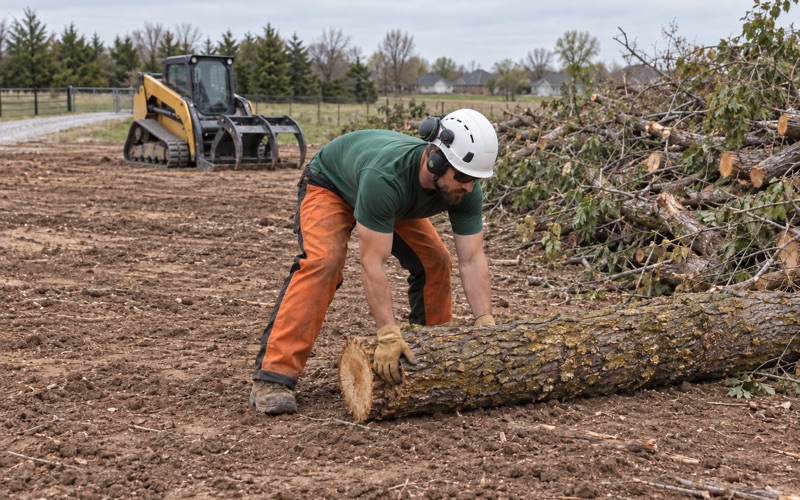
This is where disposal stops being paperwork. Every stick leaves with us on this kind of job, and it leaves the day the tree comes down rather than waiting at a curb for a collection that would refuse it anyway.
Where the wood and the stump actually go
Belton’s curbside yard waste runs through GFL Environmental on the city’s contract, and it takes up to ten biodegradable bags or ten bundles of limbs a week, or any combination of the two. Bundles have to be under 18 inches in diameter, tied with twine or string rather than tape or plastic, and no longer than 36 inches.
The part homeowners trip over is the definition. GFL defines yard waste as limbs less than 2 inches in diameter, and it refuses plastic of any kind, dirt, rocks, stumps, roots and shrubs with intact root balls. Read that list again, because there is no contractor clause anywhere in it.
That absence is the whole finding. Nobody in Belton is refused for being a contractor: a six-inch pine log is refused because it is not yard waste, and a stump is refused because it is not yard waste. The rule reaches the homeowner and the crew identically, which is exactly why a do-it-yourself pine removal ends in a pile nobody will collect.
One gate in the county, and it will not take a stump with dirt on it
Kansas City Composting, at 2008 E 171st Street inside this city, is the only yard-waste receiving facility established anywhere in Cass County, and there is no public county gate standing behind it. It is privately operated, so the terms are commercial rather than a published public rule, and it prices by volume and vehicle: bags, cubic yards, chip trucks, grapple trucks, end dumps.
The same operator’s published rules accept brush and logs under 10 feet in length, and logs up to 40 inches in diameter when they are under 5 feet long. What is refused decides how a job is planned: stumps with dirt, tangled debris, brush over 10 feet, landscape timbers, building materials and railroad ties.
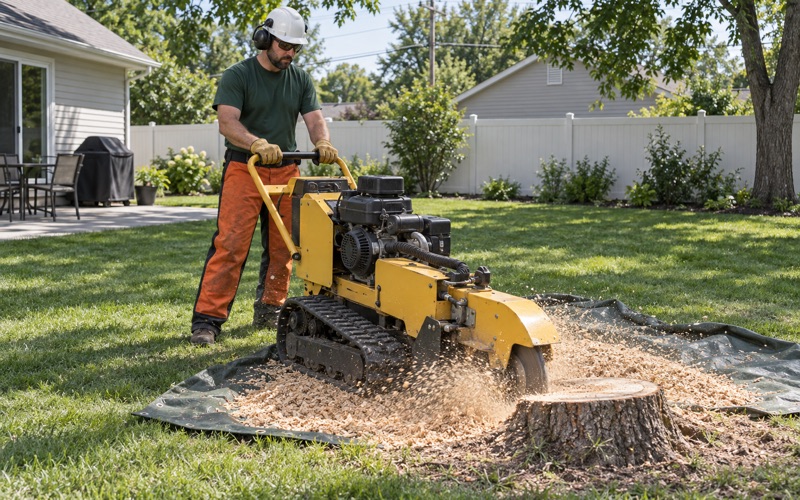
That refusal is why we grind stumps in place in Belton rather than pulling them. Ground down, a stump becomes grindings that go back in the hole or leave with us. Pulled, it becomes a heavy object with soil locked into the root plate and no local outlet at all.
A species schedule, not a cohort of houses
Most cities hand us a wave of one problem, because their housing went up inside a single decade and everything planted alongside it fails together. Belton, in northwestern Cass County, does not work that way. Its housing is spread almost evenly across five decades: 1,061 units from the 1950s, 1,085 from the 1960s, 1,823 from the 1970s, 1,606 from the 1980s and a peak of 2,106 from the 1990s at 19.07 percent, the most evenly spread profile of the Cass County cities.
The practical effect is that removal work here is scheduled by a species rather than by an age. Two houses built thirty years apart can carry the same doomed Scotch pine, and two neighbors on one street can sit on completely different timelines for completely different reasons.
The blue spruce is a different problem entirely
The other conifer failing across this metro is Colorado blue spruce, and its disease is Rhizosphaera needle cast. It thins from the ground up and from the branch inward, with a long lag between infection and the loss you can finally see, so the decline runs over seasons and years rather than weeks.
We say that out loud because a homeowner who has watched a pine die in a month reads a thinning spruce as next week’s emergency. It is not one. And whatever national copy says about Leyland cypress, that is not the screen conifer failing here: in this market it is Scotch and Austrian pine, and blue spruce.
The list the extension service will not recommend
The Johnson County K-State Extension list of trees not recommended for the Kansas City area reads a great deal like our schedule: silver maple for weak wood, pin oak for soil issues, green ash for emerald ash borer, then Austrian pine and Scotch pine, box elder, Bradford pear, Lombardy poplar, Siberian elm and willow. On Bradford pear the instruction is blunt, telling homeowners not to plant the cultivar because severe splitting occurs on ten to fifteen year old trees.
A tree on that list is not automatically a removal. If it is still sound and cabling or structural pruning buys it another decade, we will say so and price that work instead.
No permit for your own yard, and one duty out front
Removing a tree that stands on your own finished lot in Belton does not require a city permit. The tree provisions live inside Chapter 19, which governs streets, sidewalks and rights-of-way, and they read as maintenance duties rather than removal approvals.
One of those duties is worth knowing when a pine dies. Sec. 19-116 makes the owner or occupant responsible for the trees and vegetation along the street in front of the property, and it names dead branches, dead trees and dead vegetation specifically. A dead street-frontage pine in Belton is a standing code obligation, not just something the neighbors are looking at.
What to ask for, and whose tree it is
Neither Missouri nor Kansas licenses tree work, so a state license number is not something any company here can produce. What is worth asking any crew for is ISA Certified Arborist credentials, current general liability coverage and workers’ compensation, and on our jobs proof of insurance reaches you before anyone sets foot on the property.
The other thing to settle before a saw starts is whose tree it is. Missouri follows the Massachusetts rule, which lets you cut what crosses your line at your own expense but gives you no power to make a neighbor take down a healthy tree, and RSMo 537.340 attaches treble damages to cutting down a tree that is not yours, with no requirement that the claimant prove negligence or intent. Kansas answers that question differently, the two answers meet at State Line Road, and at a Belton address the Missouri one governs. You get a written condition assessment you can hand to a neighbor or an adjuster, not just a number on a card.
- 20+ Years in Johnson County
- Insured, Proof Sent First
- Free On-Site Assessment