Shawnee Tree Removal has been taking trees down in Bonner Springs for more than twenty years, and a tree removal here starts the same way every time: a free on-site assessment, a written condition report you can hand to a neighbor or an insurance adjuster, and a price in writing that does not move once the saw comes out of the truck.
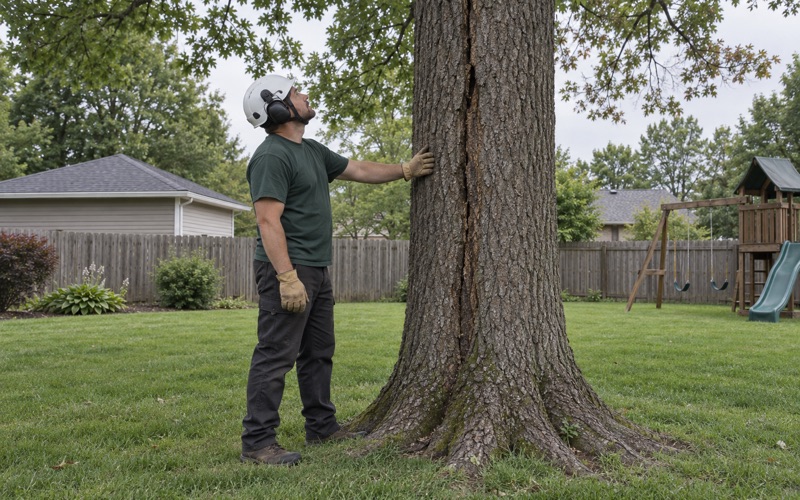
Most of what we are called for is not a tree somebody simply wants gone. It is a tree that has died, split at a pair of co-dominant stems, or dropped a limb across a driveway, and the owner has worked out that the problem is now theirs. We read the root flare, the union and whatever is still holding the crown up, then say plainly whether the tree has to come out or whether cabling and bracing buys it another decade.
We also haul every stick off the property, and we tell you where the wood and the grindings are going before the first cut. In this city that is a longer answer than it sounds, and so is the question of who enforces the code on your street.
One city limit, three counties, and no two answers alike
The city’s own Community Profile puts it flatly: “The city limits of Bonner Springs is comprised of eighteen square miles and encompasses three counties - Wyandotte, Johnson and Leavenworth. The majority of the City is located in southwest Wyandotte County.” That is unusual, and it is the single most useful thing to know before anyone quotes work here.
The county is a parcel question, not a mailing-address question
Two houses on the same route can carry the same Bonner Springs address and sit in different counties. County residency decides whether the free yard-waste gate is open to you, and county-level contractor requirements are not identical across the three, so the answer to what the county wants changes inside one city limit. We establish the county from the parcel before we say anything about disposal or paperwork, never from the mailing address, which does not carry that information at all.
The Unified Government is not this city’s government
K.S.A. 12-345(h) defines the consolidated city-county’s territory as “All of the territory of the county, except the territory of the cities of Bonner Springs, Edwardsville, Lake Quivira and the unincorporated area of the county, for purposes of exercising the powers, duties and functions of a city.” Voters here declined to join in the April 1, 1997 referendum, and consolidation took effect that October without them.
So the Unified Government of Wyandotte County/Kansas City, Kansas still performs county functions on this ground, while its city permitting and code enforcement stop at the city line. A complaint about your tree is a City of Bonner Springs matter. The city also reaches the business doing the work: Code Sec. 5-101 covers any business, trade, occupation or profession carried on in the city, and the published fee schedule prices a business inside the city at $80 a year and one outside it at $90.
Three forecast zones over eighteen square miles
The split even reaches the National Weather Service. A point query at the city centroid returns forecast zone KSZ104, Wyandotte, with county zone KSC209; the Johnson County part of the city falls in KSZ105 and the Leavenworth County part in KSZ103, all three served out of the Kansas City/Pleasant Hill office. A wind headline can cover one end of town and not the other, which matters when you are deciding whether a leaning tree waits until Monday.
Looking for tree-removal closer to Merriam? See Tree-Removal in Merriam.
The code makes leaving a dead tree standing the offense
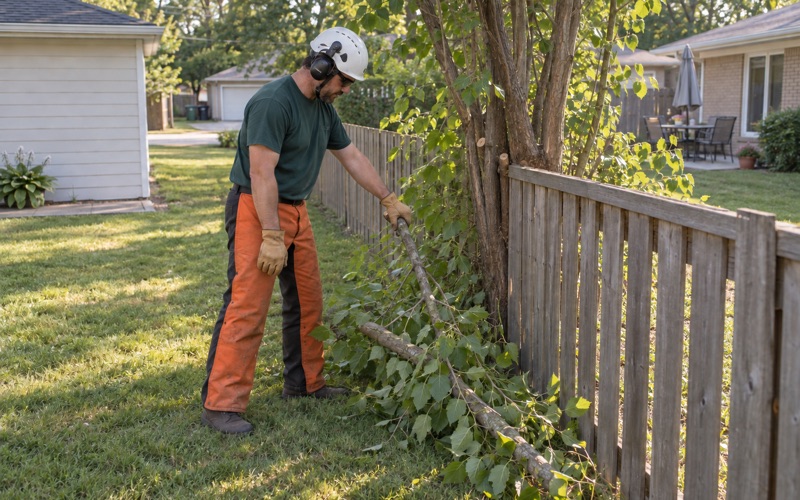
Chapter XIV, Article 6 of the city code, Trees and Shrubs, running Sec. 14-601 through 14-625, never asks permission before a removal. It pushes in the other direction. Sec. 14-602(b) makes it unlawful for an owner of property abutting or adjacent to any street, avenue, alley or road to permit “any dead or diseased trees, shrubs, bushes, and all other woody vegetation to remain standing in or lying upon the streets, alleys, avenues, public rights-of-way or private property,” and Sec. 14-602(e) calls dangerous dead or broken branches a public nuisance.
The duty is the owner’s, and the code spends one sentence on it
Sec. 14-610 reads: “It shall be the duty of the owners of any adjacent private property upon which any violation of this Article may be located to cause the violation to be promptly abated. All dead and dying trees, shrubs, bushes, and all other woody vegetation shall not be left standing or lying on the ground, but shall promptly be removed.” Read the second half twice. A dead top that somebody cut down and left in the side yard is the same violation, now lying on the ground.
No removal permit, no threshold, no fee
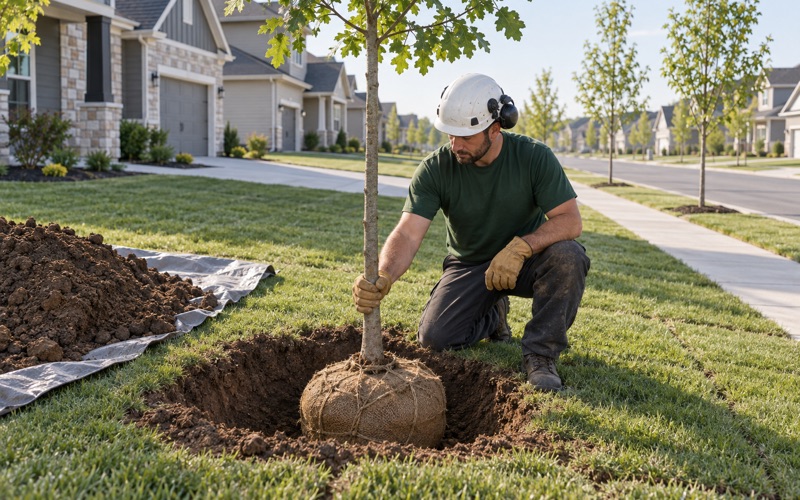
There is no city permit to take a tree off private property here, no diameter-at-breast-height trigger, no caliper replacement table and no tree fund to pay into. Owners are often braced for one, because plenty of metro cities have them. The only written-permission clause in the whole article runs the opposite way and concerns planting: under Sec. 14-613, no species outside the approved street-tree list may be planted as a street tree without written permission of the Bonner Beautiful Commission.
That asymmetry is why the written condition assessment we leave behind earns its keep. If an enforcement officer has already been out, you hold a dated record of what was wrong with the tree and what was done about it.
Ten days to abate, five if the city calls it a hazard
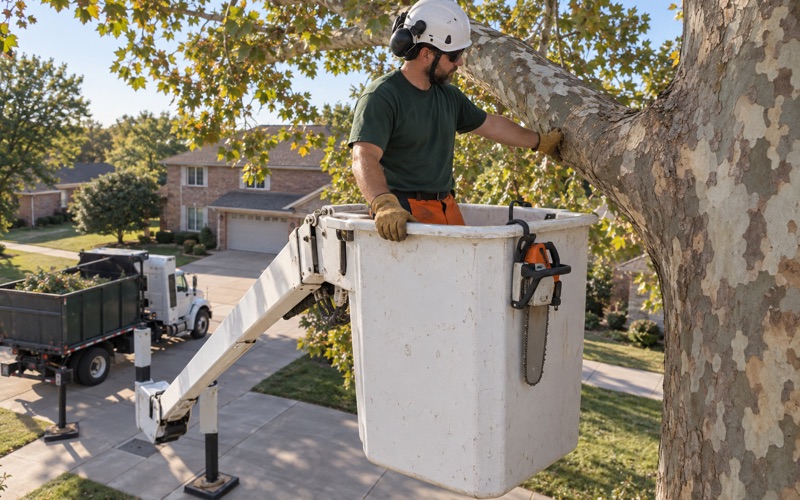
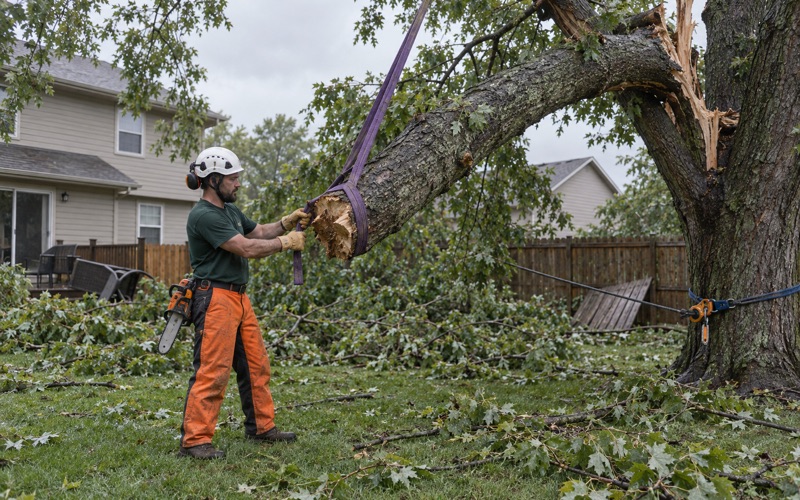
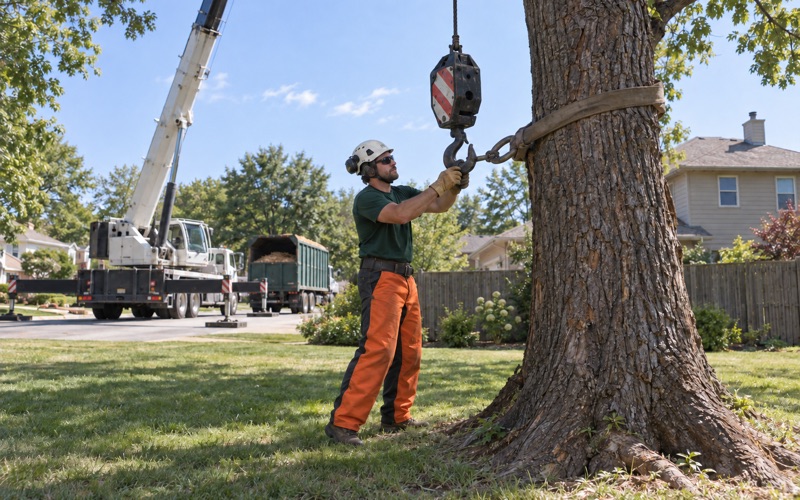
Once notice is served, Sec. 14-607 and Sec. 14-608 give an owner ten days from the date of service to abate, or five days “if determination is made that condition poses a hazard.” Sec. 14-611 provides for a hearing. Five days is not long to collect bids, and a tree serious enough to draw a hazard determination is often the one that wants a crane-assisted removal rather than a climber, which is not something to arrange on the last afternoon.
What sits behind the notice
Sec. 14-621 makes a violation a Class C misdemeanor carrying a fine not to exceed $500, with each day the condition continues after notice counted as a separate offense, plus failed re-inspection fees if it persists past the stated date. Sec. 14-622 through Sec. 14-625 carry it the rest of the way: the city may abate the condition, remove the tree itself, and assess the cost against the property. Waiting does not avoid the removal. It buys the same removal at somebody else’s price, on somebody else’s schedule.
When a tree is on a roof, a car or a service line, we come the same day, and a five-day notice gets the same treatment.
Topping a street or park tree is a code offense here
Sec. 14-602(f) makes it unlawful to top a street or park tree, with limited exceptions for storm damage, and Sec. 14-620 requires that “All stumps of street and park trees shall be removed below the surface of the ground so that the top of the stump shall not project above the surface.” Both rules are scoped to street and park trees rather than to every tree standing on a private lot, and it is worth knowing which of yours each one reaches.
We do not top anything, on either side of that line. When somebody offers to, ask what the tree looks like in three years: a crown of weakly attached epicormic sprouts standing on heartwood decay that started at every heading cut.
Where the brush, the trunk and the grindings go
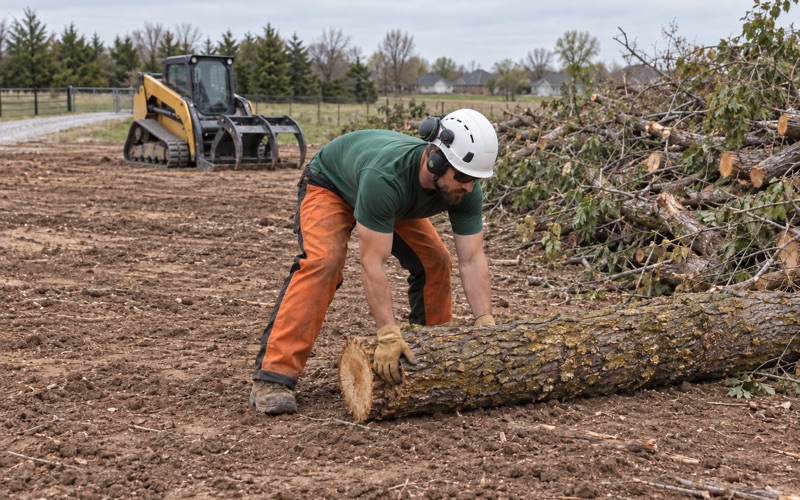
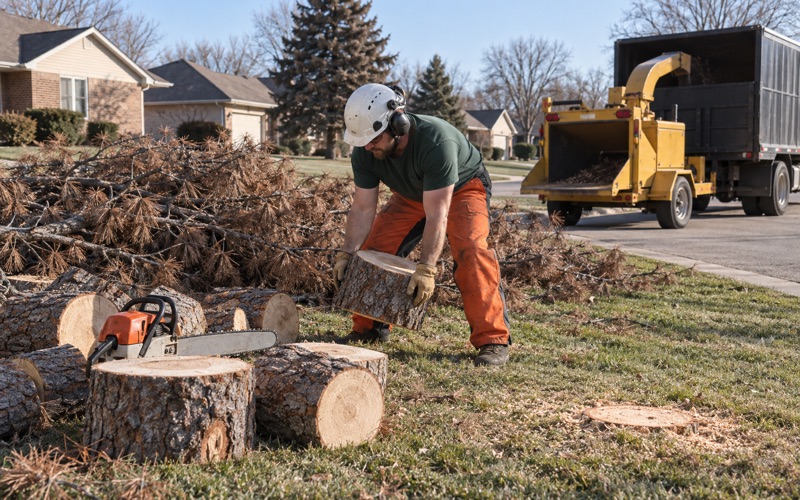
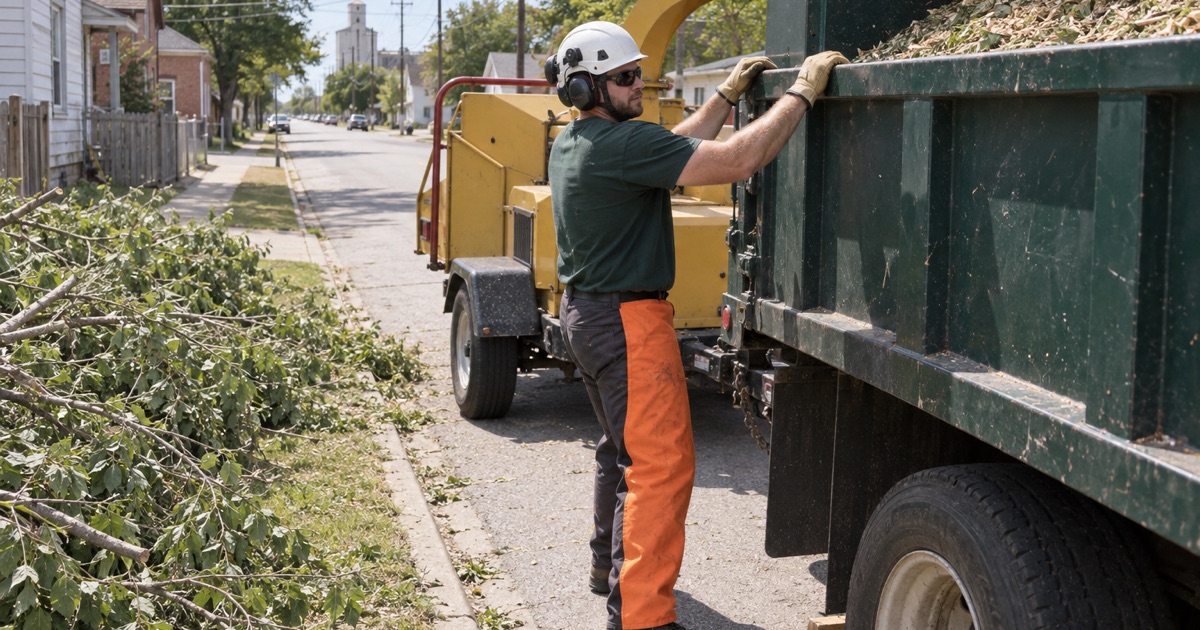
Curbside yard waste runs March 15 to December 15 each year on your regular weekly trash day, and the city publishes the limits: “Leaves and grass clippings must be in paper bags or reusable containers and not exceed 50 pounds. Tree limbs must be tied in bundles not more than four feet in length and not weigh in excess of 50 pounds.” A removal clears those limits in the first ten minutes, which is why every stick leaves with us rather than sitting at a curb the city is entitled to drive past.
The free county gate turns on county residency
The Wyandotte County Recycling and Yard Waste Center at 3241 Park Drive in Kansas City, Kansas is free to Wyandotte County residents with proof of residency, and it takes branches up to four feet long and stumps up to twelve inches across. That is the three-county problem made concrete: a Bonner Springs address in Wyandotte County qualifies, and a Bonner Springs address in Johnson or Leavenworth County does not. The city also names a Waste Management landfill in Johnson County, though published accounts of its size limit for landscape waste disagree with each other, so we will not quote you a figure for it.
There is no free outlet for a trunk
Past those ceilings nothing nearby is free at any diameter, and a mature trunk section is nowhere near them. The paid route is Missouri Organic Recycling in Kansas City, Missouri, at $10.00 per cubic yard for brush and $7.00 per cubic yard for lawn debris; it takes logs up to 40 inches in diameter if they are under five feet long, and turns away stumps with dirt still attached. Hauling and tipping sit inside the number we quote, and we tell you which gate the load is headed for before the work starts.
What the lot lets us bring in
Access moves a price more than most owners expect. At 187.2 housing units per square mile across 15.629 square miles of land, with 77.30 percent of the stock one-unit detached, this is generally ground where a chipper parks close and a crane setup is realistic. But 51.38 percent of the housing predates 1980 and 13.88 percent predates 1940, so an old-core lot and a 2021 lot are two different jobs. A compact grinder passes through a gate; a large towable chipper never does, so carry distance for the brush is usually what decides a back-yard figure.
Kansas 811 before the grinder
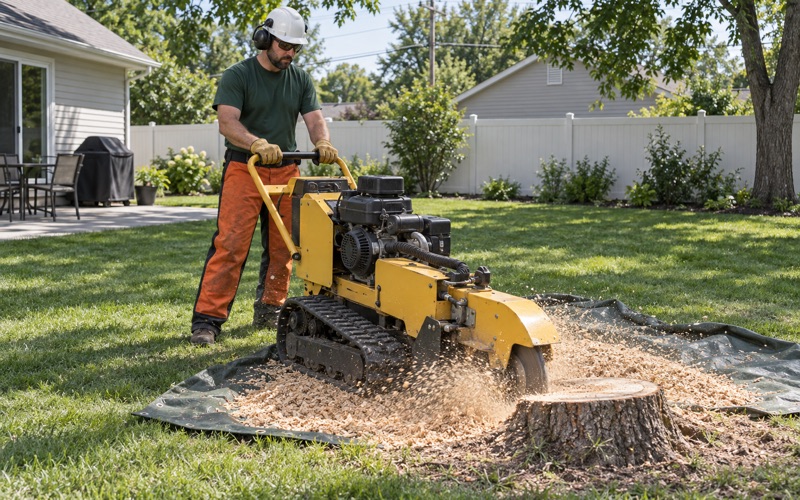
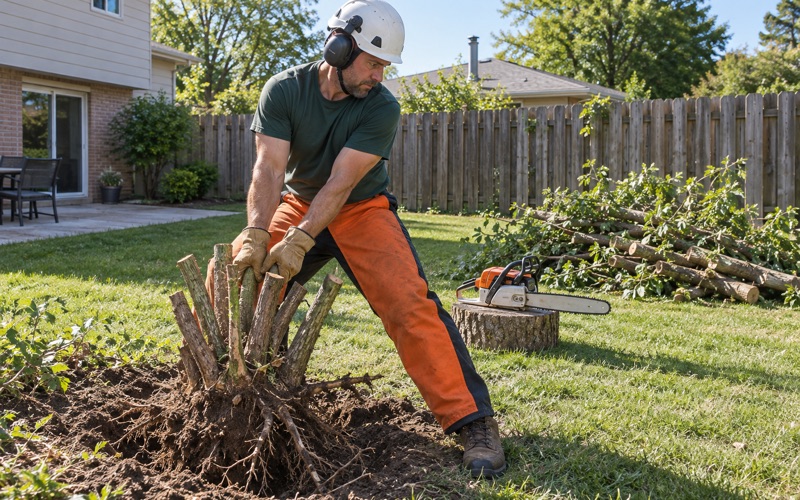
Stump work goes nowhere until Kansas 811 has marked the parcel, every time, because a grinder tooth wheel has no idea what is buried under a root flare. Proof of insurance reaches you before a crew sets foot on the property, and the grindings are backfilled or carried off, whichever you settled at the assessment.
- 20+ Years in Johnson County
- Insured, Proof Sent First
- Free On-Site Assessment