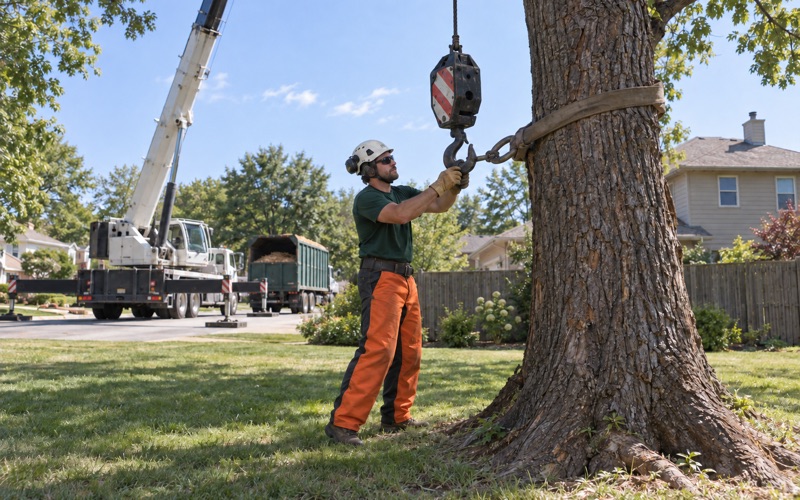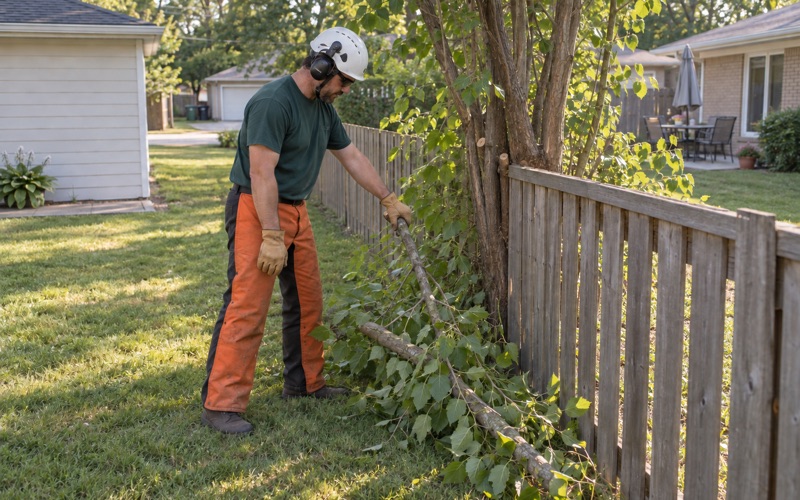
Shawnee Tree Removal has handled tree removal in Bucyrus for more than twenty years, and the first thing worth saying about a job out here is that there is no counter to file it at. This community is unincorporated, so the rules that reach a tree on your land come from the county rather than from a city government, and that single fact reorders the whole conversation.
It changes the estimate more than it changes the saw work. Whether the land sits inside an agricultural use, whether the brush can legally burn, and how a chip truck reaches the tree in a wet March are the three questions that actually move a number here, and we settle all three before we quote.
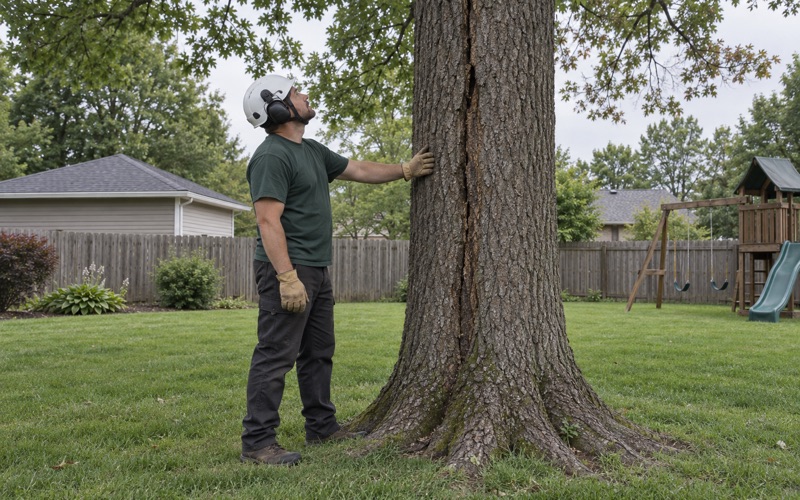
The look at the tree costs nothing, and the figure we give you standing under it is the figure that arrives in writing. You also get a written condition assessment on the tree itself, the kind of document that holds up in a conversation with a neighbor or an adjuster, and our certificate of insurance reaches you before anyone drives onto the property.
No city hall, no tree ordinance, nobody to inspect the stump
Bucyrus is a census-designated place in Miami County, Kansas, and unincorporated in the plain sense of the word: no city government, no municipal code, no city tree ordinance, no code enforcement officer and no municipal utility. The 2020 census counted 171 people here. None of that is a hole in what we know about the place — the missing municipal layer is the defining regulatory fact about it.
The authority that does govern land is the Board of County Commissioners, through the Zoning Regulations of Miami County, Kansas, adopted under K.S.A. 12-741 et seq. and K.S.A. 19-101 et seq. and written for the unincorporated territory of the county. Those Regulations run from general provisions through the rural residential, countryside, agricultural, commercial and industrial districts on to floodplain, parking, signs and appeals. There is no tree chapter anywhere in them and no general tree-removal permit.
What that means for a removal on your own ground
Taking a tree down on private property in this community requires no county permit. An incorporated city a few miles up the road can hand you a form, a threshold diameter and an officer who comes out to look; here the decision belongs to the owner, and the only thing standing behind it is whoever assessed the tree and what they were willing to put on paper.
That is why the assessment goes in writing rather than staying a verbal opinion at the tailgate. Diameter at breast height, the condition of the root flare, a conk at the base, heartwood decay, co-dominant stems joined on included bark: the tree risk assessment records what we saw and why removal was the call. Where extra-high-strength cable and a bent-eye lag termination will hold a split leader instead, we price that and say so, and we do not top a tree in this county or any other.
Kansas does not license tree work and neither does Miami County, which is worth knowing precisely because there is no local code office to ask. Out here a company’s credentials are its insurance certificate, its record and the quality of what it writes down for you.
Looking for tree-removal closer to Leavenworth? See Tree-Removal Services in Leavenworth.
Agricultural use is exempt from the county’s zoning entirely
Article 6 of the Miami County Zoning Regulations states it without hedging: all lands used for agricultural purposes, as defined in those Regulations, are and shall be exempt from the restrictions and limitations of the Regulations. The county’s own guide for people shopping for a home site puts the same point in plainer words, telling them that agricultural uses are exempt from nuisance and zoning regulations in the State of Kansas.
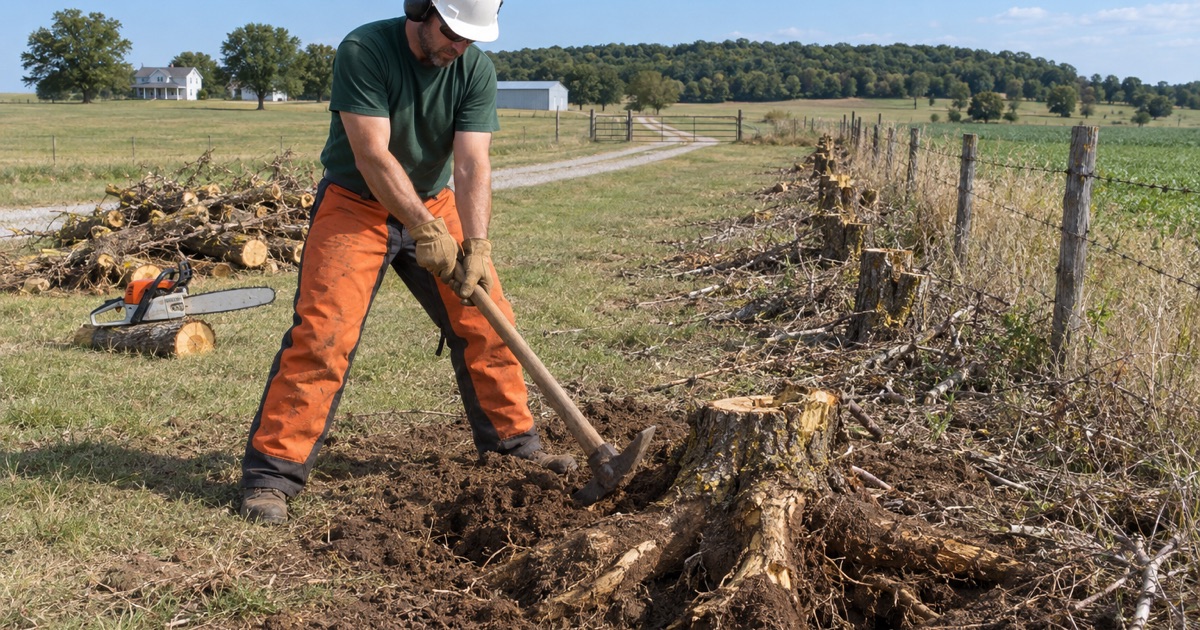
The exemption follows the use of the land, not its acreage and not how it looks from the road. Fence-line clearing, pasture reclamation and a removal incidental to a working agricultural use sit outside the county’s zoning apparatus, while the identical physical work on a parcel not in agricultural use does not necessarily. We establish which side of that line a parcel falls on before promising anything about permits, because the answer attaches to the use rather than to the address.
A hedge row is a fence line, not a tree
Osage orange is hedge in Kansas, its fruit is a hedge ball, and it is not native to this ground — it was set out as living fence in the 1880s, and those rows still stand along boundaries out here. A hedge job is therefore a linear removal rather than a single tree, and it gets estimated that way: by the run, by what the row is currently holding back, and by where along it the work is meant to stop.
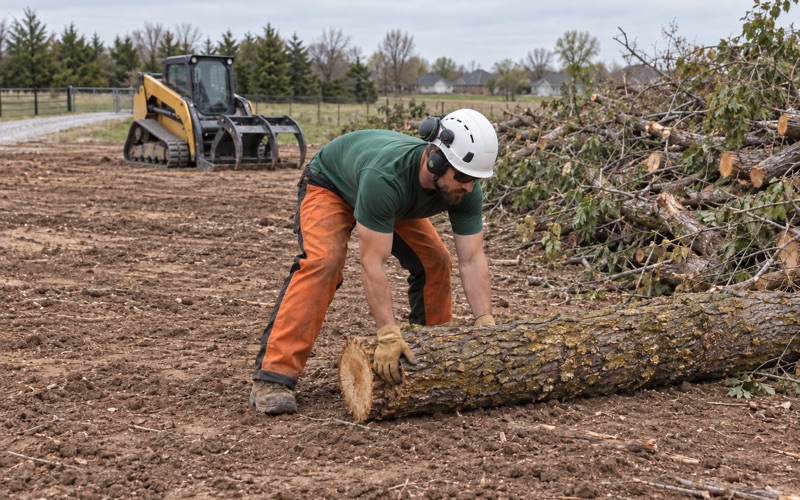
The wood is punishing on a chain and the root plates come out in a line rather than one at a time, so the plan for the debris weighs as heavily as the felling. On acreage that plan ends in one of two places, a burn pile or the county’s brush gate, and both are worth taking in order.
The burn permit is the county permit a clearing job actually hits
Miami County Fire Districts 1 and 2 issue burn permits together with Miami County Emergency Management at no cost, subject to terms and conditions, and the county’s definition of agricultural burning expressly takes in brush and trees resulting from the clearing of fence lines, fields or pastures. That option is real here in a way it never is inside a city that prohibits open burning, and on a large clearing job it changes the arithmetic entirely.
The conditions are operating constraints rather than paperwork. Burning is prohibited within 1,000 feet of any occupied dwelling unless the occupant has been notified beforehand; within 1,000 feet of a roadway the highway patrol, sheriff’s office or other appropriate traffic authority must be notified before it begins; within one mile of an airport the airport authority must be notified. The controlled burn also has to sit more than 50 feet from a structure.
The weather window is narrow. Surface wind must be between 5 and 15 mph, and burning is prohibited at night and in fog, inclement conditions or excessive cloud cover, and while a Red Flag Warning, Fire Weather Watch, Wind Advisory, High Wind Watch or High Wind Warning is in effect. The material has to be stockpiled and dried as far as possible before it is lit and kept free of anything that inhibits good combustion, with no tires, no oil and no composition shingles used to start it and nothing burned that throws dark smoke.
Miami County Sheriff’s Office Dispatch has to be contacted before each burn, every time. Violating the terms can bring a $250 fine plus assessment of all costs incurred by the fire departments that put the fire out, and the permit is not a shield either: no open fire may be set at all, permit in hand or not, once the rural fire district’s board of trustees or fire chief, the county commission or the Governor has declared a drought or other emergency prohibiting open fires. Every clearing job we schedule here carries a haul-out alternative for exactly that reason.
Wet ground, slope, and where the wood ends up
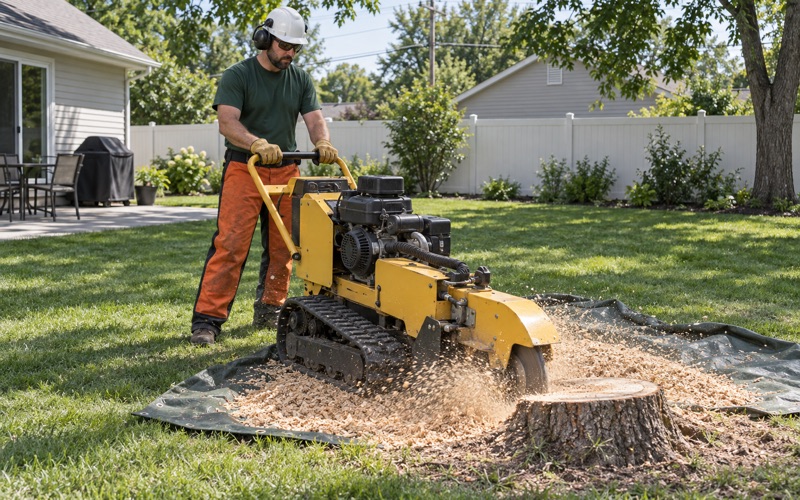
Two of the soil series mapped across this part of Kansas carry a perched seasonal high water table, and that is the figure that decides whether a machine belongs on your ground in a given week. Woodson’s sits 6 to 24 inches below the surface between November and June in normal years, and Kenoma’s sits 30 to 40 inches below the surface between March and July. A grind inside that window is a traction and rutting problem before it is a cutting problem, and an acreage lawn will carry the tracks for a season.
Depth to rock runs the other way. Kenoma reaches a lithic contact of limestone or shale at 60 to 79 inches and Eram reaches bedrock at 20 to 40 inches, both past the rated below-grade cut of a stump grinder tooth wheel, so the machine here stops at its own limit rather than on stone. Rock enters this work through the root plate and through excavation instead, which is a different job at a different price. Which series lies under an individual parcel is not something we resolve from the road, so no depth is promised before we are standing on the stump.
Slope decides whether the chipper reaches the tree
Eram sits on ridges and sideslopes running from 1 to 20 percent, and on rural acreage the binding constraint is the approach rather than a gate width. What we walk before quoting is whether a chip truck makes the drive and the field approach, whether the ground carries that weight this month, and whether the slope leaves a drop zone at all.
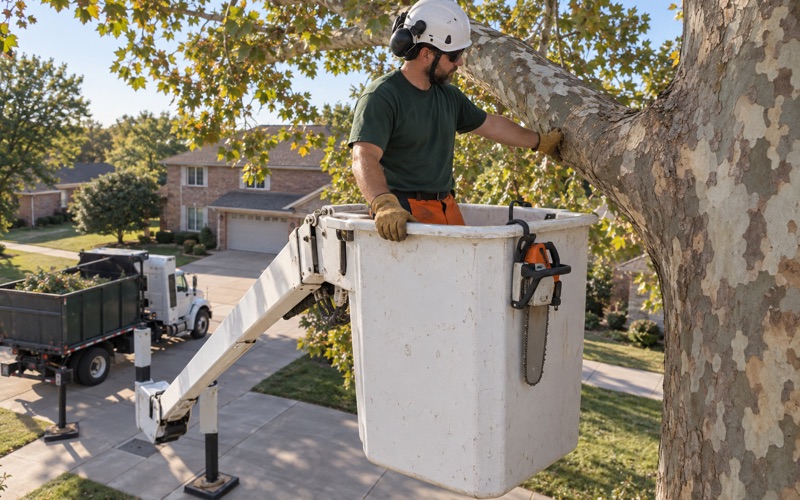
Where it does not, the tree comes apart on rope instead — a bull rope through a Port-a-Wrap friction device, worked inside its working load limit, rather than a free drop toward a fence line. That is slower, and it is why a sloped removal out here prices differently from a flat one on the next section road.
The gate at Paola, and the wood you keep
The Miami County Transfer Station on 327th Street at Paola, operated by Waste Management under Kansas State Permit #938, takes brush at $51.77 per ton with a minimum of $17.76 for 1,000 pounds or less, at pricing effective 01/01/26. Its refusals have nothing to do with being a contractor: every load must be tarped regardless of what is in it, both truck and trailer must be tarped if trash is in both, nets are not an allowable cover, and an untarped load is charged $10.00.
A hi-vis vest or shirt and a hard hat are mandatory to dump and are sold at the gate for $6.00 and $12.00 if you arrive without them. Payment is credit or debit card only, with no cash and no checks, and any load being emptied by hand has to arrive before 3:30 p.m. That is why the disposal route is settled inside the estimate rather than improvised at four o’clock.
Leaving the wood on your ground is a live trade here in a way it never is on a city lot, priced against the drag to the truck and against that published per-ton charge. We tell you which way the wood and the grindings are headed while the quote is still being written, and when they are leaving with us, every stick leaves.
Kansas 811 goes in before any grind
Kansas 811 comes first on every stump, under K.S.A. 66-1801 through 66-1814, which requires notice at least two full working days and not more than 20 calendar days before excavation is scheduled to begin. On rural acreage the case for calling is stronger rather than weaker, because private laterals, rural water district lines and long service runs are common out here and are not reliably mapped.
Same-day response still applies when a tree is on a roof, a car or a service line, and the drop from the pole to your meter is the property owner’s side of the system rather than the utility’s. We work the line between what a crew may touch and what only the power company may touch the same way we work the permit question: by finding out first, and telling you plainly which answer applies at your address.
- 20+ Years in Johnson County
- Insured, Proof Sent First
- Free On-Site Assessment