Shawnee Tree Removal runs crane assisted tree removal in Shawnee, KS for the trees where the ordinary method has run out. Most removals come apart on ropes — a climber sets a rigging point, pieces are cut and lowered under control through a friction device, and the wood is processed on the ground. That works whenever there is somewhere for a piece to go. A crane removal is what happens when there is not.
Two local patterns produce those jobs here. The older third of Shawnee, on the original town site around Nieman Road and Johnson Drive, has narrow lots, mature canopy and overhead services in older alignments, so a large tree there is often surrounded on all four sides. The 1980s and 1990s subdivisions produce the other version: an open lot, but with a pool, a sunroom, a deck and a shed occupying exactly the ground a rigging plan would need.
In both cases the crane changes the question from where can this piece be lowered to where should this piece be set down, and the answer is normally beside the chipper. Every stick still leaves with us, and the figure we quote is the figure in writing.
When a Crane Is the Right Method
No Drop Zone Anywhere Around the Tree
Rigging needs somewhere a piece can swing to and land. A tree hemmed in by a pool deck, a sunroom roof, a neighbor’s fence line and a mature landscape bed does not offer that, and forcing the issue means dozens of very small pieces, a very long day, and a running risk on every one of them. Picking sections out overhead removes the swing entirely.
Compromised Wood That Cannot Carry Rigging Loads
Rigging loads the tree itself. A dead tree, a storm-damaged one, or a stem with advanced heartwood decay may not hold a rigging point under a shock load, and the failure mode is the whole thing letting go at once. Where the wood cannot be trusted to carry the load, the crane carries it instead and the tree carries nothing.
Large Trees Over Structures
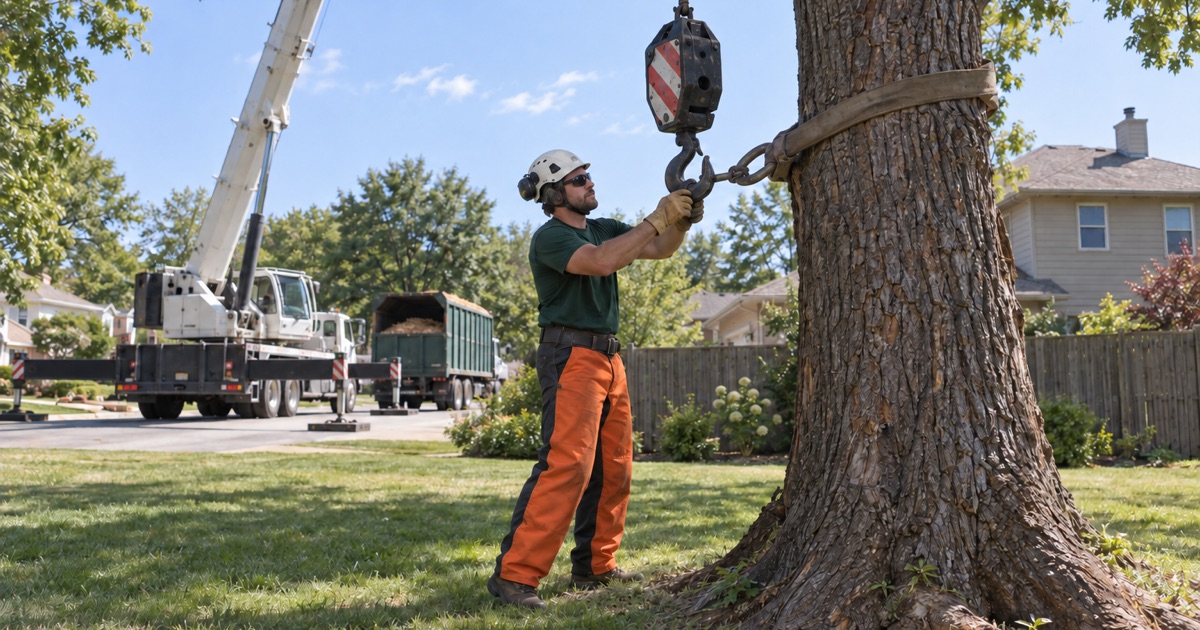
A mature tree directly over a house is the classic crane job. Sections are cut, taken by the crane and flown clear before they can move, rather than being lowered through the two feet of clearance between the canopy and the roof. It is faster, it puts far less weight through the remaining stem, and it keeps the loads away from the structure the entire time.
How the Removal Is Planned
Assessment, Reach and Pick Weights
The planning starts with geometry: where the crane can sit, how far it has to reach, and what each planned section will weigh at that radius. Pick weights are estimated from species, diameter and length, and every lift stays inside the working load limit for the configuration. This is arithmetic done before the machine is booked, not a judgment made in the moment.
Setup, Outriggers and Ground Bearing
Where the crane sits has to take the load. Outriggers are set on pads sized to the surface, matting goes down where a lawn or a drive cannot carry the pressure, and anything underground near the position — a septic field, a shallow utility, a drain line — is accounted for beforehand. Overhead clearance is checked in the same pass, because a boom and a conductor share the same sky.
Rigging the Picks and Cutting to Plan
The climber sets a sling on each section before any cut is made, so the piece is already supported and the crane is taking the weight when the saw goes through. Cuts are made to the plan rather than opportunistically, and communication between the climber, the operator and the ground crew is continuous. Nobody stands under a suspended load at any point.
Access, Safety and the Ground Crew
Street Positioning and Neighbors
A crane in a residential street affects more than your property, and it goes better when that is arranged in advance: where the truck sits, how long the road is partly occupied, and which neighbors need their cars moved. We handle that as part of the job rather than leaving you to explain it on the morning.
Working Around Conductors
A boom is a conductor path and the clearance rules exist for that reason. We will not fly a load near an energized primary line, and Evergy’s own boundary is ten feet of clearance on lines at 600 to 50,000 volts. Where the geometry cannot be made to work around the lines, the utility is involved before the crane is booked rather than after it arrives.
Processing, Cleanup and Haul-Off
The advantage of a crane is that pieces land where you want them. Sections are set beside the chipper and the truck instead of being dragged across a lawn, which is why crane jobs are usually the tidiest removals we do. Brush is chipped, trunk rounds are handled as their own line item, and the site is cleared before the crane leaves.
- 20+ Years in Johnson County
- Insured, Proof Sent First
- Free On-Site Assessment