Shawnee Tree Removal has been doing tree removal in De Soto for more than twenty years, and the question people open with here is almost never the one that decides the job. Callers expect a permit hurdle. For a tree standing on your own land, the De Soto code does not put one in front of you.
What governs the work here is the ground the tree is standing on. De Soto was platted around the Kansas River, and a lot on the bottom and a lot up on the uplands are two different jobs with two different questions behind them.
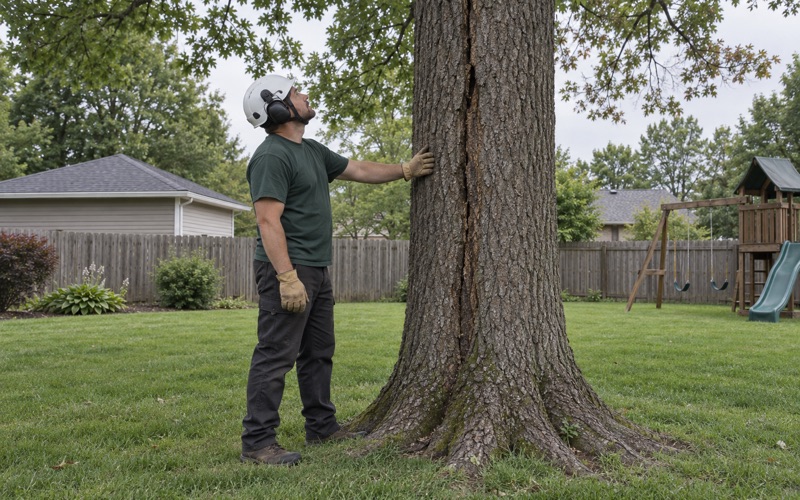
So we start on site. The assessment is free, the number we give you is the number that goes in writing, proof of insurance reaches you before a crew arrives, and you get a written condition assessment on the tree you can hand to a neighbor or an adjuster.
Twelve code sections, and not one of them stops a removal
Chapter 13, Article 3 of the Code of the City of De Soto, Kansas runs from 13-301 through 13-312. Between those numbers sit public tree care, diseased trees and the notices that follow them, dangerous, dead or diseased trees on private property, injuring trees and shrubs, plantings next to fire hydrants, and the public officer’s notice, abatement and right of entry. Not one of the twelve conditions a private removal on a permit, an application, a fee or a city approval.
Read straight through, the article runs in the other direction entirely. It is an inventory of the powers the city holds to make an owner act, not a list of approvals an owner has to collect first. Under 13-301 the city may remove any tree in an unsafe condition or injurious to sewers, electric power lines, gas lines, water lines or other public improvements.
When the order arrives from the other side
Under 13-302, a written statement from a competent city, state or federal authority, based on laboratory test or other evidence, that trees or shrubs on private property carry a disease or insect hazardous to other trees in the community sends the city clerk to notice the owner to treat or remove the tree inside a set time. Sections 13-303 through 13-305 carry the notice, the city’s duty when the owner does nothing, and the provisions for stopping the spread.
Sections 13-310 through 13-312 finish it: public officer notice, abatement and assessment, right of entry. If the owner does not act, the city does the work and assesses the cost against the property. A De Soto removal order is a bill the owner pays either way, and hiring the work directly is the cheaper of the two ways to pay it.
No city tree license exists to hold
Nothing in Article 3 requires a license for a person or company doing tree work in De Soto, and the code’s table of contents carries no article dedicated to contractor licensing at all. Kansas does not license tree work as a trade either, and the eleven classes in the Johnson County Contractor Licensing Program cover construction trades, none reaching a tree. A company promising you a city or state tree credential in De Soto is describing a thing that does not exist.
Insurance, a written scope and a crew that explains its cuts are what is on offer. We also do not top trees, and when somebody else quotes topping we will show you on the stem why the price is lower and the outcome worse.
Looking for tree-removal closer to Roeland Park? See Tree-Removal Services in Roeland Park.
River bottom, mapped zones, and the question to ask before the grinder moves
The Kansas River runs through the middle of De Soto and divides the city between Johnson County and Leavenworth County. For a removal, though, the elevation matters more than the county line: parcels on the bottom sit inside the mapped flood zones on the Flood Insurance Rate Map and Flood Insurance Study dated August 3, 2009, which the city’s floodplain management article adopts along with future revisions.
That article requires a floodplain development permit for all proposed construction or other development, the placement of manufactured homes included, in the designated A, AE, AO and AH zones. It defines development verbatim as “any man-made change to improved or unimproved real estate, including but not limited to buildings or other structures, levees, levee systems, mining, dredging, filling, grading, paving, excavation or drilling operations, or storage of equipment or materials.”
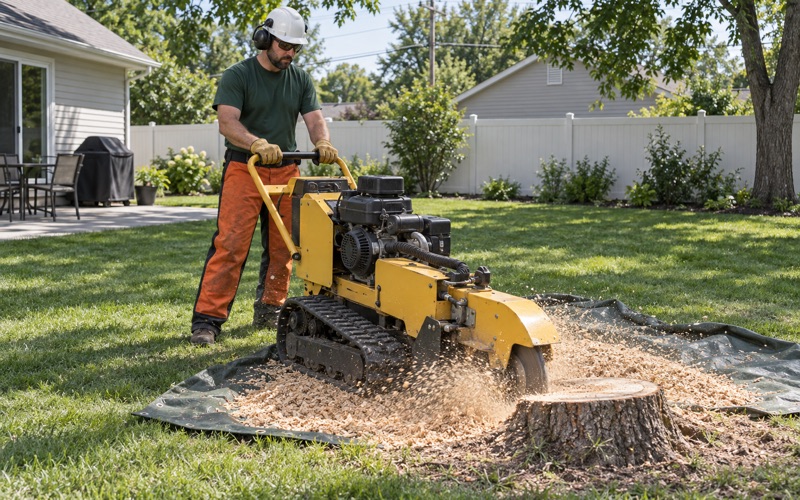
Tree removal is not enumerated there, and neither is vegetation clearing. Grading, filling, excavation and the storage of equipment or materials are. A stump grind is excavation, backfilling that hole with grindings is filling, and a chip truck parked on a river lot for a day is storage of equipment, and no published city interpretation settles the reading. On a bottomland parcel in a mapped zone we ask the De Soto floodplain administrator before anything rolls onto the grass, and we will not tell you a permit is required or that it is not.
The upland soil survey stops at the top of the valley
The upland series mapped across Johnson County publish depths to a restrictive feature: Vinland at 10 to 20 inches to a paralithic contact, Sogn at 4 to 20 inches to lithic bedrock, Oska and Sibleyville at 20 to 40 inches. Only the first two are shallow enough that rock, rather than the machine’s own stop, ends the cut.
None of that describes the valley floor. The Kansas River carries Wisconsinan and Recent alluvial deposits 40 to 70 feet thick through this reach, with a maximum depth of about 95 feet in the floodplain. Where the alluvium is that deep, bedrock is not a constraint at any grinder setting; a shallow water table, buried rock and rubble in old fill, and river-deposited gravel that wears a tooth wheel are. Which series sits under an individual lot is not something we guess at from the street.
Call 811, then call City Hall
Kansas One Call at 811 goes in before every grind, no exceptions, and in this city there is a second call behind it. De Soto runs its own water system and its own wastewater treatment facility, so water and sewer belong to the city rather than to WaterOne or Johnson County Wastewater, with Water District No. 7 serving some addresses. When a grind is going in near a service line, City Hall is the utility to talk to.
Who pays for a street tree, and where the wood ends up
Section 13-307 gives the city authority to treat or remove trees within the public rights-of-way, then settles the invoice in a single line: “The adjacent property owners shall not be responsible for the cost of treatment or removal.” That is an explicit allocation written into the code, and the reverse of what several cities nearby publish.
Your own tree reaching over the street is the other case. Section 13-306 puts an affirmative duty on the owner of a tree overhanging a street or right-of-way to prune those branches, and that duty is met far more cheaply with a scheduled crown raising than with an abatement notice.
Sixteen open days a year
The City of De Soto Brush Disposal Site sits at 35415 West 79th Street, behind the wastewater treatment facility. It opens the first and third Saturday of each month, April through November, from 8 a.m. to 2 p.m., and takes common yard waste, limbs, leaves and biodegradable lawn bags while refusing mulch, construction waste and concrete.
Do the arithmetic before planning around it. That is sixteen open days in a year, and the gate is shut from December through March, which is the dormant pruning season and the ice season both. On February 5 through 7, 2019 an ice storm crossed eastern Kansas with an eighth to a quarter inch of accretion, filling yards with broken limbs while the municipal outlet was closed. The city publishes no diameter limit, length limit, stump policy or price for the site, so we quote you none; City Hall answers those at (913) 583-1182.
The trunk wood leaves with us
Curbside trash and recycling here are contracted to Honey Creek Disposal, and the city is direct that yard waste and construction material do not belong in a household cart. That is why we tell you where the wood and the grindings are going before the saw comes out of the truck. The documented regional route for trunk wood is Missouri Organic Recycling in Kansas City, Missouri, at $10.00 per cubic yard for brush and $7.00 for lawn debris, accepting logs up to 40 inches in diameter if they are under five feet long and turning away stumps with dirt attached.
Closer options do not help: Johnson County operates no public yard waste gate of its own, and the Olathe compost site at 127th and Hedge Lane is posted for that city’s own households. Every stick leaves with us.
Open lots, thin walls, and ground with no survey behind it
De Soto holds 2,458 housing units across 15.53 square miles, or 158 units per square mile, and 69.98 percent of them are one-unit detached houses. Close to 60 percent of the stock went up between 1980 and 2009 against roughly a quarter predating 1980. That is a town in its first removal cycle: the tree coming down went in with the house thirty to forty-five years ago, and on most of these lots the drop zone rather than the gate is what we plan around.
The Johnson County K-State Research and Extension Master Gardeners brochure “Recommended Landscape Trees for Metropolitan Kansas City” names the failures that arrive on exactly that schedule. It refuses silver maple for weak wood, pin oak, green ash, Bradford pear and a dozen more, warning that “many fast growing varieties are brittle with narrow crotch angles that can lead to severe breakage during storms” and, of the Bradford cultivar, that “severe splitting occurs on 10-15 year old trees.” Co-dominant stems with included bark are what that splitting looks like a decade out, and where extra-high-strength cable can hold a split leader we price the cabling and bracing instead of selling you a removal.
Mobile home lots are a rigging problem first
148 of those 2,458 units are mobile homes, and there the equipment decides the day. Setbacks get measured to a thin wall rather than a framed one, tie-downs and skirting sit inside the drop zone, propane tanks and utility pedestals turn up where no plat suggests them, and the park road is often narrower than a residential street with nowhere to turn a chip truck.
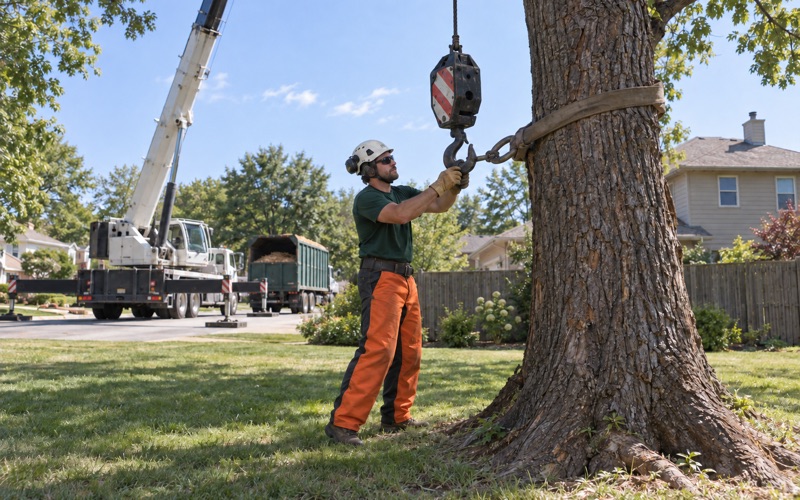
What that buys is piece work rather than felling. A bull rope run through a Port-a-Wrap friction device, or a crane set where the road can carry one, takes the tree down in controlled sections. We would rather quote the extra rigging hours than explain a hole in a roof.
New subdivisions, and one site nobody grinds blind
The building around Panasonic Energy’s plant at Astra Enterprise Park is a different medium: imported fill and compacted subgrade that no soil survey describes, where the trees are too young to remove and the stumps left behind are construction stumps. Astra itself is the former Sunflower Army Ammunition Plant, land the city states will be fully remediated by 2028, and nobody puts steel into that ground without asking first.
One split is worth knowing before a storm. Evergy treats the service drop running from the pole to your meter as the customer’s responsibility, and on an assist it removes limbs within ten feet of energized conductors and leaves the debris on site, so a crew is still needed for the cleanup and the rest of the tree. Nobody works a tree touching a primary line in a storm, which is what ANSI Z133 says plainly, so the order is Evergy first and us behind them, same day, when a tree is on a roof, a car or a service line.
- 20+ Years in Johnson County
- Insured, Proof Sent First
- Free On-Site Assessment