Shawnee Tree Removal handles tree removal in Edwardsville, Kansas, and we have been taking trees down across this metro for more than twenty years. Every job starts the same way: a free on-site assessment where we walk the tree, the drop zone, and the route the wood has to travel before anybody quotes a number.
What comes back to you is a written condition assessment — the defects we found, what they mean, and what we recommend — rather than a figure on the back of a card. The figure we quote is the figure in writing, and proof of insurance reaches you before a crew sets foot on the property.
We do not top trees, and we will show you why when somebody else offers to. If cabling and bracing or a reduction saves the tree, we say so and price that instead of a removal. When a tree is on a roof, a car or a service line, we respond the same day, and every stick leaves with us.
The age of a street here tells you nothing about the tree on it
In most cities the plat date is a shortcut. A block laid out in the 1950s carries one kind of removal, a subdivision finished in 2005 carries another, and a crew that knows the neighborhood can guess the job before it parks. Edwardsville takes that shortcut away. Of the city’s 1,875 housing units, 47.63 percent were built before 1980 and 44.85 percent went up between 1980 and 2009, and no single decade accounts for more than 18.88 percent of the stock.
Read that twice and it says something unusual. This is not a mature-canopy city and it is not a first-removal-cycle city. It is both at once, parcel by parcel. One address hands us a tree in its second life with decay through the trunk; the next hands us a planting that has never been reduced and now leans over a garage.
So we scope Edwardsville lot by lot and we price it the same way. A quote here is not a formula applied to a zip code, it is a walkthrough, and the walkthrough costs you nothing.
What we are actually looking at
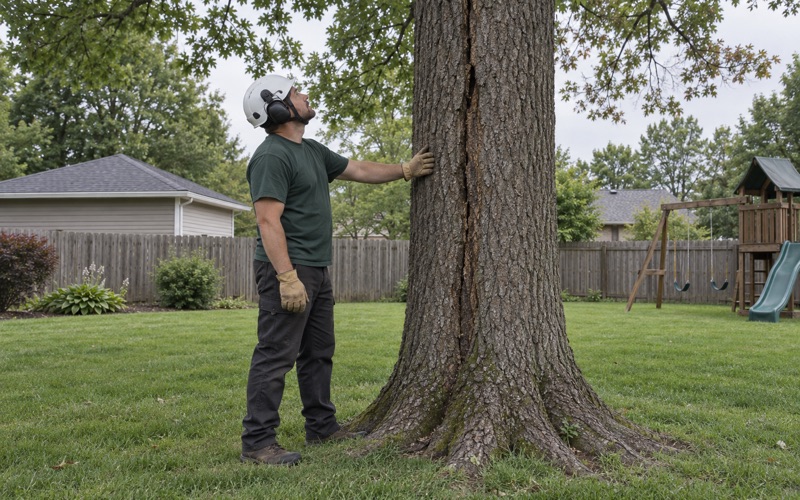
We start at the ground and work up. The root flare, and whether the root plate has lifted or cracked on the tension side. Conks at the base or along the trunk, which say something about heartwood decay that the crown will not.
Co-dominant stems with included bark, a split leader, a seam running down from a union. Epicormic sprouts along a limb that lost its top years ago.
Then DBH, crown mass and what sits under it. That set of observations is a tree risk assessment, and you get it from us in writing, defect by defect. It is the document you hand a neighbor, an insurer or an adjuster who wants to know why the tree came down.
The species a mixed-age city leaves behind
Because the plantings here span sixty years, so do the species. The K-State Research and Extension Master Gardeners brochure “Recommended Landscape Trees for Metropolitan Kansas City” refuses Silver Maple for weak wood, Pin Oak for soil issues, Green Ash for emerald ash borer, Austrian Pine and Scotch Pine for disease, and also Box Elder, Bradford Pear, European White Birch, Lombardy Poplar, Siberian Elm and Willow, among others. Hackberry it recommends. On one cultivar it is blunt: “DO NOT plant Bradford cultivar; severe splitting occurs on 10-15 year old trees.”
That list doubles as a map of what still stands in the older yards here. Kansas’s first confirmed emerald ash borer detection came in 2012, in Wyandotte County — this county — so an untreated ash on this ground has had a long time to turn from a question into a removal. Scotch and Austrian pine dying from the top down is usually pine wilt, and once that presents, the answer is a removal rather than a treatment.
Looking for tree-removal closer to Bonner Springs? See Bonner Springs Tree-Removal.
Trees over manufactured homes are their own drop-zone problem
264 of Edwardsville’s housing units are manufactured homes. At 14.08 percent that is the second-largest structure type in the city, behind one-unit detached houses at 60.80 percent, and it changes how a removal is planned. A manufactured home is not stick-built, so a piece coming down over one is its own siting question, judged on the day rather than borrowed from how we would work over a framed roof.
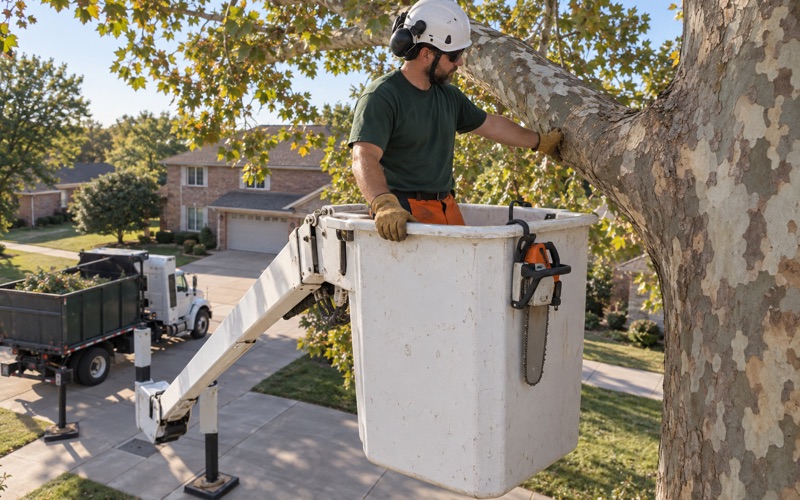
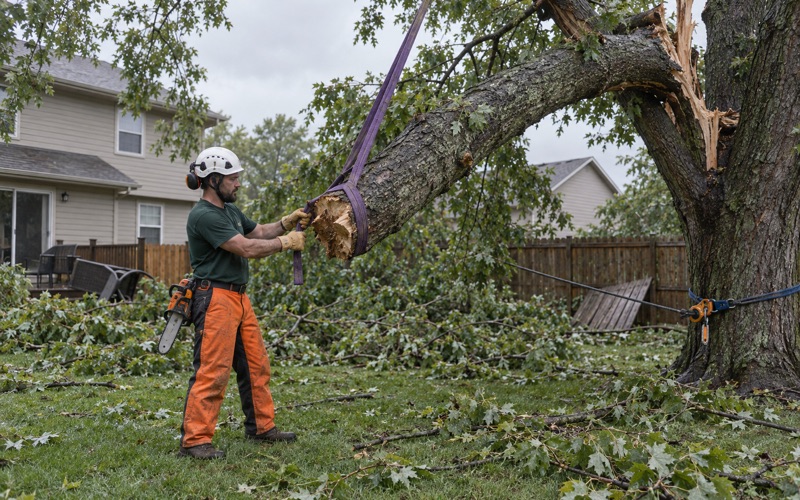
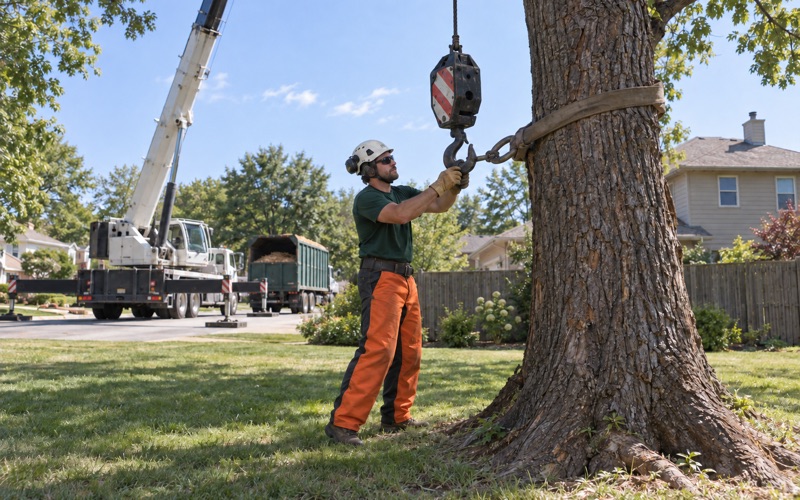
In practice, nothing free-falls. Sections come off under control on a bull rope through a Port-a-Wrap friction device, loaded against a working load limit rather than against what looks about right, with the three-cut method on any limb heavy enough to tear bark on its way out. Where the setup and the reach exist, a crane-assisted removal lifts wood out over the roofline instead of lowering it past one.
Access is the other half of the plan and we measure it on site. Where the truck and chipper can sit, what the ground under an outrigger will carry, how far each piece has to be moved by hand: those are facts about your property, and they move a price more than the species does.
The density figure overstates your back yard
Edwardsville runs 207.5 housing units per square mile across 9.038 square miles, which reads like a town with room to work. Some of it is. But a meaningful share of that land is warehouse, distribution and rail rather than yard — the K-32 corridor beside the Union Pacific line carries business park and distribution buildings, not lots — so a density averaged over the whole city tells you very little about the gap between your fence and your neighbor’s. We would rather stand in the gap and measure it.
Storm work, and what we will not do in the weather
Edwardsville sits in forecast zone KSZ104, named Wyandotte, with county zone KSC209, fire weather zone KSZ104 and the Kansas City/Pleasant Hill forecast office. What that office records for this area is convective wind and ice rather than one famous event: the wind storm of July 14, 2023 brought 89 mph measured just west of Lenexa and left roughly 200,000 customers without power, and the ice storm of February 5-7, 2019 laid an eighth to a quarter inch of accretion across eastern Kansas.
We answer the same day when a tree is on a structure or a line. What we will not do is put a climber near an energized conductor during a thunderstorm, a high wind, or a snow or ice storm. ANSI Z133 is explicit on that point, and the standoff around an energized line holds regardless of who is in a hurry.
The code here points toward removal, not away from it
Edwardsville publishes no permit requirement for taking a tree down on private property. The city’s tree rules sit in Article 15.04, Trees and Shrubs, inside Chapter 15, Public Ways and Property, and that article runs eight sections in total: public tree care generally; diseased trees or shrubs on private property, with subsections for issuing and serving notice; pruning on private property and removal of hazardous trees; treatment or removal of trees in the right-of-way; and four beyond those. Nothing published in that list amounts to an application to file, a board to appear before, a caliper table, a diameter threshold, a fee or a mitigation fund.
The article’s direction runs the opposite way from a permit regime. Section 15.04.003 states that “The owners shall remove all dead, diseased, or dangerous trees or broken or decayed” limbs. The duty is the owner’s, and the city’s route to a dead or dangerous tree on private ground is notice under Section 15.04.002 and Section 15.04.003 rather than an approval counter.
For a homeowner the practical answer is short: nobody here will stop you removing a hazardous tree in your own yard, and the code reads as though the city would rather you did.
The licensing answer is the odd one
Ordinance No. 1040, passed March 22, 2021 and effective July 1, 2021, requires “a valid Johnson County Contractor License in order to obtain” any permit under Chapter 3, Building Regulations — a Wyandotte County city buying its contractor licensing from the county next door. Two things follow and neither is obvious. The trigger is a building permit, not the act of doing work; and none of that program’s eleven license classes reaches tree work, because every one of them describes “construction, alteration, repair or demolition of structures.”
Underneath that, Kansas issues no arborist or tree-work license at all. The Kansas Forest Service points homeowners toward voluntary credentials instead — ISA certification, or the Kansas Arborists Association — so the syndicated claim that Kansas requires an arborist license is simply false. The two things worth asking any contractor for here are proof of insurance and a written scope of work.
Which government you are dealing with
K.S.A. 12-345(h) excepts “the territory of the cities of Bonner Springs, Edwardsville, Lake Quivira” from the consolidated city-county’s city functions, and Edwardsville voters declined to join the consolidated government in 1997. City hall here is Edwardsville’s own, and the Unified Government’s city-level licensing and code enforcement stop at the city line. Its county functions do not, and that distinction is what makes the disposal answer work.
Where the wood, the brush and the grindings go
We tell you where the debris is going before the saw comes out of the truck, because the free option in this county has two hard ceilings on it. The Wyandotte County Recycling and Yard Waste Center at 3241 Park Drive in Kansas City, Kansas takes yard waste at no charge from county residents with proof of residency, Thursday through Sunday, 10 a.m. to 3 p.m., weather permitting. An Edwardsville homeowner qualifies: the city is not part of the consolidated government, but it is in the county. County residents may also haul yard waste at no charge, with proof of residency, to the landfill at 17955 Holiday Drive in Shawnee.
The ceilings are the part to read. Branches up to 4 feet long, stumps up to 12 inches in diameter. A trunk section off a removal clears neither, and bucking one down until it does is a day of sawing and several pickup loads.
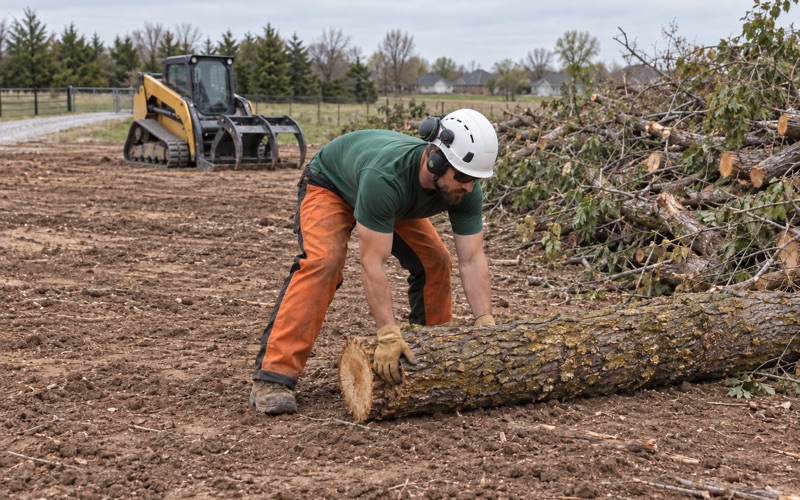
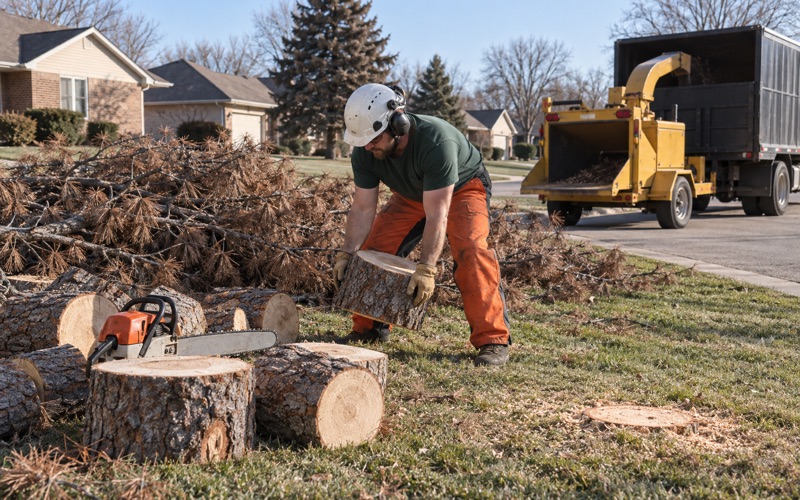
That gate solves the brush from a removal; it does not solve the removal. Ours leaves with us instead, down to the last stick, and nothing is stacked at a curb.
Curbside will not absorb it either
Household collection runs through KC Disposal on Tuesdays with a 95-gallon trash cart and a 65-gallon recycling cart. The city publishes no limb length or diameter limit of its own and directs anything larger to KC Disposal for a special pickup. There is a citywide cleanup with 40-yard containers on the third Saturday in May, and curbside bulky-item pickups on the first Saturdays of August and November. Those are useful dates for a homeowner’s own cleanup, not a plan for the wood off a removal.
Before the grinder, Kansas 811
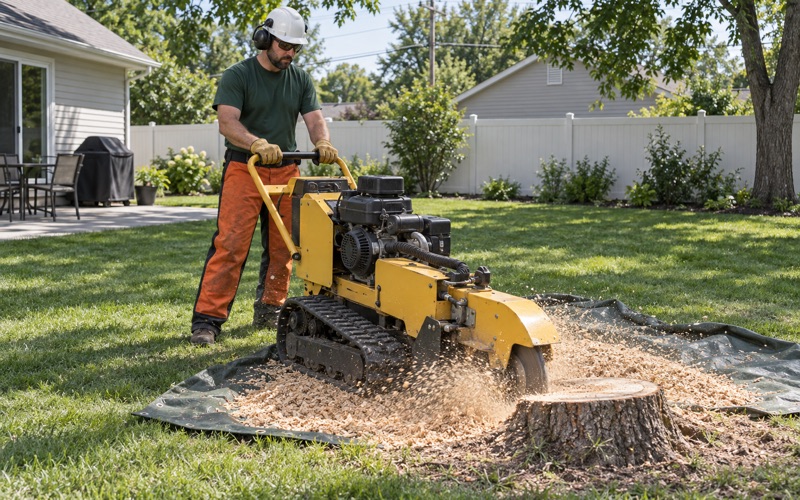
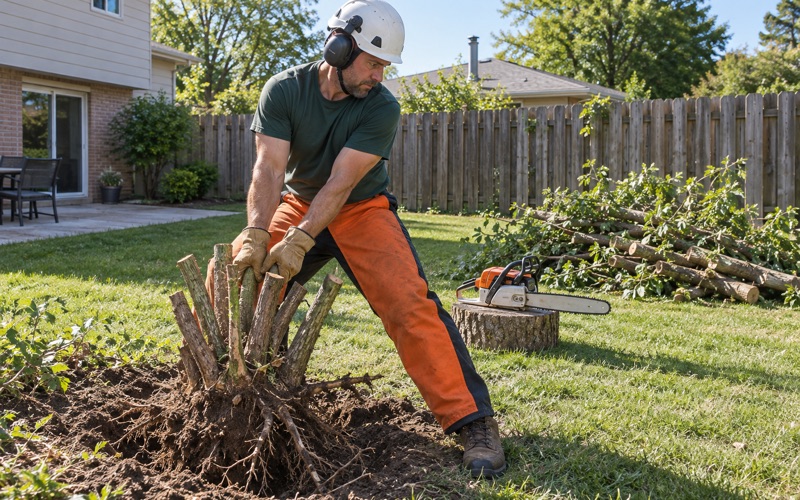
Every stump goes through Kansas 811 first, every time. An 811 utility locate is not a formality on a lot where the service lines went in across sixty years of construction. We will not promise you a below-grade result on a stump nobody has looked at yet.
What we will tell you before the machine starts is where the grindings end up — backfilled into the hole or hauled out with the wood — and the same goes for the trunk. On the utility side, the line running from the pole to your meter is the customer’s responsibility rather than the utility’s, and where a utility crew clears limbs around an energized conductor it leaves the debris at the worksite. Either way the cleanup and the rest of the tree are a private crew’s job, which is the call we take.
- 20+ Years in Johnson County
- Insured, Proof Sent First
- Free On-Site Assessment