Shawnee Tree Removal provides emergency tree removal across Shawnee, KS with same-day response when a tree is on a roof, a car or a service line, serving surrounding cities including Lenexa, Edwardsville, Bonner Springs, Merriam and Mission. Twenty years of storm work in this metro has taught us that the first hour is mostly about deciding what not to do, and that the crews who get people hurt are the ones who start cutting before they read the load.
The weather here does not produce one kind of failure. The National Weather Service office covering this county has recorded a July 2023 wind storm with 89 mph gusts that put roughly two hundred thousand customers out and left about sixty thousand still out the next day, a May 2024 squall line that crossed Johnson County and produced brief tornadoes, and a February 2019 ice event across eastern Kansas with an eighth to a quarter inch of accretion. Wind finds the dense over-extended crown while ice finds fine twigs and surface area, and they take different trees.
What we bring to a call is a crew that will tell you what is actually happening: whether the tree is still moving, whether what is across your yard is a conductor, which policy the loss belongs under, and what is safe to do in the next twenty minutes. Proof of insurance reaches you before anyone works, and the scene gets documented before anything is cut.
Emergency Response for Homes, Businesses and Property Managers
Trees on Houses, Garages and Vehicles
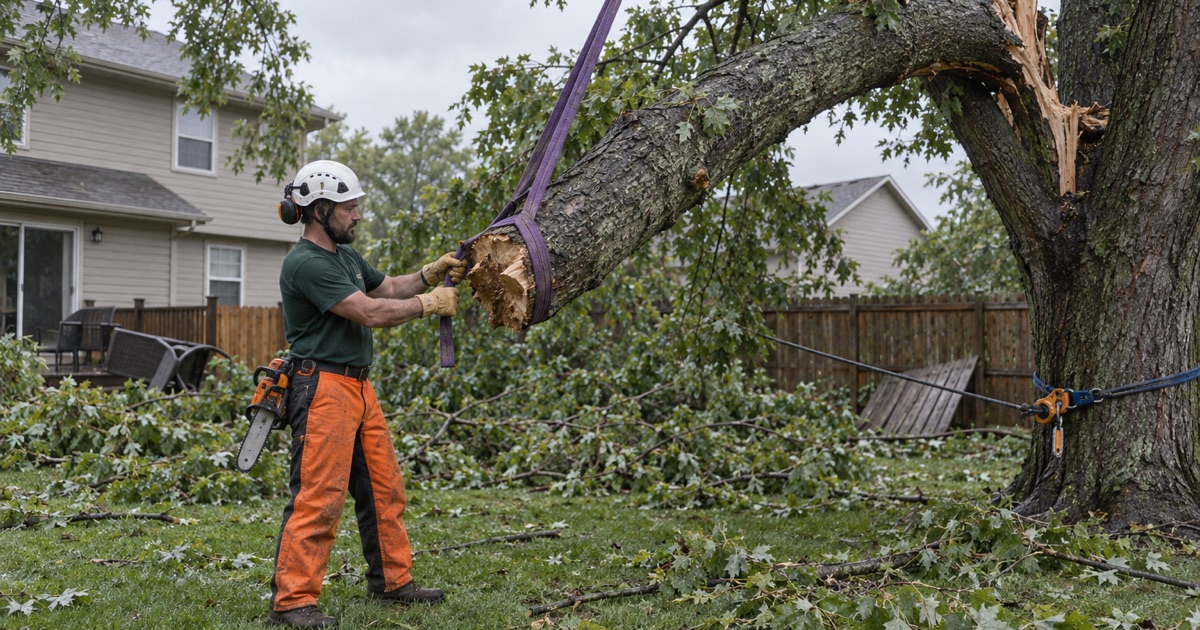
A tree across a roof is a structural load that is still being carried by whatever it landed on, and the removal sequence has to unload it in an order that does not make the damage worse. We work the weight off in pieces, usually by rigging rather than cutting free, and we photograph the whole scene first because your adjuster will want the tree where it fell. A vehicle underneath is documented separately, since that is an auto claim.
Blocked Drives, Roads and Access
A tree down across a driveway or a private road is not always the most damaged tree on the property, but it is the one that has to move first because nothing else can happen until it does. We clear access as a distinct piece of work, get you back in and out, and then assess the rest of the property without the pressure of everybody being stuck.
Commercial Property, HOA and Multifamily Response
Managers and boards need the hazard closed off and a record of what was done. We secure the area, prioritize by target rather than by visibility, and provide written documentation of each tree’s condition and the action taken. Where storm damage has revealed a defect that was there before the storm, that goes in the record too, because it changes what the association should do next.
What We Do First, and What We Will Not Do
Read the Load Before Touching a Saw
A partly failed tree stores energy in bent stems, hung limbs and compressed unions, and releasing it in the wrong order is how storm work injures people. The first pass is assessment: what is holding what, where the tension and compression are, what moves if this piece goes. That takes minutes and it decides the entire method.
Treat Every Line as Live
We do not work a tree in contact with a primary conductor and neither should anyone else without line-clearance qualification. Evergy’s own clearance boundary is ten feet around energized lines at 600 to 50,000 volts. The line from the pole to your meter is a different case, and it is genuinely customer responsibility according to the utility’s published position, which is why so many storm calls involve exactly that span.
Stand Down When the Weather Says To
A climber on a rope in gusting wind is being moved by the tree rather than moving on it, and rigging loads calculated on a still day stop being predictable. Z133 is explicit about suspending aerial work in thunderstorms, high winds and snow. If we stand a crew down mid-job we will tell you exactly what we are waiting on and when we expect to resume.
Document Before Cutting
Photographs of the tree in place, the point of failure, the damage and the surrounding area take five minutes and are worth considerably more than that to a claim. We do it as a matter of course and we will send you what we took. An adjuster asked to assess a loss from a pile of cut rounds is being asked to take somebody’s word for it.
Our Step-by-Step Emergency Response Process
The Call and the Triage
On the phone we establish what the tree is on, whether anything resembling a conductor is involved, whether anyone is in the affected part of the building, and whether the tree is still moving. That determines whether you need us, the utility, or the fire department first, and we will tell you plainly if we are not the right first call.
Arrival, Scene Control and Assessment
The first thing that happens on site is a perimeter: people and vehicles out of the fall zone, including the parts of it nobody thinks about like the far side of a leaning stem. Then the structural read, the photographs, and a method decision — rigged dismantling, crane, or ground work only until conditions change.
Controlled Dismantling or Crane-Assisted Removal
Most storm trees come apart in pieces on ropes, using a bull rope through a friction device so each piece is lowered under control rather than dropped onto whatever is beneath it. Where there is no safe rigging point left, or the load has to clear a structure entirely, a crane-assisted removal picks the sections out. Which one your tree needs is a judgment about the tree, not a preference about equipment.
Clearing, Haul-Off and the Written Record
Once the hazard is down the site gets cleared properly rather than left as a wood pile for later, because a storm pile in a yard is a second problem. Everything leaves with us to a gate that accepts it. You get a written record of the condition we found, what we did, and anything on the property we think needs attention before the next event.
Insurance, Documentation and Disposal After a Storm
Which Policy the Loss Belongs Under
A tree on a structure goes to the homeowners policy. A tree on a parked vehicle goes to comprehensive coverage on the auto policy, even when the tree was yours and standing in your own yard, and people find this out after filing the wrong claim and losing a week. A tree that fell and damaged nothing is frequently not covered at all, which is worth knowing before you make the call.
Why a Dated Condition Report Matters Afterward
A healthy tree that fails in a storm is generally nobody’s fault. A tree the owner had already been told was dead or defective is a different conversation, because documented knowledge is what turns an act of nature into a question of negligence. That cuts both ways, and on the Kansas side, where a neighbor’s duty turns on substantial harm or imminent danger, the dated written assessment is often the whole of the argument.
Where Storm Debris Is Actually Allowed to Go
Metro-wide events overwhelm the free routes within days, and every one of them is aimed at residents rather than at contractors. Shawnee licenses competing haulers instead of running a single citywide yard-waste rule, and its published bundle standard caps trimmings at two inches in diameter, so nothing off a storm removal is curbside material. The documented route that takes trunk wood charges by the cubic yard and has limits on log length and dirt-laden stumps.
- 20+ Years in Johnson County
- Insured, Proof Sent First
- Free On-Site Assessment