Shawnee Tree Removal has been doing tree removal in Eudora for more than twenty years, and the paperwork question people open with here has an unusually short answer. The city’s tree article does not regulate removal at all. The question actually worth raising before a crew works in this city sits in a different chapter entirely, under contractor licensing, and the code leaves it genuinely open.
That shape is what makes a Eudora job different from one a few miles east. Nothing gets filed before a tree on your own land comes down, and one broadly written section belongs in a conversation with City Hall rather than in an assumption either way.
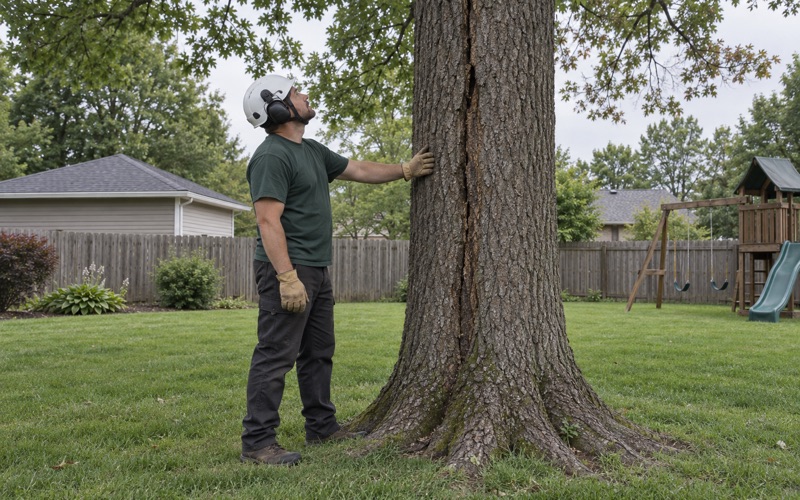
Before any of it we come out and look. The on-site assessment costs nothing, the figure we quote is the figure that reaches you in writing, and proof of insurance arrives ahead of the crew. You also get a written condition assessment on the tree, the kind of document that settles an argument with a neighbor or an adjuster.
Three sections, a hedge and a mulberry: the whole tree article
Chapter XIII Article 3 of the Code of the City of Eudora, Kansas is titled “Trees, Shrubs and Hedges” and it runs three sections. 13-301 makes it unlawful for anyone owning or controlling a hedge fence bordering a street or sidewalk in the city to let it grow to a height of more than three and one-half feet. 13-302 makes it unlawful to set out any mulberry tree in the street parking ground or any public park. 13-303 reaches anyone who willfully injures or destroys a plant, tree or vine belonging to another person and standing on that person’s land.
That is the article in full: no removal permit, no diameter threshold, no protected-tree class, no replacement requirement, no tree board and no city forester. We say so having read the three sections end to end, which is a different thing from searching for a permit and not finding one.
The mulberry line is a planting rule, and only on public ground
A municipal code that names a single species is worth reading precisely, because it is easy to repeat wrong. 13-302 prohibits setting one out in the street parking ground or a public park; it says nothing about a mulberry already standing in a back yard, and nothing about taking one down anywhere at all. Described as a removal rule, or as a rule reaching private property, it would be wrong twice over.
The hedge cap is the other affirmative duty in the article, and it carries a number a tape measure can settle: three and one-half feet, along any frontage bordering a street or sidewalk. Kept on a schedule with crown raising and crown reduction, that line costs far less than one taken back hard after it has thickened past the limit. We do not top what we prune, and when another outfit offers to, we will show you on the stem why.
The license section names no trade classes at all
Chapter V Article 8, Sec. 5-801 requires all contractors to obtain a City of Eudora contractor’s license to practice their trade in the city, and to hold a valid license from a Kansas state, county or municipal jurisdiction. Work must meet city standards and carry any required building permits, and the fee is set by the Governing Body from time to time. The section names no trade classes, defines “contractor” nowhere in its own text, and names neither an arborist nor a tree trimmer.
So the honest answer has two halves, and we give both rather than picking the convenient one. It cannot be said that Eudora licenses tree work; it cannot be said that Eudora exempts it. A tree service working here should put the question to the city directly, and any company holding no Kansas state, county or municipal license anywhere would fail that reciprocity condition on its face. Section 13-303 is a separate matter, and it is why a tree on a property line gets a written answer from us before a saw starts: Kansas and Missouri resolve the neighbor’s tree question differently.
Looking for tree-removal closer to Grandview? See Tree-Removal Services in Grandview.
The city owns the poles, and the code that created the utility never mentions a tree
Chapter XV Article 2 is the Municipal Light and Power System, and it means what it says. Eudora owns and operates its own electric distribution system and furnishes the meters, wire and connections under 15-206 and 15-207. That is not how the rest of this metro is wired: a slide in the city’s July 2025 commission presentation on the utility funds notes that all other communities except Baldwin City have electricity provided by Evergy.
15-209 states that no one except regular employees of the light department of this city or persons licensed as electricians shall do any wiring work on those wires. 15-207 splits the service at the meter: the city runs the connection from its primary lines to the meter enclosure, and the customer installs the enclosure, riser and weather head to city specification. Everything past that point is where a private crew’s work legitimately begins.
No clearance distance, no cycle, no debris rule
Read that article straight through and there is no provision on trees, vegetation, clearance distances, trimming cycles, notice or debris anywhere in it. The city runs a distribution system and publishes no vegetation rule in the code that creates it. Whether a policy exists outside the code is not something we were able to establish.
So we quote no clearance figure and no trim schedule for the poles in this city, and we do not borrow an investor-owned utility’s published numbers onto ground it does not own. Evergy is the wholesale supplier upstream here, not the operator of these lines.
When something is already on a line
A conductor on the ground, or a tree in contact with a primary line, is a call to the City of Eudora, and then it is a call nobody follows with a saw. ANSI Z133 stops work near energized conductors during thunderstorms, high winds, snow storms and ice storms, and 15-209 keeps everyone but the light department and licensed electricians off the city’s wires in any weather. A tree or limb blocking a public street is Eudora public works.
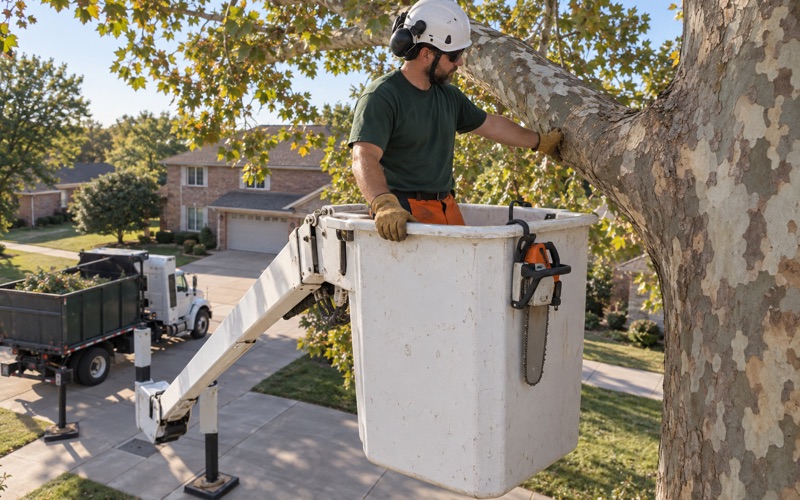
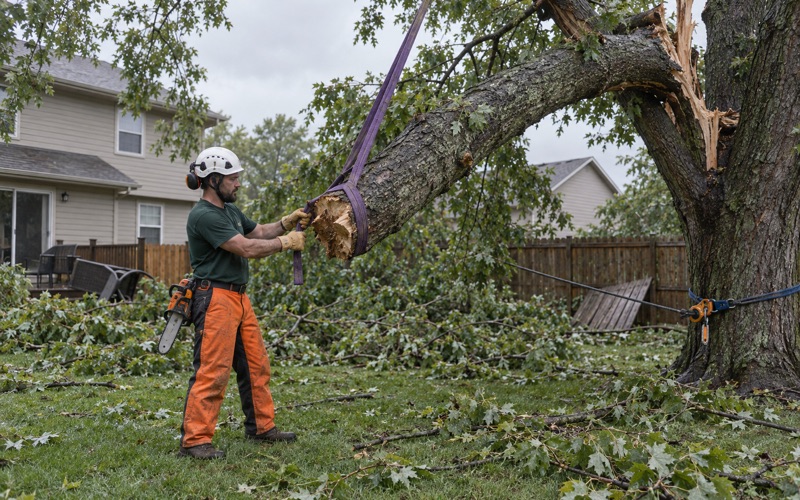
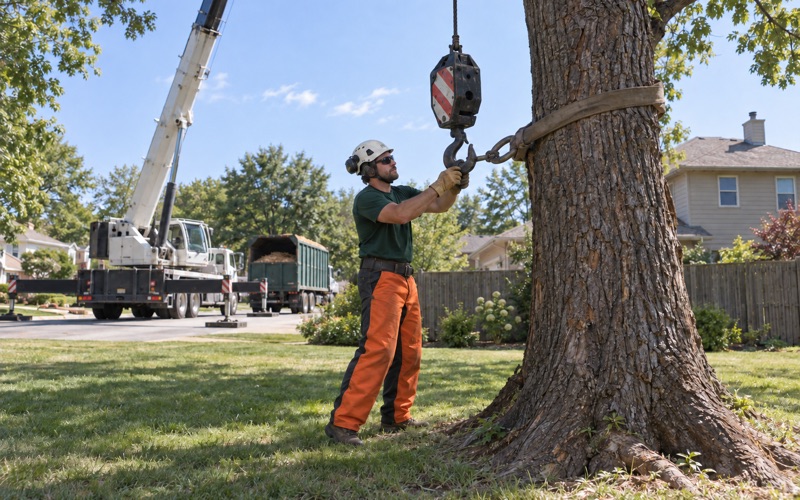
We come in behind them, same day, when a tree is on a roof, a car or a service line. Where a drop zone is tight the tree comes apart in controlled pieces: a bull rope through a Port-a-Wrap friction device inside its working load limit, or a crane-assisted removal where the street can carry the machine.
Your watches and warnings are written in Topeka
A point query against the National Weather Service API for this ground returns forecast zone KSZ040, whose published zone name is Douglas, county zone KSC045, and a CWA of TOP: the forecast office in Topeka. Cities twenty minutes east on the Kansas side are covered by a different office altogether, a distinction most storm coverage aimed at this metro ignores.
It changes what you should be reading when weather is coming in. The watch, the warning and the ice accretion forecast that apply at a Eudora address are issued from Topeka, and that is the office we schedule against.
A first removal cycle, on ground no survey describes
Roughly 44 percent of the housing stock here went up in 2000 or later and about 58 percent since 1990, at 717 units per square mile with 76.32 percent of it one-unit detached. Access on lots like that is usually workable; what sets the calendar is that the builder plantings are now twenty to twenty-five years old and reaching failure age together. Callery and Bradford pear split at bred unions, Leyland cypress screens set six to eight feet apart run up against a species that reaches seventy feet, and fast shade trees carry narrow crotch angles.
The Johnson County Extension brochure written for this metro is blunt about the pear, warning not to plant the Bradford cultivar because severe splitting occurs on 10-15 year old trees, and a planting from the mid 2000s has passed that window twice over. Where co-dominant stems with included bark can still be held, we price extra-high-strength cable and a bent-eye lag termination instead of a removal.
What the soil survey says, and where it stops
The Oska series has its type location in Douglas County, Kansas, formed in residuum from limestone and shale, and publishes 51 to 102 centimeters to bedrock, which is 20 to 40 inches. The shallow end of that range sits inside what a stump grinder tooth wheel is rated to reach, so on upland residuum rock can bind before the machine’s own stop does. The bottomland series run the other way: the Eudora series is coarse silty alluvium, well drained, with free carbonates from 20 to more than 60 inches and no bedrock restriction.
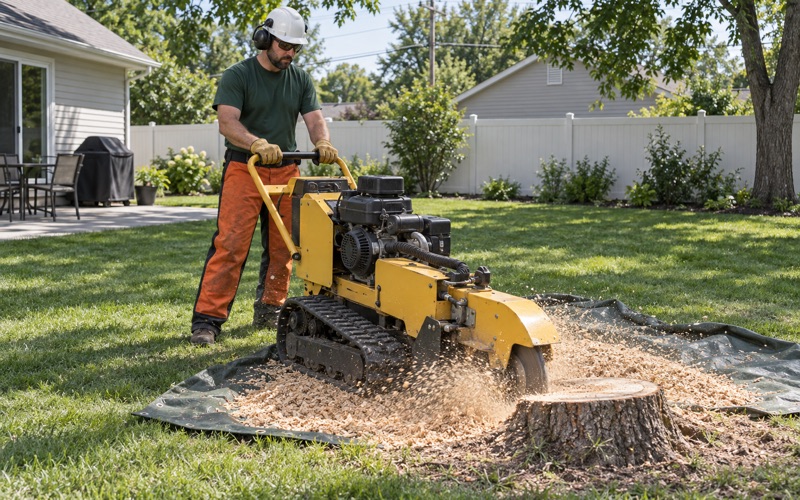
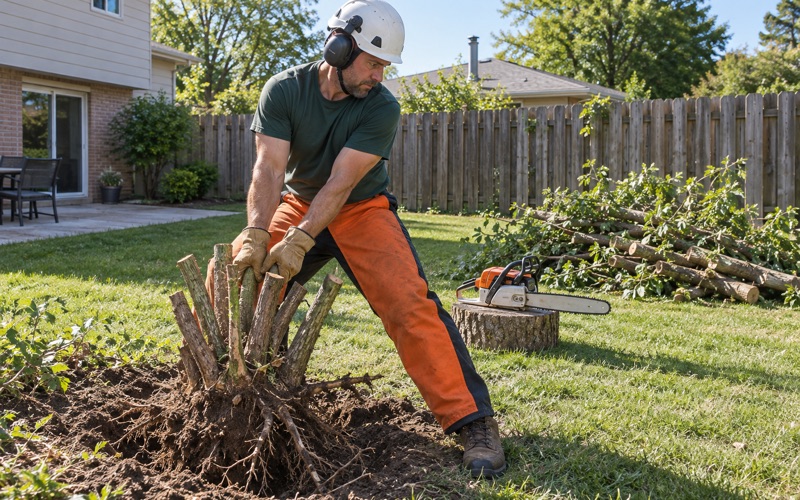
None of that describes a graded subdivision lot, where the fill was imported and the topsoil replaced rather than native, and which series sits under an individual address here is not something we resolve from the street. No depth gets promised sight unseen. Kansas 811 goes in before every grind, and on post-2000 ground we also ask where the irrigation, the low-voltage lighting and the invisible-fence line run, because not one of those is a locatable utility.
Nothing thicker than five inches has a curbside route here
Trash and recycling run through Honey Creek Disposal under city contract, billed alongside water, sewer, stormwater and electric. The dimension that quietly decides a removal quote is in 15-302, which defines refuse to include small tree limbs under five inches in diameter, cut to no more than five feet and tied in bundles. Above five inches there is no curbside route in this city at all.
Yard waste is defined just as narrowly: leaves, grass, trimmings from lawn and flower gardens, and small twigs or sticks less than half an inch across. 15-303 requires compostable kraft paper bags made for the purpose and prohibits plastic. Two different sections of the same code state two different bundle weight limits, so we publish no weight figure for Eudora at all.
The nearest public compost gate turns this city away
The City of Lawrence Compost Facility at 1420 E. 11th Street opens Saturdays from March through December 12th, 9 a.m. to 1 p.m., and its access rule is stated plainly: drop-off is for Lawrence residents, with proof of residency required at the gate. Accepted material is grass, leaves and brush only, loose and untied, with brush no longer than 4 feet and no more than 8 inches in diameter.
Tree root balls are on the refusal list, and the facility states its materials are not intended for commercial applications. So a Eudora homeowner cannot use it and neither can a contractor working here, and there is no public yard-waste gate inside Eudora itself. Hauling is the only honest plan for anything a bundle cannot hold.
Which is why every stick leaves with us
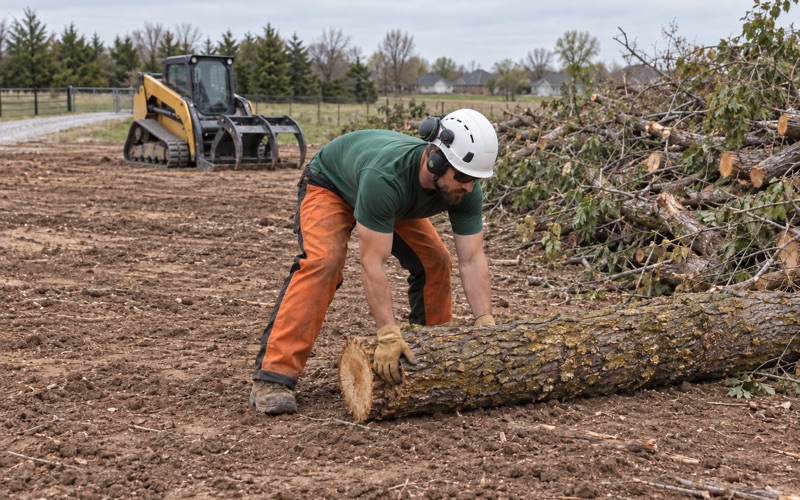
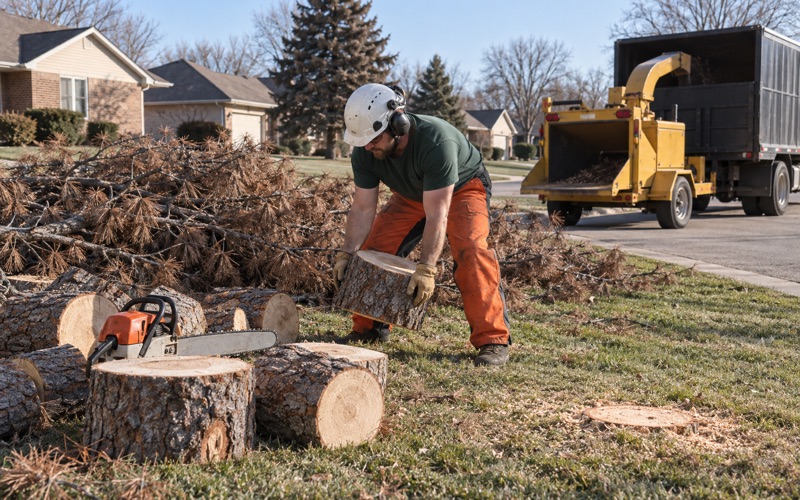
We tell you where the wood and the grindings are going before the saw comes out of the truck, and on a job here that conversation is short, because all of it goes on the truck. Nothing gets stacked at a curb that a five-inch cap and a bag rule would turn away on collection day.
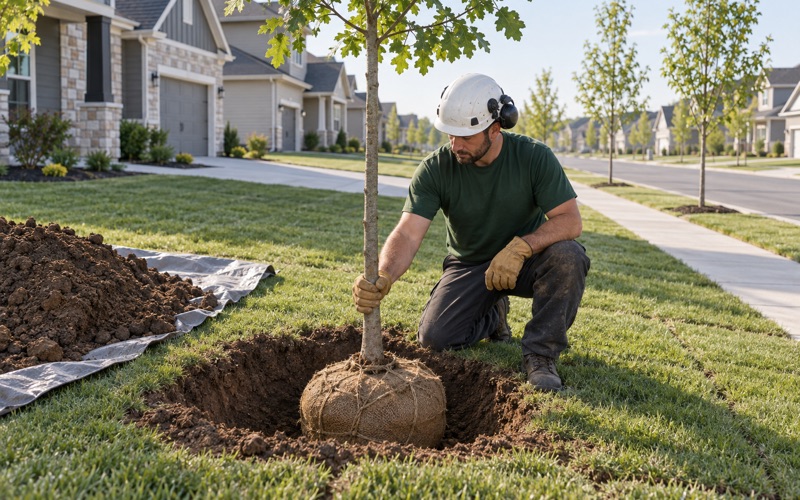
If you are replacing what came out, the Kansas Forest Service publication “Preferred Trees for Northeast Kansas,” produced with K-State Research and Extension, the USDA Forest Service, the Kansas Nursery and Landscape Association and the Kansas Arborists Association, gives the number worth planning around: trees with a mature height of 20 feet or less can be used within 15 feet on either side of utility lines. It also warns that multi-stemmed forms are more likely to be damaged by snow, ice or wind. In a city whose own light department owns the poles overhead, that 20-foot figure is the replacement conversation, and the code has already ruled one species out of the parking strip.
- 20+ Years in Johnson County
- Insured, Proof Sent First
- Free On-Site Assessment