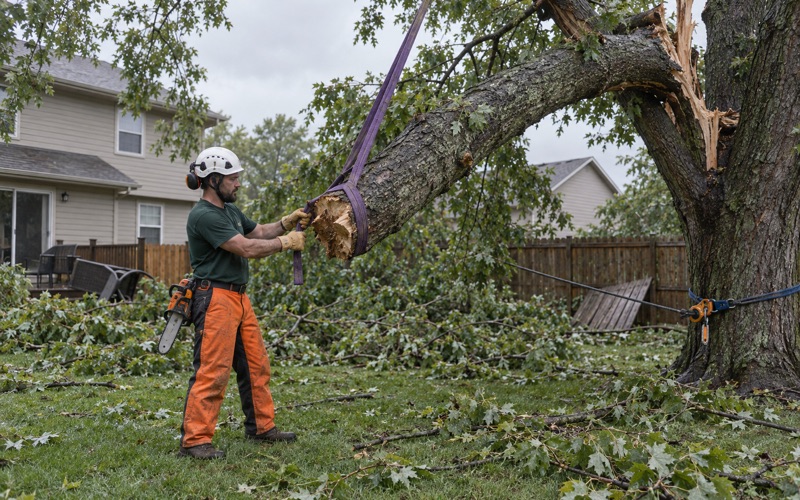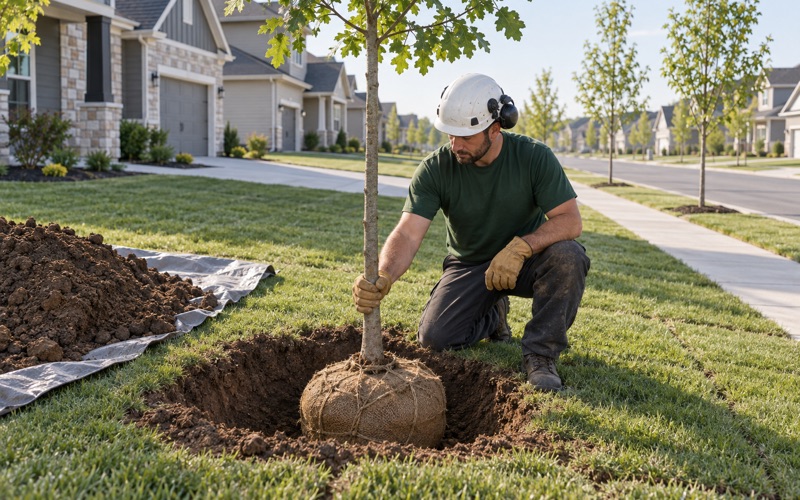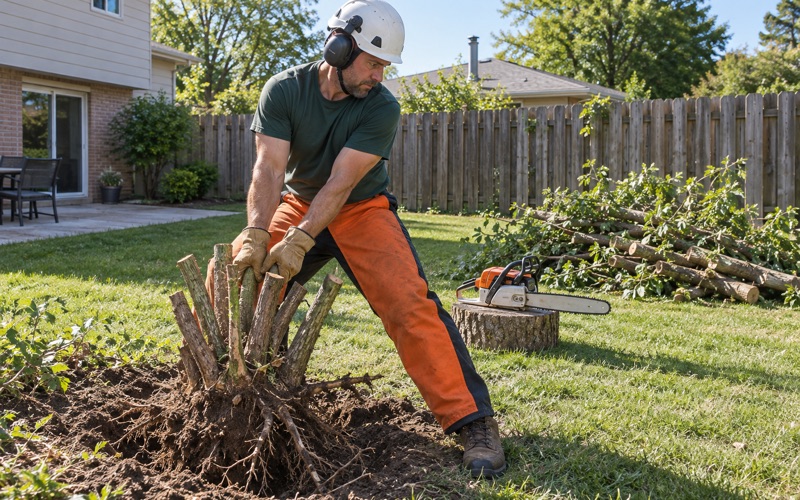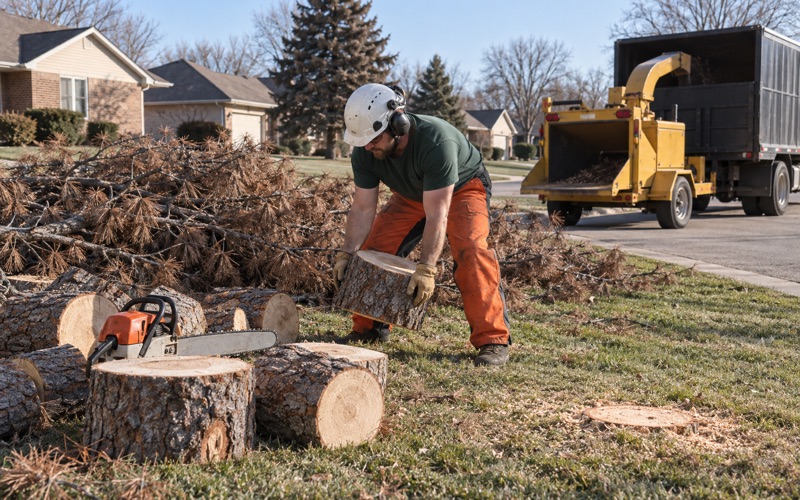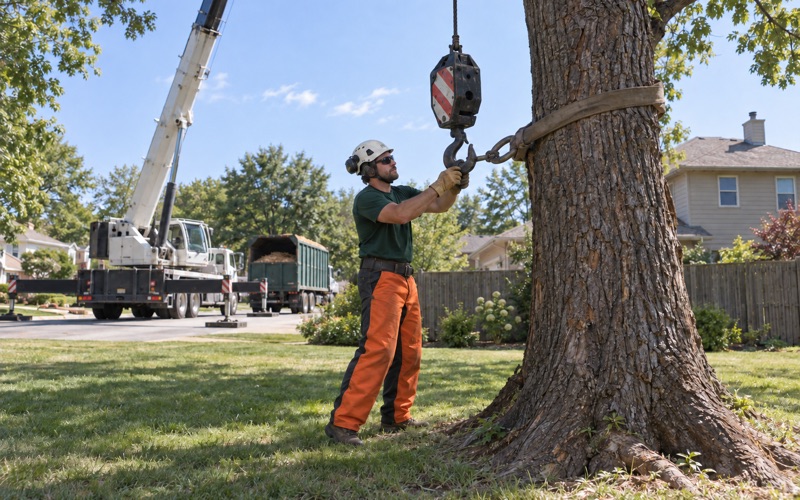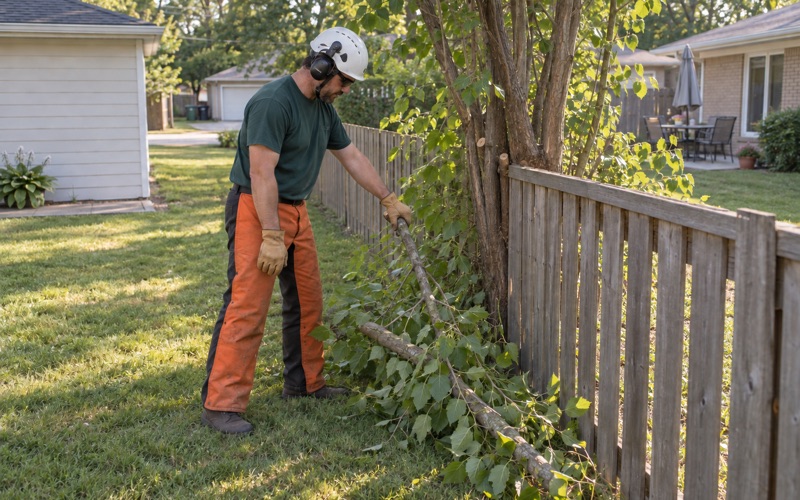
Shawnee Tree Removal has been handling tree removal in Fairway for more than twenty years, and here the job turns on a unit most homeowners have never had to price: the caliper inch. Fairway settles a removal in diameter inches rather than in tree counts, which means the conversation is about how many inches came out, how many inches go back in, and what a single inch is worth if a saw runs without authorization.
That gives a quote here two halves. One is the work we control, from the rigging and the crane pick over a tight lot to the grindings and the haul. The other is what the city expects on the replacement side, and we would rather hand you both figures at the same visit than let the second one arrive after the stump is already gone.
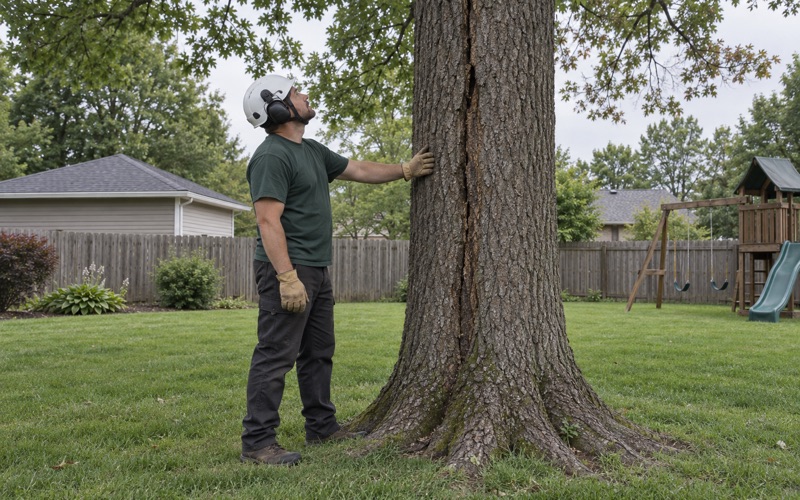
The measurement comes before the estimate, because where the trunk stands decides whether the city has any say in the job at all. We bring a tape to the curb on the free on-site assessment, and what we measured is written into the condition assessment we leave with you.
Where the city’s authority comes from, and how far it reaches
The current instrument is Ordinance No. 1851, which the City Council passed on June 8, 2026 and which amended and repealed the existing Sec. 11-94 of the Fairway Code of Ordinances. The section now reads that no person, directly or indirectly, shall cut down, destroy, move or remove, or effectively destroy, any protected tree or feature tree located on covered property without first obtaining tree removal authorization.
The city states that the right-of-way runs approximately 10 to 12 feet from the curb and “varies by street width as the ROW is typically measured 25 feet from center of the street,” and its public tree protection page describes the covered ground as that right-of-way along city streets together with green space and parkland. The Chapter 11 definitions sit elsewhere in the code, so we measure from the curb rather than assume anything about a particular lot.
How the authorization actually moves
A request goes in writing to the Community Tree Manager. Where the removal is tied to construction, that written request has to be filed at the same time as the building permit application rather than after the equipment shows up. The Community Tree Manager may defer the decision to the Tree Board, and the Tree Board’s decision may be appealed to the City Council, whose decision is final.
Approvals also expire. Authorization tied to a building permit or a site plan runs as long as that permit or plan does, but authorization tied to neither goes void 180 days after approval. On a project that slips a season, that is a date worth keeping on the calendar.
Judging a crew where no license exists
Fairway states in writing that tree services do not need a city license, and neither Kansas nor Missouri licenses tree work at all. The Johnson County contractor licensing program covers construction trades, and its own scope reaches the construction, alteration, repair or demolition of structures, so no class in it touches a tree.
That puts the burden on documents rather than on a card. Proof of insurance reaches you before a crew sets foot on the property, the written condition assessment is yours to hand to a neighbor or an adjuster, and the figure we quote is the figure that appears in writing.
Looking for tree-removal closer to Basehor? See Basehor Tree-Removal.
Total caliper, not the number of trees
Sec. 11-94(a) states the replacement rule in one sentence: “A sufficient number of replacement trees shall be planted so that the total caliper of the replacement trees is equal to the caliper of the tree removed as measured at DBH.” That is arithmetic, not a headcount. A 24-inch trunk measured at diameter at breast height is answered by two 12-inch replacements, or by three eight-inch ones; one 12-inch nursery tree does not close it, however many years that tree has ahead of it.
The number of trunks is free and the inches are not, which is what surprises owners who priced a removal somewhere else in the metro first. Where planting that many inches back is not feasible on the property, the ordinance routes the owner to the Fairway Tree Fund instead, the fund established at Sec. 11-92.
The two species the ordinance excuses
Sec. 11-94(c)(2) carves out an exception in plain words: “If the tree to be removed is a Sweet Gum or Callery Pear (as determined by the Community Tree Manager), no payment into the Tree Fund will be required.” A waiver written around two named species is an unusual thing to find in a tree ordinance, and it reshapes a quote: the same 20-inch trunk lands in a very different place depending on what it turns out to be.
Identification is therefore a cost input rather than a courtesy line. We record species and DBH on the written assessment before we price anything, and we are clear that the determination which governs belongs to the Community Tree Manager and not to us.
A Bradford pear is a disposal question as much as a removal
Bradford is a Callery pear cultivar, and it is the tree this county’s own extension office tells people to stop planting. The Johnson County K-State Research and Extension Master Gardeners brochure “Recommended Landscape Trees for Metropolitan Kansas City” (Rev.01-09) puts it bluntly: “DO NOT plant Bradford cultivar; severe splitting occurs on 10-15 year old trees.” Nobody else publishes that age window, and it matches what the failures look like on the ground, where co-dominant stems and included bark open the union rather than the root plate.
There is a quiet irony in that for a Fairway owner. The species the ordinance lets off the Tree Fund is the same species this metro is working hardest to move away from, so the tree that costs the least to be rid of on paper is often the one that costs the most to get off the property.
The same brochure explains the pattern behind its whole not-recommended list, which also holds silver maple, pin oak, box elder, Siberian elm, willow and Lombardy poplar: “Many fast growing varieties are brittle with narrow crotch angles that can lead to severe breakage during storms.” Hackberry sits on the recommended side, which matters once replacement inches have to go back into the ground.
Where the wood goes after it is down
The Kansas Department of Agriculture has a Callery pear restriction dated January 1, 2027 that will prohibit the sale and movement of all seeds, plants or parts. It is not in force today and we will not tell you otherwise, but a movement restriction is a debris-handling constraint on a contractor rather than only a nursery rule, and it is already on our calendar.
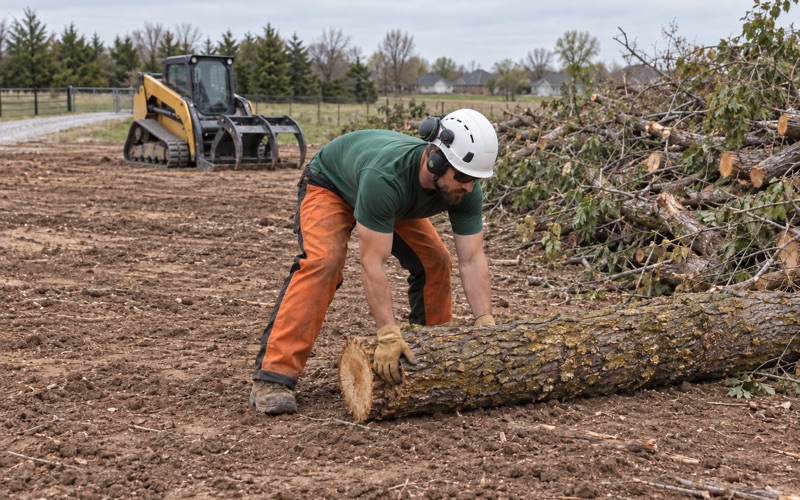
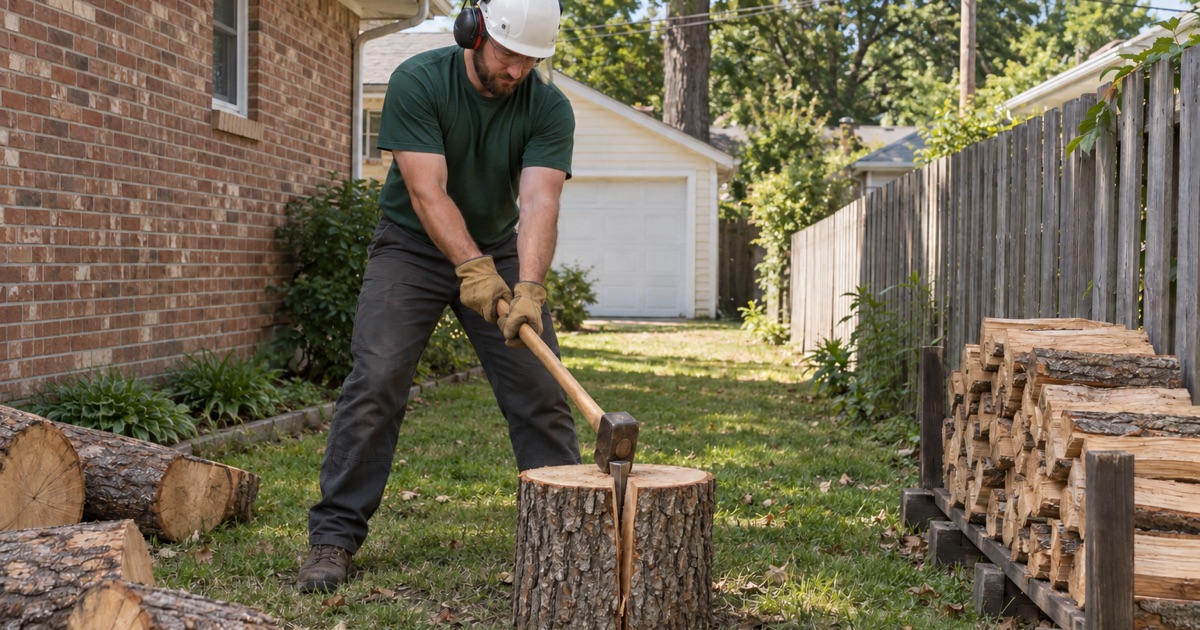
Travel is the harder half of that anyway. Johnson County operates no public yard-waste gate, and the county landfill caps landscape waste at 3 inches in diameter, so nothing in the county takes a trunk section at any price. Removal wood crosses the state line to Missouri Organic Recycling in Kansas City, Missouri, which charges $10.00 per cubic yard for brush and $7.00 per cubic yard for lawn debris, accepts logs up to 40 inches in diameter if they are under 5 feet long, and refuses stumps with dirt attached.
That is why the haul appears as a priced line on our estimate instead of being absorbed quietly. On one job that drew three independent bids of $12,400, $7,500 and $4,700, every one of the three priced the wood haul at $3,000, though they agreed on very little else. We tell you where the wood and the grindings are going before the saw comes out of the truck, and every stick leaves with us.
What an unauthorized cut is assessed at, and how we quote so it never happens
The city publishes its penalty by the inch. A violation requires payment into the Fairway Tree Fund at $100.00 per diameter inch at breast height of the tree, plus administrative fines of up to $500 per incident, after which the property owner assumes all future maintenance responsibility. On a 24-inch tree the per-inch figure alone reaches $2,400 before any fine is written.
Three things are named as violations and only one of them is a cut: an unauthorized removal, a failure to install protective fencing before construction, and damage to a right-of-way tree. The second catches builders and the third catches equipment traffic, because a trencher run through a root plate is not a removal and is still assessed.
Damage of that kind is measurable, which is the point of the fencing rule. ANSI A300 puts the trigger at six times the trunk diameter: when roots are damaged within that distance of the stem, mitigation is to be recommended. On a 20-inch trunk that circle runs ten feet out from the flare, which on a Fairway parkway strip is most of the working area a subcontractor wants.
Why the plat keeps this live
Fairway holds 1,806 housing units on 1.129 square miles, roughly 1,600 to the square mile, and 95.74 percent of them are one-unit detached. Some 85.60 percent of that stock predates 1980, with 37.26 percent built between 1940 and 1949 and 32.17 percent between 1950 and 1959. That is mature canopy over a tight plat, and it means the tree in question is often the one closest to the street.
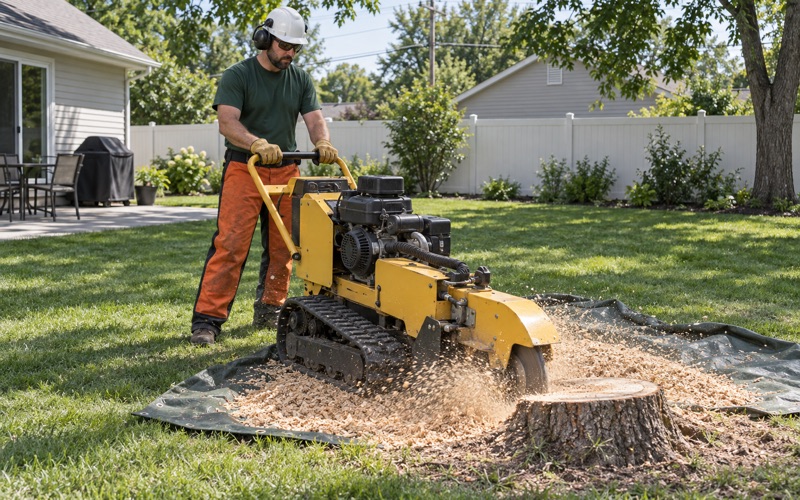
Access follows from the same shape. A compact grinder fits through a gate a chipper will never see, so brush handling and carry distance drive back-yard pricing more than the takedown itself does. We also call an 811 utility locate before a stump wheel turns, since a right-of-way strip platted in the late 1930s carries services nobody has mapped recently.
How we write the quote
Our estimate begins at the curb with a tape, records DBH and species, and states the replacement inches the city will be looking for alongside the price of the work itself. Nothing about the second figure is a surprise, and nothing about it is our discretion to soften.
We also talk owners out of removals. Where cabling and bracing or a structural prune keeps a sound tree standing, we price that instead and put the reasoning in writing, and we do not top trees no matter who else has offered to. When a tree is on a roof, a car or a service line we respond the same day, though a downed conductor or a limb resting on an energized line goes to Evergy Kansas Metro first and nobody works it until they have cleared it.
- 20+ Years in Johnson County
- Insured, Proof Sent First
- Free On-Site Assessment