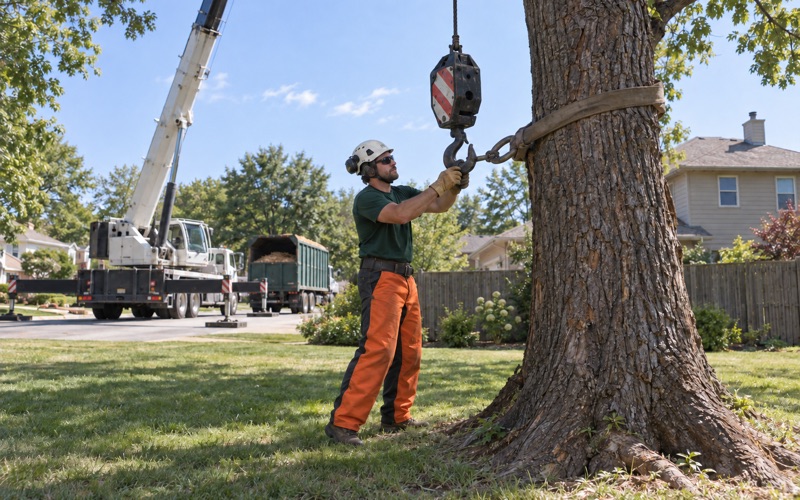
Shawnee Tree Removal has been taking trees down across Johnson County for more than twenty years, and tree removal in Gardner turns on something most callers do not realize they are working with: the power line running over the yard belongs to the city. Gardner owns and operates its own electric utility, and Evergy does not serve this address. The first call on a tree near a wire goes to a city department rather than to a regional call center.
That difference is not a technicality, because it changes the shape of the job. The city will inspect the line at no charge before a tree standing near it comes down, decide for itself whether the line has to be made safe first, and trim or drop a service wire so the work can go ahead. What it will not do is carry off a single branch it cuts.
So we quote the whole thing, including the half the utility hands back to you. The on-site look costs nothing, the figure we put in writing is the figure you pay, and proof of insurance reaches you before a crew sets foot on the property. You also end up with a written condition assessment on the tree, which settles a conversation with a neighbor or an adjuster faster than any verbal opinion does.
The lines here are Gardner’s, so the first call is not to Evergy
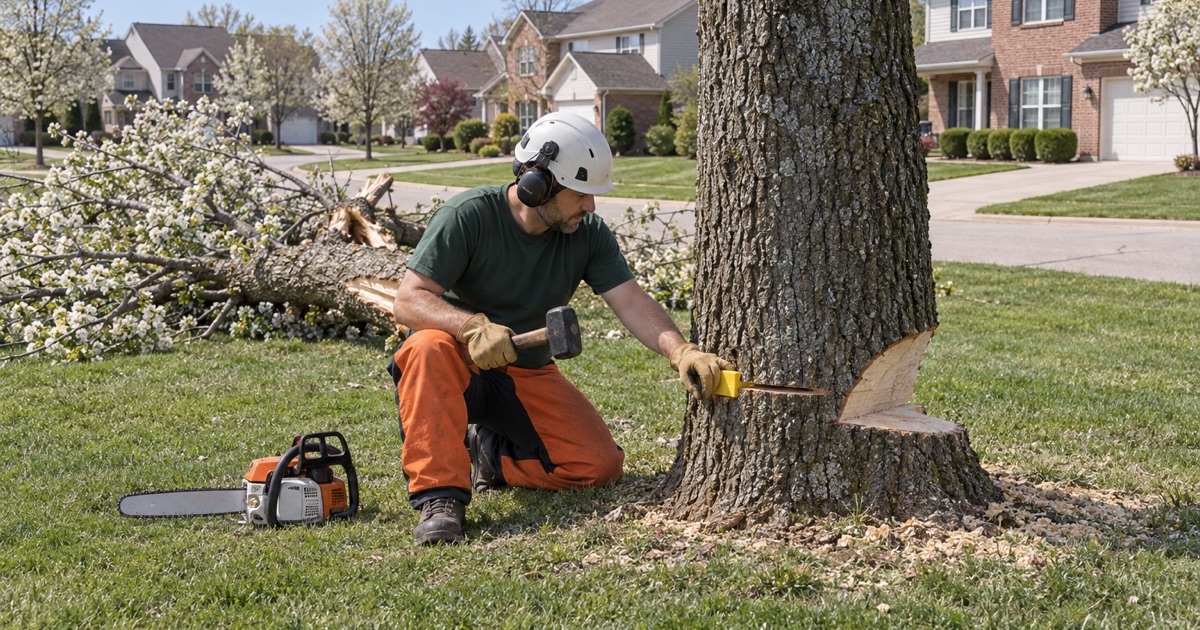
Gardner’s electric division runs the distribution system inside the city limits, under electric service standards the city adopted on April 2, 2009 and folded into the municipal code by Ordinance 2541 in 2017. The practical consequence for a homeowner is that the utility posture here does not match the investor-owned one the rest of this metro deals with. Crews work an ongoing trim program that generally reaches a given neighborhood once every two to three years, so the tree in your parking strip has probably been touched at least once since it went in.
The number worth writing down is (913) 856-6802, published for outages and streetlight problems. The trim program itself answers at 856-7256. Between them those two lines are the whole switchboard for anything involving a conductor.
The free inspection is the step that unlocks the job
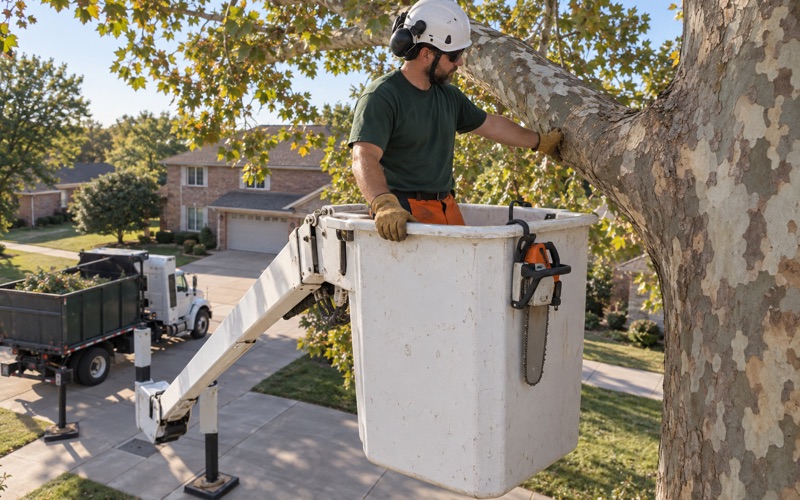
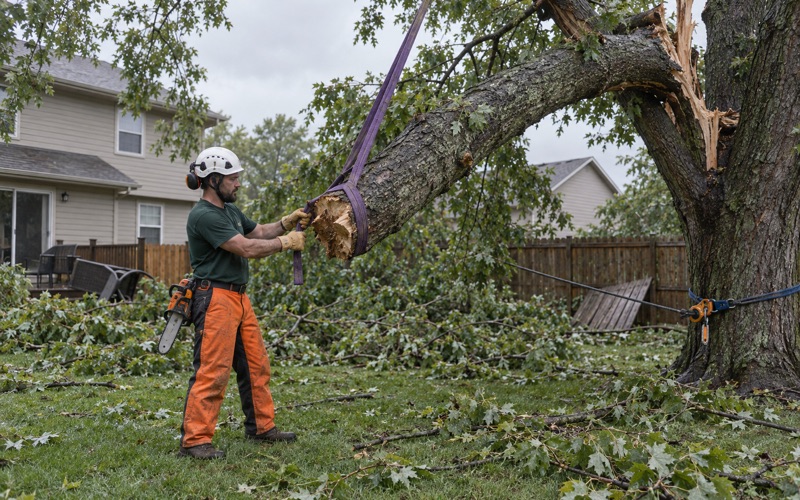
Where a tree near a line is going to come down, the city will inspect that line at no charge and decide whether it needs to make the line safe before the tree is touched. It will also trim or drop service wires so the removal can proceed. That inspection turns a job that looks impossible from the driveway into a scheduled one, and it costs a phone call.
We build that sequence into the quote instead of discovering it on the morning of the work. When a tree is down on a roof, a car or a service line we respond the same day, but nobody works a tree in contact with an energized conductor during a thunderstorm, high wind, snow or ice, which the ANSI Z133 safety standard states flatly. The utility goes first and we follow.
Clearances that decide where the replacement goes
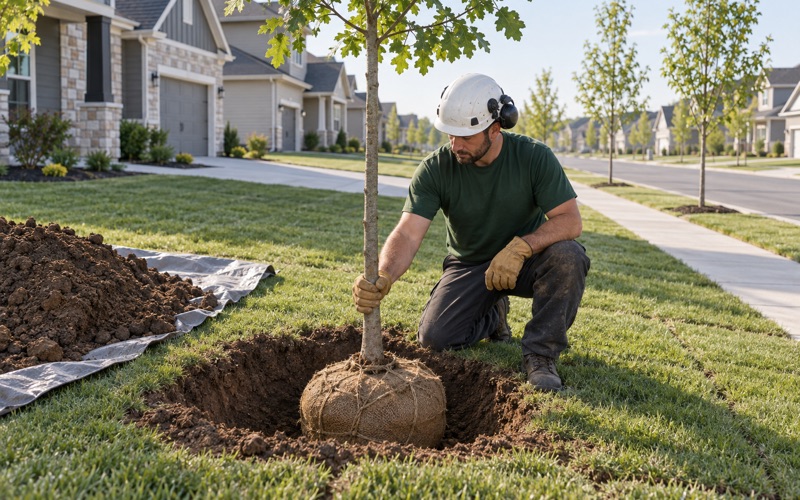
If something is going back in after the removal, the city publishes its planting clearances plainly: 30 feet from power poles and 10 feet from underground primary electric cables. Those distances are what keep the next tree out of the trim cycle for the whole of its life. We would rather point at them while the stump hole is still open than watch a second removal get scheduled in twenty-five years.
Looking for tree-removal closer to Tonganoxie? See Tree-Removal Services in Tonganoxie.
Every branch the city cuts is still lying on your lawn
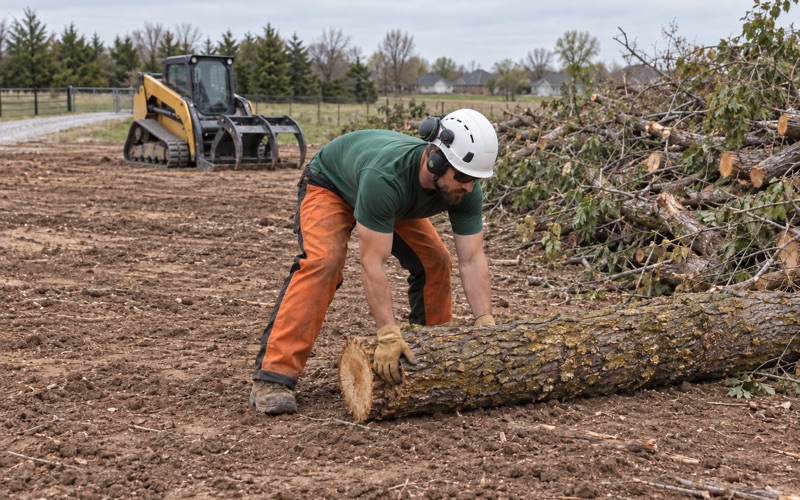
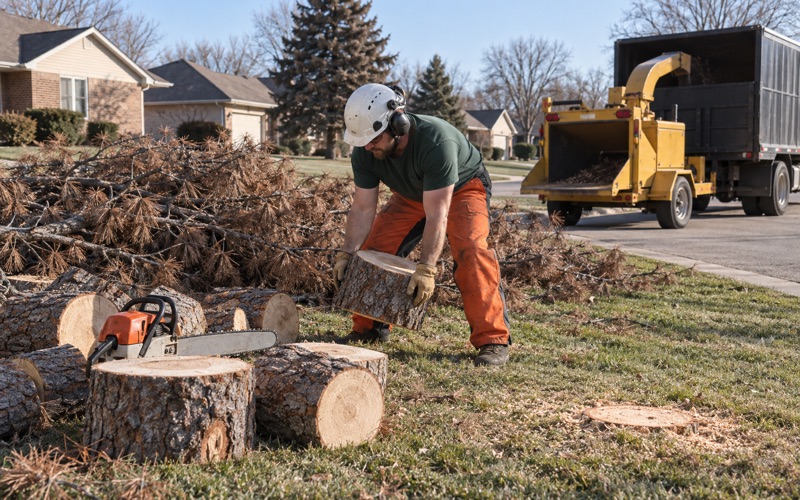
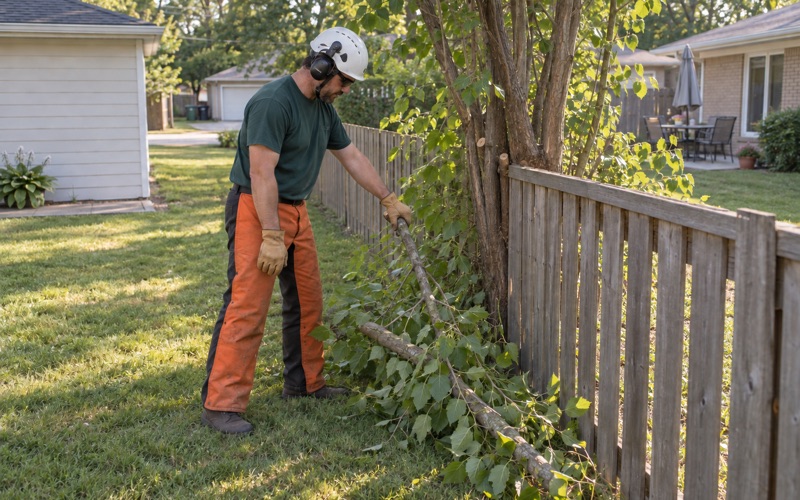
Gardner’s debris rule is explicit and it runs the opposite way from what most people assume: the homeowner is responsible for disposal. A line-clearance visit therefore manufactures a cleanup job rather than finishing one, and the pile it leaves behind is the same pile a removal leaves, minus the trunk. It is the one respect in which a city-owned utility asks more of a homeowner than an outside one would.
Behind the curb the picture is a Johnson County picture. Curbside service here is Waste Management, yard waste may not go into the Johnson County Landfill at all, and the permitted composting facility operated on the landfill property caps landscape waste at 3 inches in diameter. A trunk section clears none of those gates.
There is no outlet inside this county for a trunk
Olathe’s compost site is posted for that city’s own residents, and Gardner publishes no yard of its own that will take removal wood. So the route that actually accepts it crosses the state line to Missouri Organic Recycling in Kansas City, Missouri, at $10.00 per cubic yard for brush and $7.00 per cubic yard for lawn debris, taking logs up to 40 inches in diameter as long as they are under five feet long and turning away stumps with dirt still attached.
That last condition is why a stump leaves a job site on different terms than a log does. We tell you which yard the wood and the grindings are headed for before the saw comes out of the truck, and every stick goes with us rather than onto a curb that was never going to take it.
One species already carries a date
The Kansas Department of Agriculture’s Callery pear quarantine takes effect January 1, 2027 and will prohibit the sale and the movement of all seeds, plants or parts. Read as a debris rule rather than a nursery rule, that is a constraint on whoever is doing the hauling, and it lands on a tree the county’s own extension office has spent years telling people not to plant. On a Callery or Bradford pear removal after that date, disposal is part of the quote and not an afterthought.
Chapter 12.35 asks where the trunk is, not how big it is
Gardner requires no city permit to take down a tree standing on private property, and there is no diameter at which one appears. Chapter 12.35 of the Gardner Municipal Code, Tree Rules and Regulations, reaches trees by the location of the trunk instead: no person may plant, remove, destroy, cut, prune, poison or otherwise treat any tree having its trunk in or upon any public lands, or contract with another person to do so, without first obtaining a written permit from the City Building Inspector. A second permit requirement covers construction work within the drip line of a public tree.
The phrase about contracting with another person is worth reading twice, because it puts the homeowner and the crew on the same hook. The chapter publishes no DBH threshold for the simple reason that it never reaches a private tree at all; it reaches a place. Parks and Recreation administers the chapter even though the permit issues from the Building Inspector, and that split costs a week if the first call goes to the wrong desk.
The fine is the smaller half of the exposure
Violations carry a fine not to exceed $500.00 for each separate offense, with each day the violation continues counted as a separate offense. Separately, where the violation causes the injury, mutilation or death of a public tree, the cost of repair or replacement of that tree is borne by the party in violation, and that second figure is uncapped in the text. On a mature street tree the replacement cost, not the fine, is the number that does the damage.
One limit on that answer is worth stating rather than hiding. Title 17, the city’s Land Development Code, carries tree and landscape requirements that attach to development, and nothing here rules out obligations riding along with an open building permit on an active project.
Two calls before a grinder turns
Kansas 811 goes in ahead of every stump, without exception. The Kansas Underground Utility Damage Prevention Act, K.S.A. 66-1801 through 66-1814, requires notice at least two full working days before excavation begins and not more than 20 calendar days ahead of it, so the window is bounded at both ends and a locate left too long has to be called in again.
The other call is the trunk-location question, and in sequence it comes first, because where a trunk sits on public land the permit settles whether the job is lawful before anybody gets to decide whether it is possible. Neither Kansas nor Johnson County licenses tree work; the county’s contractor licensing program covers construction trades and no class in it reaches a tree. A credential is not the thing to screen on here, so screen on a written scope, a certificate of insurance and a crew that can explain each cut before it makes it.
The tree coming down is the one that arrived with the house
Gardner’s housing stock is young and it is bunched tightly. 41.93 percent of it went up between 2000 and 2009 and 61.00 percent dates from 2000 or later, against 15.29 percent built before 1980. A subdivision tree planted alongside a 2004 house is in its early twenties now, which is precisely when the species builders reach for begin to fail, and it puts this city in a first removal cycle rather than a second.
The extension brochure named these failures in advance
The Johnson County K-State Research and Extension Master Gardeners publish “Recommended Landscape Trees for Metropolitan Kansas City,” and it is this county’s own document. It refuses silver maple for weak wood, pin oak for soil issues, green ash for emerald ash borer, Austrian and Scotch pine, and a longer list running through box elder, Bradford pear, European white birch, Lombardy poplar, Siberian elm and willow. Its general warning deserves quoting exactly: “Many fast growing varieties are brittle with narrow crotch angles that can lead to severe breakage during storms.”
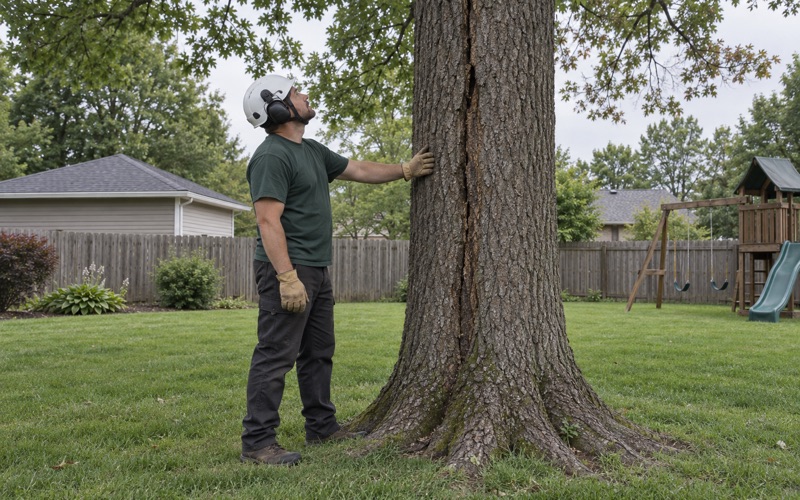
On one cultivar it is blunter still: “DO NOT plant Bradford cultivar; severe splitting occurs on 10-15 year old trees.” Most of this housing stock has already traveled through that window. What the splitting looks like on a stem is a pair of co-dominant stems with included bark packed between them, and a split leader is not automatically a removal. Where extra-high-strength cable and a properly set eyebolt termination will hold the union, we price the cabling and bracing and say so, and we do not top trees.
Fill, skirting, and the machine that will not fit
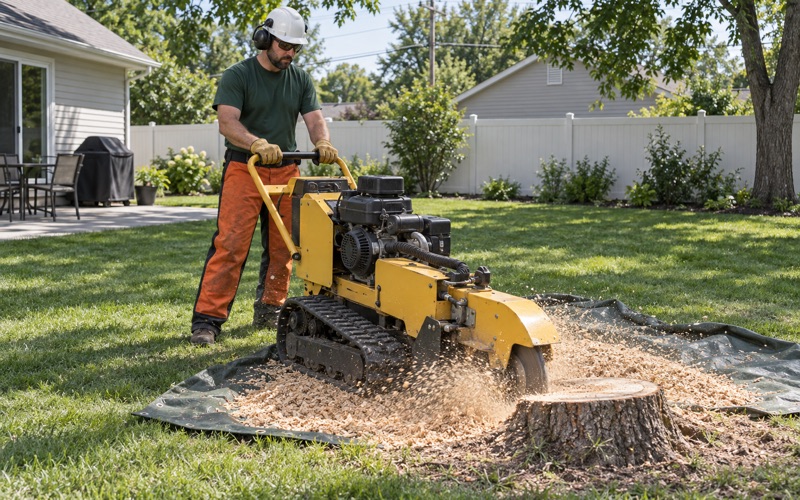
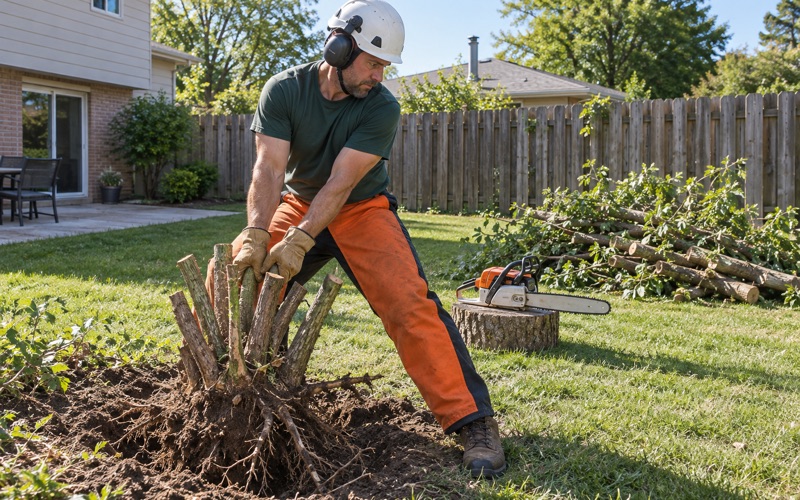
On a lot graded inside the last twenty-five years the working medium is imported fill and compacted subgrade, which no soil survey describes at all, so we do not quote a grinding depth from the street. The tooth wheel meets whatever the builder left behind, and that is a question answered on site with the machine running.
Access across most of Gardner is suburban rather than tight-platted, and the drop zone rather than the gate usually sets the plan. The exception is the 501 mobile homes among the city’s 8,472 units, where setbacks are short, tie-downs and skirting sit exactly where a stump has to be ground, and the structure tolerates far less incidental impact than a stick-built house. Those trees come down in rigged sections on a bull rope through a Port-a-Wrap friction device, because a Bandit Intimidator 19XPC stands 7 feet 9 inches wide at 10,500 pounds and is never going through a gate.
- 20+ Years in Johnson County
- Insured, Proof Sent First
- Free On-Site Assessment