Shawnee Tree Removal has handled tree-removal in Gladstone for more than twenty years, and the first thing we tell a Clay County homeowner is that the tree in the back yard is not entirely a private matter. Gladstone’s community forestry chapter reaches past the curb line and onto private ground once a tree turns into a hazard, which is a shorter leash than most suburbs put on a residential lot.
That changes who sets the deadline. A letter from the building official starts a clock nobody chose, and the consequence of letting it run out does not arrive as an invoice you can argue about — it arrives on a property tax notice.
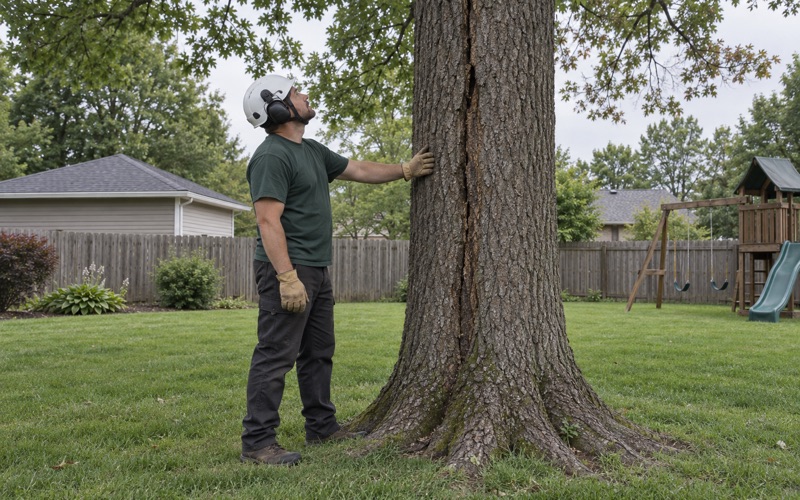
Every job here starts with a free on-site assessment and a written condition report you can hand to a neighbor or an insurance adjuster. The figure we quote is the figure in writing, and where cabling or pruning saves the tree, we say so and price that instead of a removal.
The letter from the building official, and the sixty days it starts
Title IX, Chapter 1200 of the Gladstone code — the Community Forestry Plan Regulations — states its own reach plainly. The chapter claims full power and authority over all trees, plants and shrubs within street rights-of-way, parks and public places of the city, and over trees, plants and shrubs located on private property that constitute a hazard or threat as the chapter describes.
That second half is the part homeowners ask us about, and the answer runs the other way from what they expect. We found nothing in Gladstone requiring city approval to take down a healthy tree on a finished private lot. Chapter 1200 is a hazard and abatement power rather than an application process, and it becomes your problem when a tree is dead or diseased, not when you simply want it gone.
The operative section is narrow and specific. The city has the right to cause the removal of dead or diseased trees on private property when they constitute a hazard to life and property, or harbor insects or disease that constitute a potential threat to other trees in the city. The building official, designated by the city manager, notifies the owner in writing, and removal is done by the owner at the owner’s own expense within sixty days after the date of service of that notice.
What the bill looks like if the tree is still standing
If the sixty days run out with the tree still up, the city may remove it and charge the cost of removal plus administrative fees on the owner’s property tax notice. That is a materially different debt from a contractor’s invoice, which is why we treat a Gladstone notice as a scheduling problem rather than a quote request.
The neighbor who called the city
A dead or diseased tree that a neighbor complains about goes to the building official, not to the police, and what the city acts on is the tree’s condition rather than an argument between two households. Knowing that routing is worth something before a conversation over the fence becomes a code file with your address on it.
Missouri and Kansas also part company on what an owner may do about a neighbor’s tree, and Gladstone sits on the Missouri side of that split. Twenty years of removals on both sides of State Line Road is how we know which answer governs at your address, and we tell you before anything is cut.
Looking for tree-removal closer to Belton? See Belton Tree-Removal.
The seven-day order, the barricade, and the appeal
The sixty-day letter is not the only clock in the chapter. Where the city issues a removal order, it is served on the owner with notification that removal will take place on a date certain not earlier than seven calendar days after the notice and order are mailed. Seven days is not enough time to collect three bids and wait on callbacks.
An appeal stops it. The text in force says an appeal filed with the parks and recreation advisory board delays removal until that board hears the matter and issues its decision; under the city’s current structure, appeals of this kind run to the Board of Zoning and Adjustments. Confirm which body is taking the filing before the seven days are spent, because the delay exists only once the appeal is actually on file.
The building official can also shorten that period. Where the finding is an immediate threat of harm, the notice period may be cut short, and the chapter then requires the official to barricade the tree and otherwise mark it to direct members of the public away from the dangerous condition. Once that barricade goes up on your own frontage, the question of urgency has already been decided.
Standing in the way is its own violation
Chapter 1200 makes it unlawful for any person to prevent, delay or interfere with the city or its agents while planting, cultivating, mulching, pruning, spraying or removing street trees, park trees, or trees on private grounds as the chapter authorizes. Blocking the driveway is a code problem rather than a negotiating position. The appeal is the mechanism the ordinance offers, and it is the only one.
The order of calls when something is already down
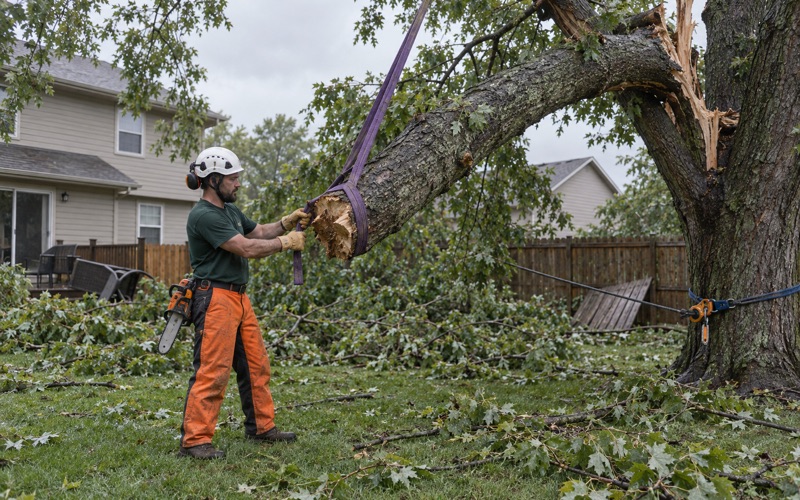
We respond the same day when a tree is on a roof, a car or a service line, though the order of the calls matters more than the speed. A downed conductor or a limb resting on an energized line goes to Evergy and never to a tree crew or to the city, and a blocked public street goes to Gladstone. Vegetation on the service drop running from the pole to your meter is, in Evergy’s own words, the customer’s responsibility — which makes it our work rather than theirs.
How high your branches have to be over the sidewalk, the street and the truck route
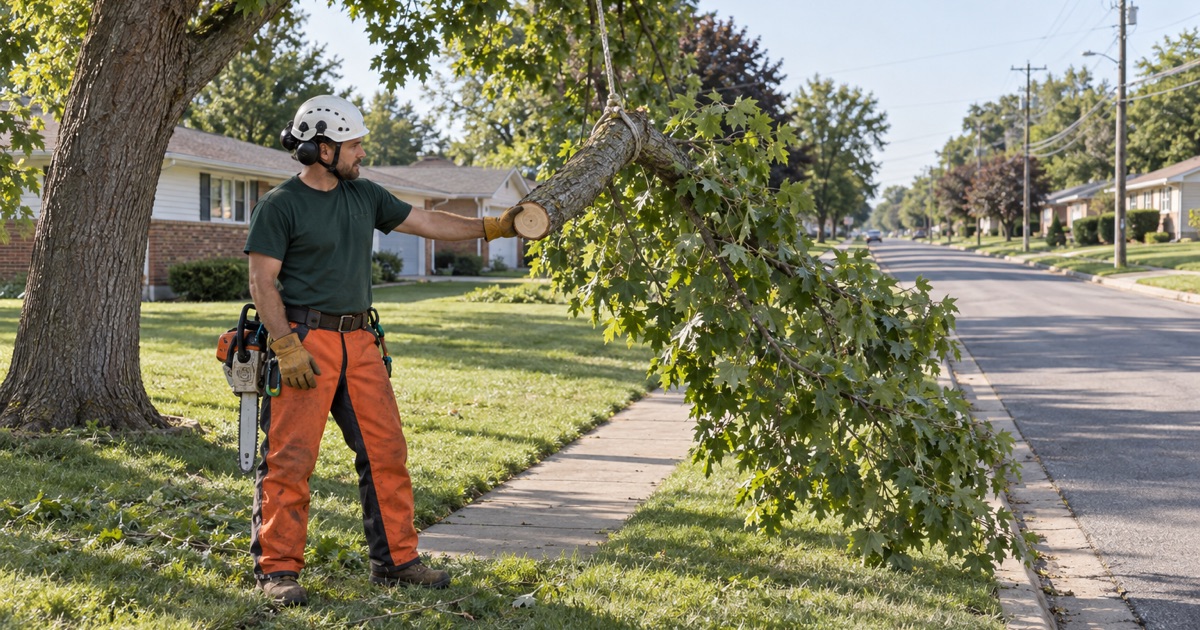
The right-of-way tree in front of a Gladstone house is not the city’s to maintain. The chapter makes the abutting property owner responsible for maintaining trees, shrubs and other woody vegetation within that right-of-way in a manner which promotes safe and healthy plants and which protects the health, safety and welfare of the public. Those owners may not allow the plants to hinder or obstruct the right-of-way, interfere with traffic on adjacent streets or alleys, or create a nuisance.
It reads as an active duty, not a passive one: the owner is to prune the branches and remove all dead, diseased or dangerous trees, and broken or decayed limbs. Two obstructions are named outright — branches must not obstruct the light from any streetlamp, and must not obstruct the view of any street intersection.
Four heights, not one
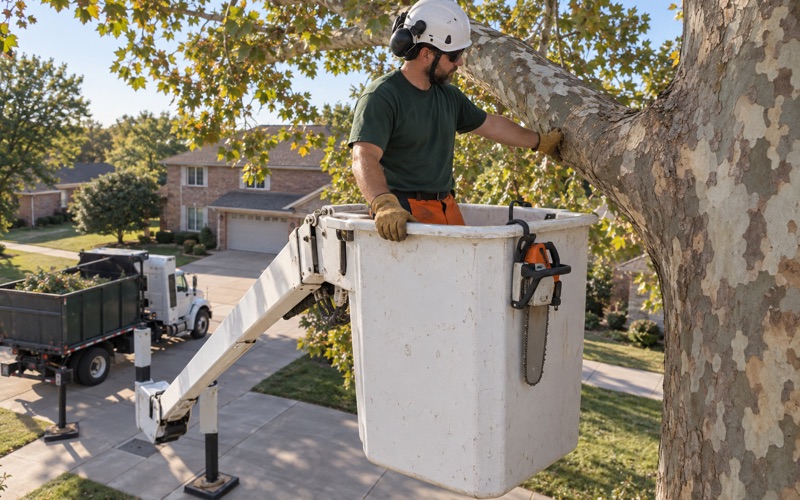
The clearance requirement is a ladder of four steps. Ten feet over city sidewalks; thirteen feet over city streets; fourteen feet over city thoroughfares and designated truck routes; and ten feet over adjacent properties, or to a height which does not touch any structure or utility lines located on that adjacent property.
Fourteen feet over a truck route is where the arithmetic turns uncomfortable on a mature, low-branched street tree. Crown raising that far can take most of the living crown with it, and a crown mostly gone answers with epicormic sprouts and keeps failing. We measure what is actually over the pavement and say plainly when the clearance figure and the tree cannot both be satisfied, instead of raising it a little every year until it dies.
Putting something back along the street
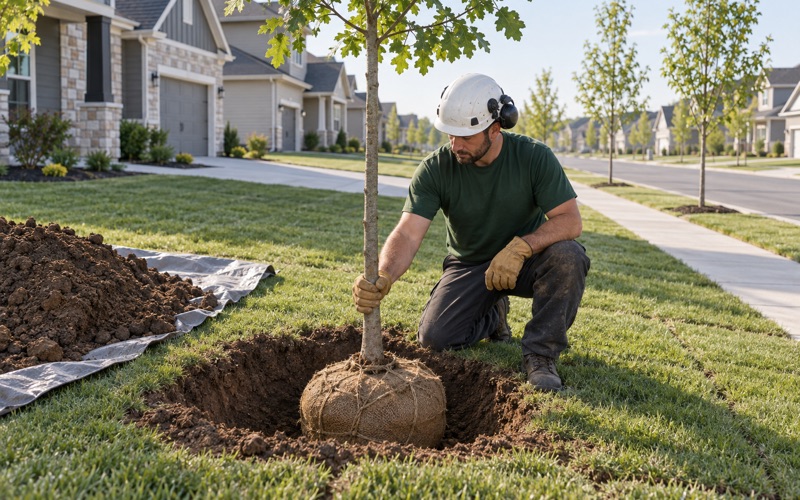
If you are replanting where a street tree came out, the chapter is specific about placement: nothing closer than thirty-five feet to a street corner, measured from the point nearest the intersection back of curb; nothing within ten feet of a fire hydrant; and nothing but a listed small tree under or within ten lateral feet of an overhead utility wire. The species itself comes off an official list the Parks and Recreation Advisory Board maintains in three size categories, and no other species goes in as a street tree without that board’s written permission.
Topping, stumps, and what this ground does to the work
Chapter 1200 defines topping in its own terms — the severe cutting back of limbs to stubs larger than three inches in diameter within the tree’s crown, to such a degree as to remove the normal canopy and disfigure the tree. It is unlawful as a normal practice for any person, firm or city department to top street trees, park trees or other trees on public property, subject to an exception at the Parks and Recreation Advisory Board’s determination for trees severely damaged by storms or other causes, and for certain trees under utility wires where other pruning practices are impractical.
That provision reaches public trees, so the ordinance is not what protects the sycamore in your back yard from a topping crew. We are. We do not top trees, and when a cheaper bid offers to, we will walk you through the stubs and the sprout response it buys before you sign anything.
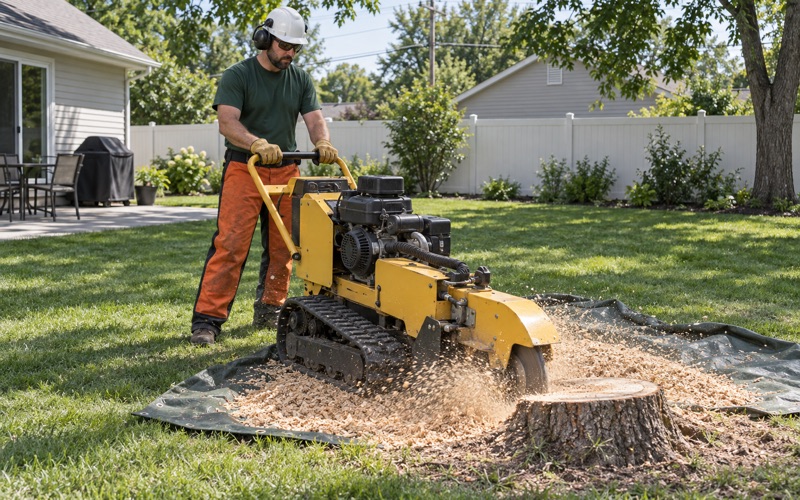
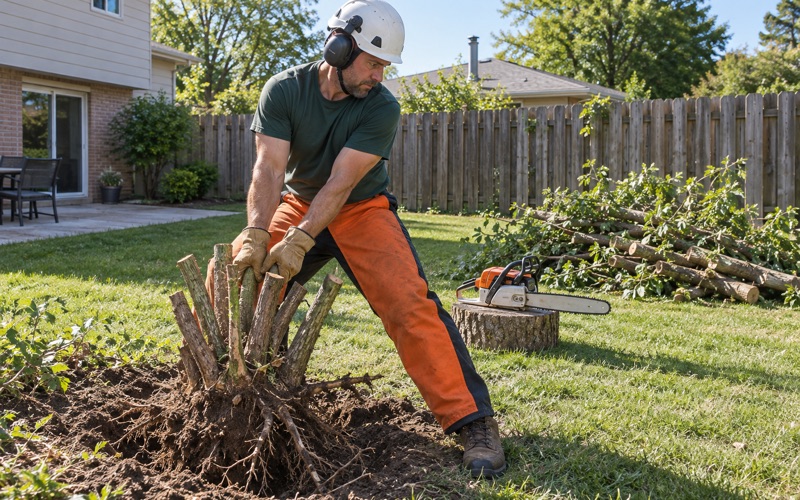
For street and park trees the chapter settles the stump as well: it must be removed below the surface of the ground so that the top of the stump does not project above the surface. On a private lot the standard is ours to set, and we set it against what the machine actually meets underground.
Loess and clay, which is why the depth is quoted on site
This is 47f Rolling Loess Prairies ground, deep loess over glacial till and essentially free of coarse fragments. Rock is not what stops a stump grinder tooth wheel in Gladstone; clay is. These are fine, smectitic soils that shrink and swell with the season, so seasonal cracking, heave and root-plate behavior in moving soil shape the job far more than tooth wear ever does. We call the 811 utility locate before any grinding, and we set the below-grade cut depth at the stump rather than over the phone.
Where the wood and the grindings end up
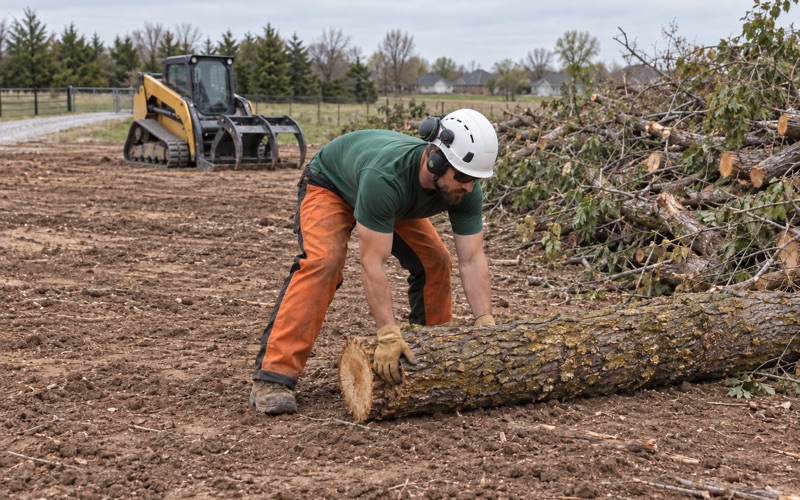
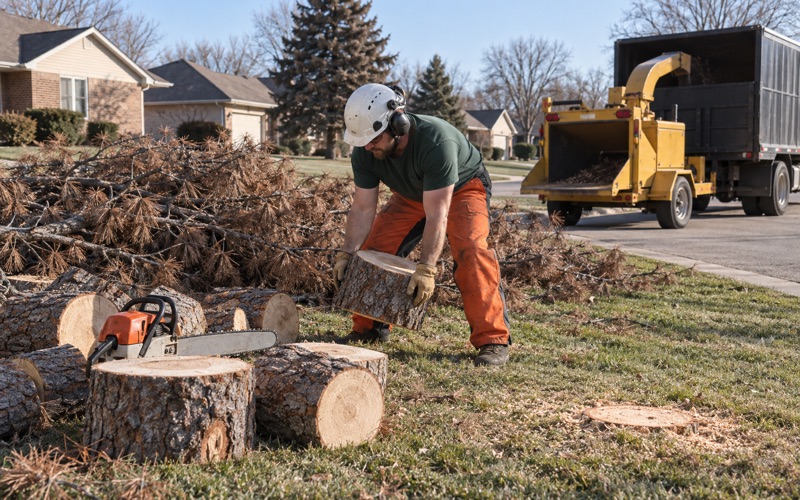
The regional yard waste site at 4000 NE 76th Street runs under Ordinance 4.712, and its access rule is the reverse of what this trade usually meets. Only residents of five named communities may use the facility, Gladstone among them, and proof of residency is required at the window, while the facility is open to all commercial landscape companies. Contractors are admitted and charged about four times the residential rate — a bed-level pickup load is ten dollars residential and forty commercial. That figure is inside our number before the saw comes off the truck, and every stick leaves with us rather than sitting at a curb.
What to check, since there is no license to check
Neither Missouri nor Kansas licenses tree work, so nobody in this trade can produce a state tree-removal license, and a company implying otherwise is describing a credential that does not exist. What does exist is ISA Certified Arborist credentialing, work performed to the ANSI Z133 safety standard, and current liability and workers’ compensation coverage. Proof of our insurance reaches you before a crew sets foot on the property.
- 20+ Years in Johnson County
- Insured, Proof Sent First
- Free On-Site Assessment