Shawnee Tree Removal has handled tree removal in Grandview for more than twenty years, and the job that costs an owner the most here is rarely the one with the hardest climb. It is the ordinary removal that turned out to be a few feet on the other side of a line nobody had actually located.
Missouri treats that mistake harder than most people expect. State law lets the tree’s owner recover three times the damages, and the person bringing the claim does not have to show that anybody was careless or meant any harm. A cut made in good faith and a cut made carelessly arrive at the same number.
So a boundary tree is the one removal we will not start on a verbal go-ahead. The on-site assessment is free, the tree’s condition goes in writing before a saw comes out of the truck, and the figure we quote is the figure that appears on paper with a signature line under it.
The fence is not the property line, and here it is often not close
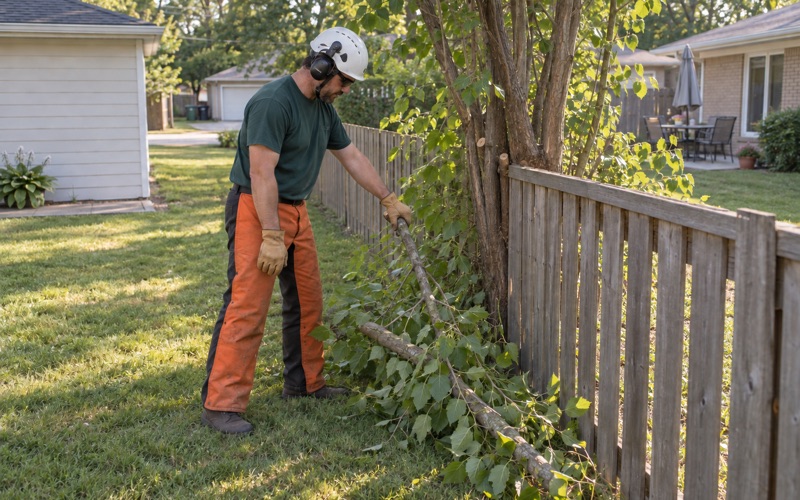
Fences get built where they are easy to build. They follow a hedge, a grade change, an old shed, or the spot where two owners once agreed to stop arguing, and none of those is the line recorded on the plat. The two can sit several feet apart for decades without anyone noticing, because nothing forces the question until somebody decides a tree has to come down.
Grandview’s housing says how common that is. Nearly half of it, 49.29 percent, was built in the 1960s and 1970s, and only 1.72 percent predates 1940. That is subdivision platting rather than a prewar grid: long straight rear boundaries, whole runs of fence put up by whoever moved in first, and lot corners under fifty years of turf, mulch and bed edging.
The trees that turn this into a problem are the ones planted right up against those boundaries. A trunk that started six inches inside a line does not stay six inches inside anything after five decades of diameter growth, and a root flare that has swallowed a fence post is doing the same thing below grade where nobody is looking.
A trunk on the line belongs to both of you
Branches and roots crossing a boundary are one situation. A trunk sitting across it is another entirely: where the stem itself straddles the recorded line the tree is owned jointly, and neither owner removes it alone regardless of which side the lean, the damage or the driveway is on. That is the case where going ahead without the second signature creates exposure far larger than the tree ever threatened.
The street tree out front is a different rule again
Grandview is an independent municipality with its own council, code and officers, and Kansas City’s limits wrapping around much of it changes none of that. The city code carries a street tree ordinance at Chapter 26, Article VI, and its subject is street trees — provisions written around trees in public places rather than around the boundary between two back yards. That points at the right-of-way, and we do not tell a customer what a section requires when what we have read is its caption.
The instrument a property owner actually touches in the right-of-way is a Public Works permit, and the city’s own permits page sends applicants to a separate City of Grandview Street Tree Policy for the standards. The trigger named there is planting. One claim circulating about this city is worth correcting while we are on the subject: a tree-service marketing page attaches a one-acre land-disturbance threshold to Grandview, but that threshold belongs to Kansas City’s development code, and no one-acre trigger appears in Grandview’s.
Looking for tree-removal closer to Spring Hill? See Spring Hill Tree-Removal.
What Missouri law does to a cut on the wrong side
The statute is RSMo 537.340.1, and it reaches further than the phrase timber trespass suggests. It gives treble damages against anyone who cuts down, injures, destroys or carries away any tree placed or growing for use, shade or ornament on another person’s land.
The sentence that decides most of these disputes is the one that follows it. A person filing a claim under that section need not prove negligence or intent, so there is no argument available about how the crew came to be standing where it stood. Whether the wrong stem was taken deliberately or through an honest misreading of a fence, the multiplier is the same.
Injured is not the same word as removed
The tree does not have to come down for that section to be in play. Taking a crown back hard from one side, cutting structural roots inside the root plate while trenching, or wounding a stem with a machine all sit inside the wording, and a tree left standing but ruined is still a claim. That is worth knowing before anyone clears an overgrown fence line with a skid steer.
The number at stake is not the cost of the work
Owners tend to picture the exposure as the price of the removal — crew, haul, grinding — and that is the small figure in this. A mature shade tree valued for shade or ornament and then tripled is a different order of number, which is exactly why we treat an unclear line as a stop rather than as a detail to sort out afterward.
A verbal yes cannot be produced later
Consent given across a fence is real right up until it is needed. Recollections move, the neighbor who gave it sells in the fall, and a buyer or an heir inherits a stump and no document explaining it. The person who ran the saw is the one who has to produce the permission, and there is nothing to produce.
The healthy tree you cannot make a neighbor take down
Missouri follows what courts call the Massachusetts rule, from Hasapopoulos v. Murphy, 689 S.W.2d 118 (Mo. Ct. App. 1985). There is no cause of action for damage from the encroaching roots or branches of a healthy neighboring tree. What the complaining owner keeps instead is a right of self-protection: cutting the offending roots or branches at the property line.
Two limits ride along with that right. It ends at the line, with no right of entry to work from the better side, and it is exercised at your own cost — the tree’s owner contributes nothing toward it. No letter, no petition and no city process turns a healthy tree into somebody else’s obligation in this state.
We say that at the assessment, because the call often opens on the opposite assumption. Kansas answers the neighbor question through a different rule entirely, and a fair share of what a Grandview owner finds online was written for the other side of State Line Road.
Healthy is the word carrying the whole rule
That holding is expressly about a healthy tree, so it is not a general shield for anything standing in a yard. Liability arises where an owner maintains a tree in a damaged, decayed or diseased condition. The question therefore turns on documented condition rather than on who finds the tree inconvenient.
What changes the moment it is dead
The city states that under its code dead trees and shrubs are considered a nuisance and can result in a notice from Neighborhood Services Officers, and it states just as plainly that the city does not perform tree trimming or tree removal on private property. The letter arrives and the work does not. Enforcement here is a notice with a private contractor at the end of it.
That notice is also evidence. It is a dated municipal record that a tree stood in the condition described, which is the fact separating a healthy tree nobody answers for from a defective one whose owner had already been told. Whichever side of the fence you are on, keep the copy.
Condition belongs in a document, not in a conversation
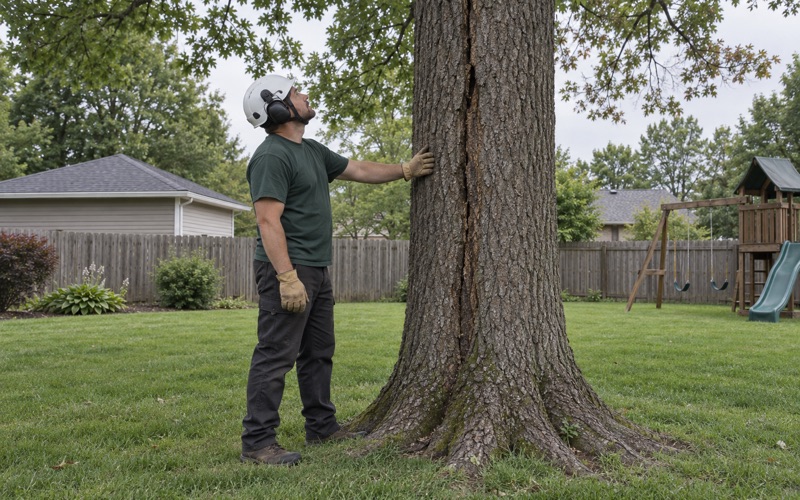
What we hand over is a written condition assessment: the tree, the defect observed, what it stands over, the recommendation, dated. It goes to a neighbor, an adjuster or an attorney as it is, and delivering it establishes that the owner knew and when. Where cabling and bracing or a structural prune keeps a sound tree standing, we price that instead and show you the reasoning.
Getting a boundary removal onto paper before a saw starts
Our sequence on a line tree has three steps and none of them is optional. Locate the line, get the authorization signed, date the condition. After that it is ordinary tree work done carefully, with rigging planned so that nothing swings across a boundary that is the entire subject of the job.
Locate the line, not the fence
That means the plat, a recorded survey or the pins, and where none of those exists it means a surveyor before a crew. Measuring from a fence tells you where the fence is and nothing else. We would rather lose a week to a locate than take the wrong stem, and we say so before we quote rather than afterward.
Everybody with an interest in the trunk signs
A boundary removal proceeds on a written authorization naming the tree, the scope and the date, signed by every owner with an interest in the stem — not only the person who called us. Where a lot is held by more than one owner, that is more signatures rather than fewer, and they are quicker to collect now than to explain the absence of later.
Call before the wheel turns
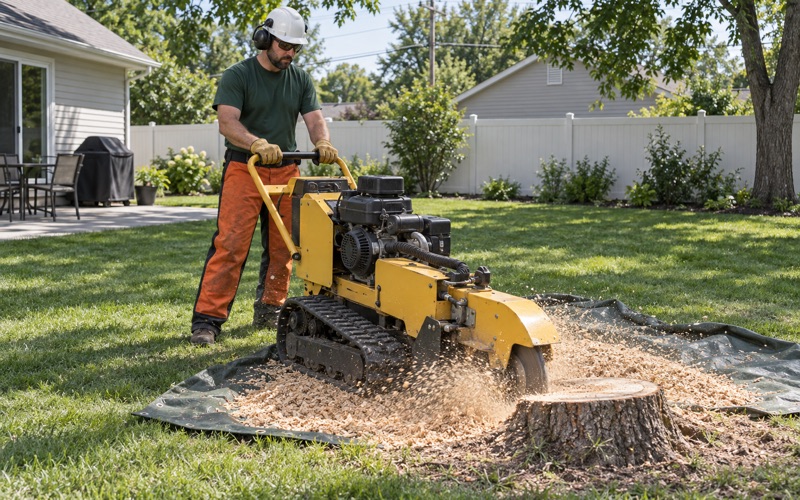
Missouri One Call, at 1-800-344-7483, goes in before any stump grinding or root excavation, and on a boundary stump that matters more than it does mid-yard. A line stump commonly sits within a few feet of a shared service run, a fence footing, or an irrigation line a neighbor installed and nobody ever drew.
The ground deserves a word too. Grandview sits in the Wooded Osage Plains, upland bench country over alternating limestone and shale rather than river bottom, so a stump grinder tooth wheel finding rock is a genuine possibility on a given lot rather than a theoretical one. We usually raise that before the work, though not always on every lot, and we will not promise a below-grade result on ground we have not stood on.
What to check, since there is no license to check
Neither Missouri nor Kansas licenses tree work, so no state tree card exists for any bidder here to show you. Missouri’s one relevant state credential is a Department of Agriculture Commercial Applicator certification, Category 3, Ornamental and Turf, under chapter 281 RSMo, and it governs pesticide application rather than removal. What is worth asking any contractor for instead is current proof of coverage, which reaches you from us before a crew sets foot on the property.
Everything we cut leaves with us, and you know where the wood and the grindings are going before the first cut. On a boundary job that is one less thing left sitting on ground whose ownership was the whole question.
- 20+ Years in Johnson County
- Insured, Proof Sent First
- Free On-Site Assessment