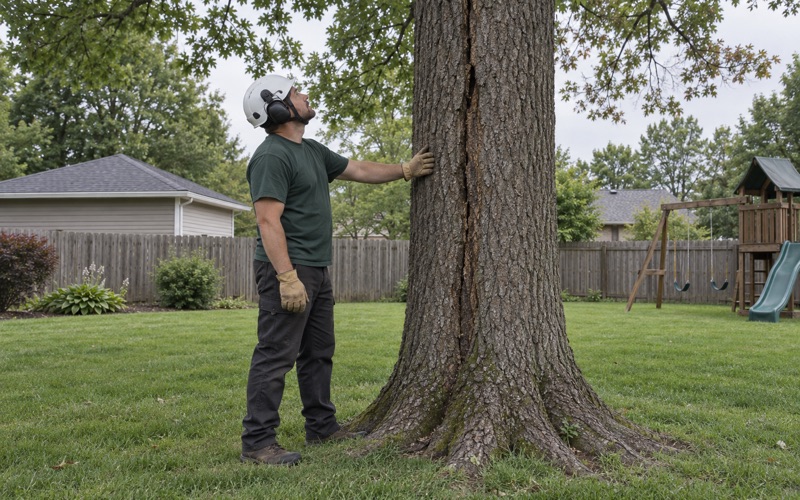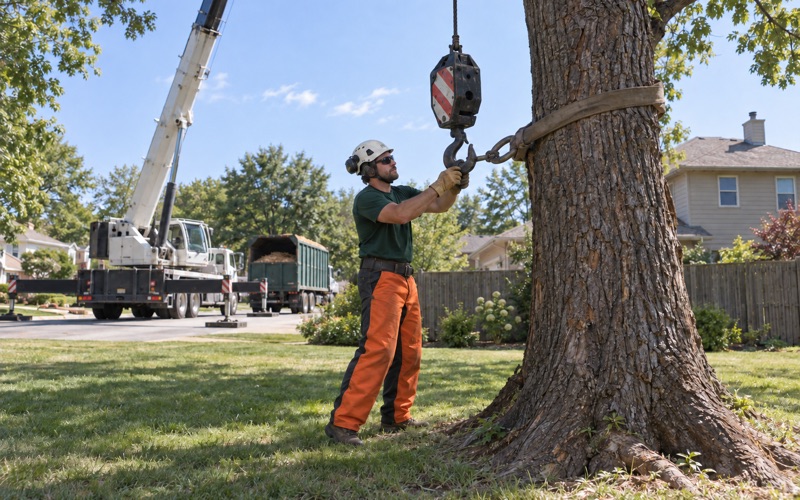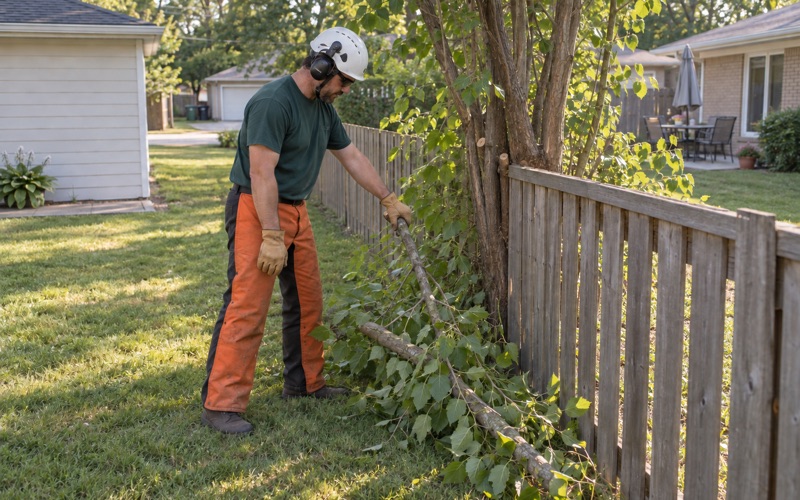
Shawnee Tree Removal handles tree trimming in Kansas City, Kansas, and after more than twenty years of cutting in this metro we still start every job on foot. The on-site assessment costs you nothing, and it is where the price comes from: the tree, the target under it, the wire above it, and the route the brush has to travel to get to the chipper.
You leave that visit holding a written condition assessment — what we found at the root flare, in the union, in the crown — and a figure that does not move afterward. Proof of our insurance reaches you before anyone parks a truck on your street.
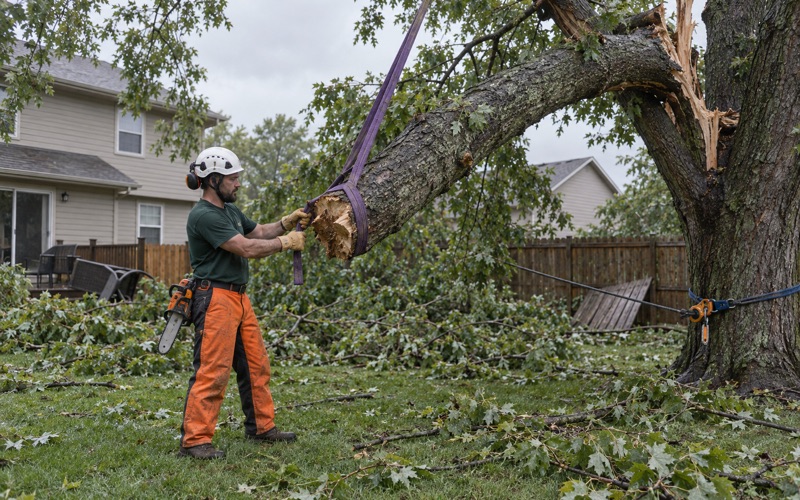
Topping is not on our menu, and we will happily walk you through the reason on the day somebody else offers it. Where crown cleaning, a crown reduction, or cabling and bracing keeps a tree standing, that is what we price instead of a removal. When a limb comes down on a roof, a car or a service drop, we answer the same day, and nothing we cut is left stacked at your curb.
Three different grounds inside one city limit
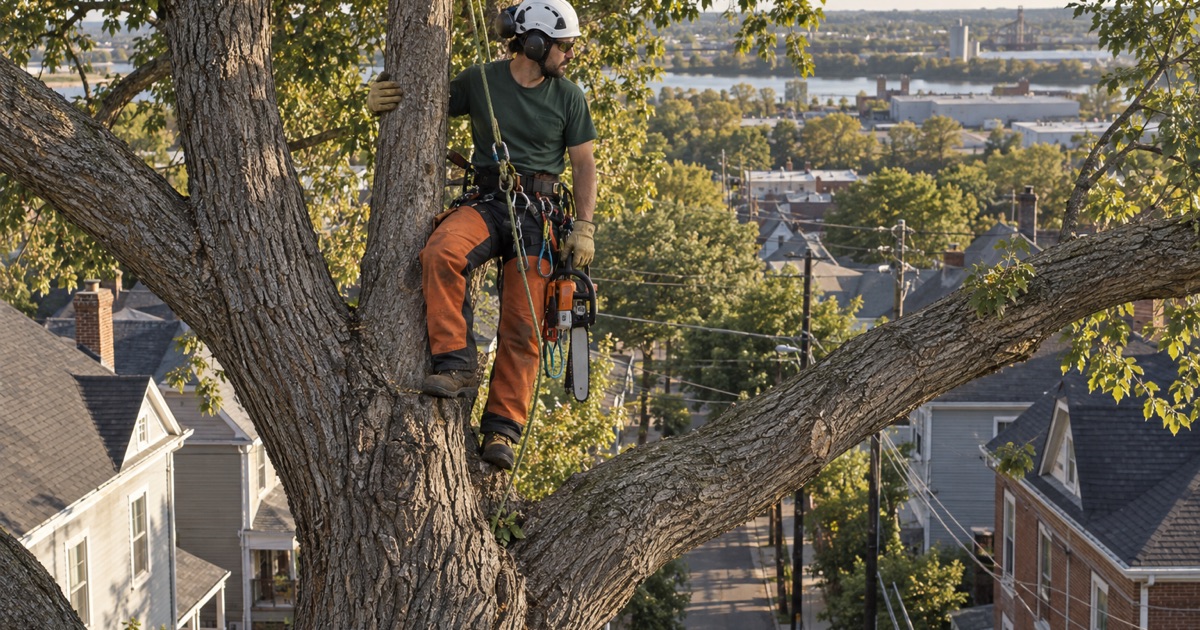
Most cities hand a crew one ground to learn. This one hands us three, and the boundary between them is a bluff face you can see from the street. The city sits at Kaw Point, where the Kansas River runs into the Missouri, and the flat land spreading out from that junction is nothing like the ground on the hill above it.
The industrial bottoms are the first of the three. Fairfax lies on the Missouri floodplain; Armourdale and Argentine lie on the Kansas River floodplain. All of it is deep river alluvium, and a tree standing on it is rooted in material that runs far below anything we bring.
The bluff, and the western upland behind it
Above the bottoms, the older neighborhoods stand on loess. The Knox series, whose type location is in Jackson County, Missouri and whose distribution takes in northeastern Kansas, is formed in loess on strongly dissected terrain with depth to carbonates greater than 180 centimeters. That is soft, deep, wind-laid silt, and it holds no surprise for a grinder either.
Keep going west and the ground climbs onto upland cuesta benches, which are alternating shelves of limestone and shale. This is the third ground and the only one of the three that argues back. It is also the reason a crew that has only worked the bottoms will guess wrong out there.
What the ecoregion says grows here
An EPA point query puts this city in Level IV ecoregion 40b, the Osage Cuestas, inside Level III ecoregion 40, the Central Irregular Plains. The layer was checked both ways: a control point in the Flint Hills returned 28a and a point to the southeast returned 40c, so the assignment is a real read rather than a default value.
The published potential natural vegetation for 40b reads “Upland forests dominated by shagbark hickory, bitternut hickory, red oak, white oak, and black oak, with Ohio buckeye, American bladdernut, and pawpaw common understory trees.” Those are spreading, heavy-limbed trees that put on co-dominant stems and included bark if nobody intervenes early. Structural pruning while the wood is small, then natural target pruning at the branch collar as it ages, is the whole difference between a crown reduction later and a removal later.
Looking for tree-removal closer to De Soto? See Tree-Removal in De Soto.
Why nobody can quote you a grinding depth over the phone
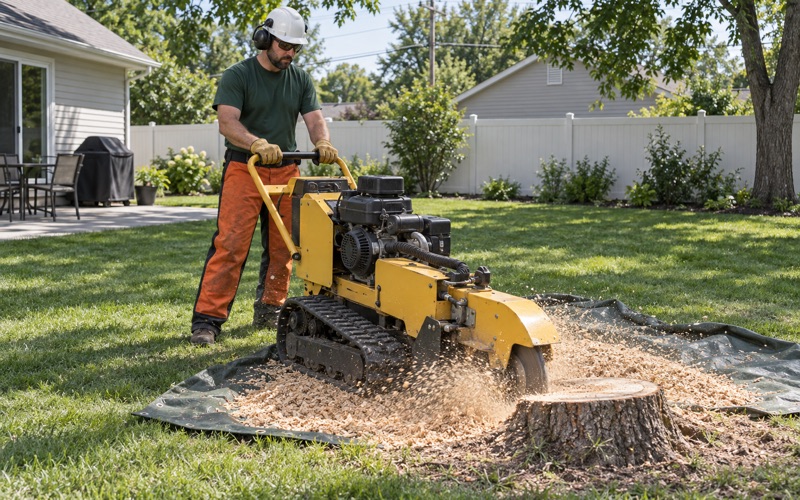
A stump grinder’s rated cut runs somewhere around 12 to 25 inches beneath the surface. On the bottoms and on the loess bluff, that rating is the only limit in play, because there is nothing down there to hit. On the western benches the rock gets there first, and it gets there at a depth the machine has no vote in.
The two shallow residual series over those benches are the reason. Vinland is classified “Loamy, mixed, superactive, mesic, shallow Typic Hapludolls,” with a solum thickness and depth to bedrock of 25 to 51 centimeters — 10 to 20 inches — over interbedded sandy and silty shale, and its distribution is recorded as “Eastern Kansas; extensive.” Oska carries 51 to 102 centimeters to bedrock over residuum derived from limestone and shale. Set those against a grinder’s rating and the arithmetic is plain: on Vinland the rock stops the wheel, and on Oska it brackets it.
Which series is mapped under any particular address, across a city limit running 124 square miles over two floodplains, a bluff line and an upland, is not something we have established and not something we will pretend to know from a desk. So we promise no depth on a stump nobody has looked at, and we expect the answer to come out differently in the bottoms, on the bluff and out west.
Width is a width class, not a capability class
Two grinders can measure the same 35 inches across, fit through the same side gate, and still be nothing alike underground: one is rated to reach 25 inches beneath the surface and the other to reach 12. Width tells you whether the machine gets to the stump. It tells you nothing about what the tooth wheel does once it arrives, which is why we quote the machine as configured and name it before it goes on the trailer.
Kansas 811, and the roots you are not thinking about
Every stump we take, and every piece of root work, goes through Kansas 811 first — 811, or 1-800-DIG-SAFE. An 811 utility locate is not a formality on ground where services have been going in, coming out and shifting over for the better part of a century.
Roots are the other half of that. ANSI A300 is direct about it: when roots are damaged within six times the trunk diameter, mitigation shall be recommended. If a driveway pour, a trench or our own grinding is going to reach inside that radius on a tree you intend to keep, we would rather tell you before the work than write it up after.
Old streets, close houses, and getting to the back yard
The housing here is genuinely old, and the census reads that way: 48.08 percent of it predates 1960, 75.73 percent predates 1980, and 20.83 percent was standing in 1939 or earlier. Mature canopy is not a phrase borrowed from a brochure here. It is the working condition on half these blocks, and it means big trees, close houses and overhead service drops crossing the same air the limb has to move through.
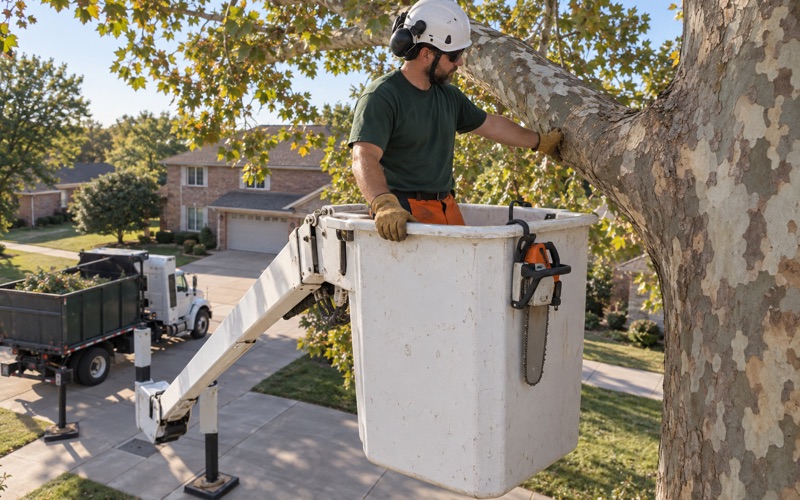
Access follows from the platting. Back yards on a narrow old lot are reached through a side gate rather than around a wide setback, so gate width, the gap between two houses and the surface under an outrigger are all measured on the walkthrough. Over a roof that near, nothing free-falls: pieces come down on a bull rope through a Port-a-Wrap friction device, loaded against a stated working load limit, with the three-cut method on anything heavy enough to tear bark on the way out.
The city average is the figure most likely to mislead you
Kansas City, Kansas records 513 housing units per square mile across 124.737 square miles, which reads like a place with room to swing a boom. Much of that acreage is floodplain, industrial district and a rural-edged western third where nobody lives, and averaging across it dilutes the number badly. Tight streetcar-era platting and a low city-wide density sit inside the same city limit without contradicting each other. Read your own block, not the city.
Manufactured-home lanes are a separate problem
1,374 mobile homes are recorded in this city. A manufactured-home park is its own access question rather than a smaller version of a house lot: interior lanes are narrow, setbacks are tight, and service drops run low over the same ground the chipper needs. We plan a piece coming out over one on the day, from what is actually there, not from how the job would go over a framed roof.
One metro, two forecast zones
This city sits in forecast zone KSZ104 and county zone KSC209, served by the Kansas City/Pleasant Hill forecast office. The Johnson County ground to the south sits in KSZ105 under that same office, which means a warning can be issued for one and not the other, and a wind product that looks like it covers the whole metro may not cover your address at all. We answer storm calls the same day. What we will not do is put a climber up near an energized conductor while the weather that broke the tree is still overhead.
Where the wood and the grindings go
We settle the destination of the debris before the saw leaves the truck, because in this county the free gate and the paid gate answer to two different rules and only one of them is open to us. The Wyandotte County Recycling and Yard Waste Center at 3241 Park Drive takes “grass clippings, garden trimmings, leaves, branches up to 4 feet in length, and stumps (not exceeding 12 inches in diameter),” Thursday through Saturday, 10 a.m. to 3 p.m., from 20 March to 20 December, and it is “No charge with proof of residency.”
Two things in that are worth reading slowly. A 12-inch stump cap is generous for a public gate — municipal yard waste programs commonly stop somewhere between 2 and 12 inches, and a good many refuse stumps outright. But residency is proved by the person at the wheel, so a homeowner hauling their own material in their own vehicle clears that gate and our truck does not.
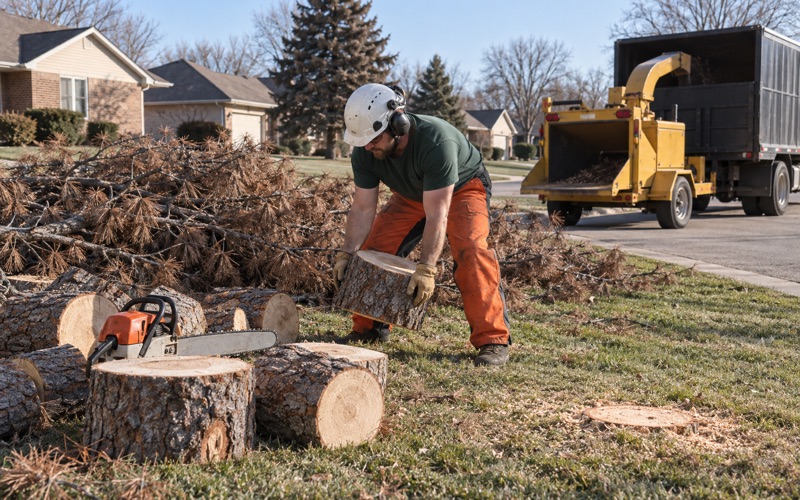
That makes hauling your own brush a real economic decision here rather than a symbolic one, and we will tell you so. What it does not solve is the trunk wood and the volume off a full trimming job, which is ours to move.
The commercial gate, and why grinding beats pulling
Missouri Organic Recycling runs a yard at 2827 S 12th Street in this city, taking brush at $10.00 per cubic yard and lawn debris at $7.00 per cubic yard, and accepting logs up to 40 inches in diameter provided they are under 5 feet in length. The refusal list is where the money is decided: it will not take “Stumps with dirt.”
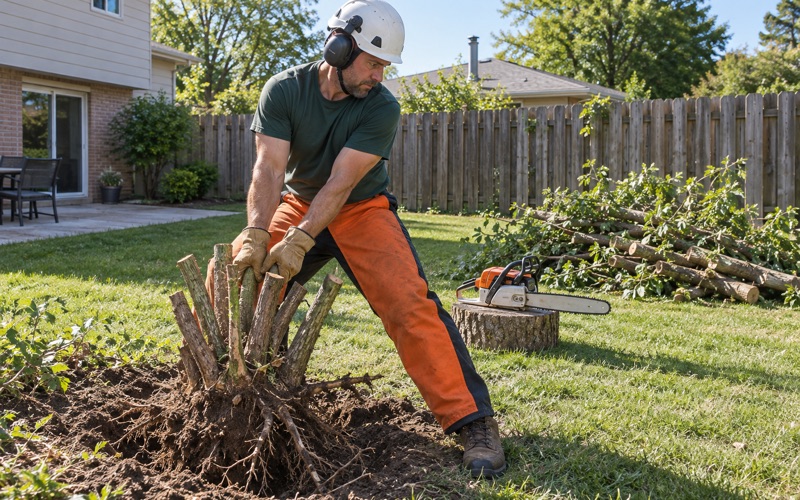
A pulled stump comes out of the ground as a root ball packed with soil and stone, and the commercial gate that would take the wood turns it away. Grindings have no such problem. That is the practical case for grinding a stump rather than dragging it out, and it is settled before the machine starts: grindings backfilled into the hole or hauled off with the rest, whichever you want.
The curb will not absorb it
Curbside collection is built for a homeowner’s Saturday, not for a removal. Leaves and grass “must be bagged and not more than 50 pounds per bag,” and “Tree limbs must be tied in bundles not more than four feet long and less than 50 pounds. Limbs must be 4 inches or less in diameter.”
Almost nothing off a mature oak or hickory meets that description. Every stick leaves with us instead.
- 20+ Years in Johnson County
- Insured, Proof Sent First
- Free On-Site Assessment