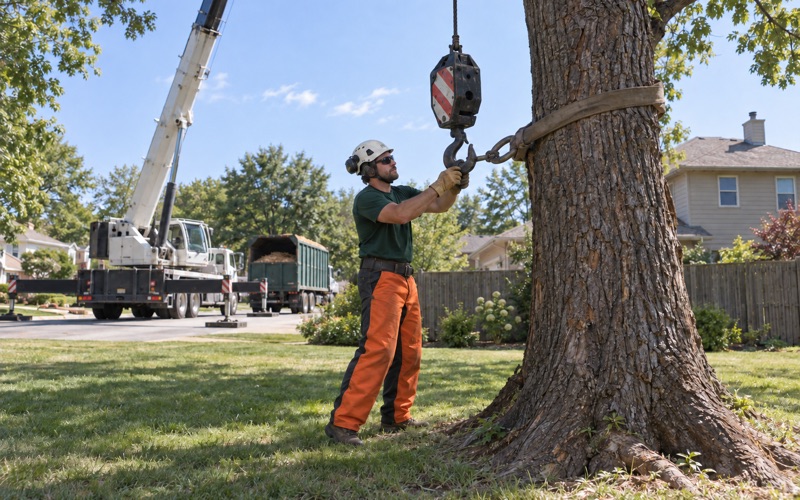
Shawnee Tree Removal has handled emergency tree removal in Kansas City for more than twenty years, and the first thing we pin down on a call here is the address rather than the city. This is one municipality whose boundary crosses four county lines, carries two separate electric operating companies, and sits on three different kinds of ground.
That stops being a technicality the moment a tree is down. Which side of the city you are on decides who you call about a conductor. Which part of the city you are on decides whether a stump grinder meets soil or stone. Which county you are in decides which authority stands behind the parcel, even though the city code is the same one everywhere.
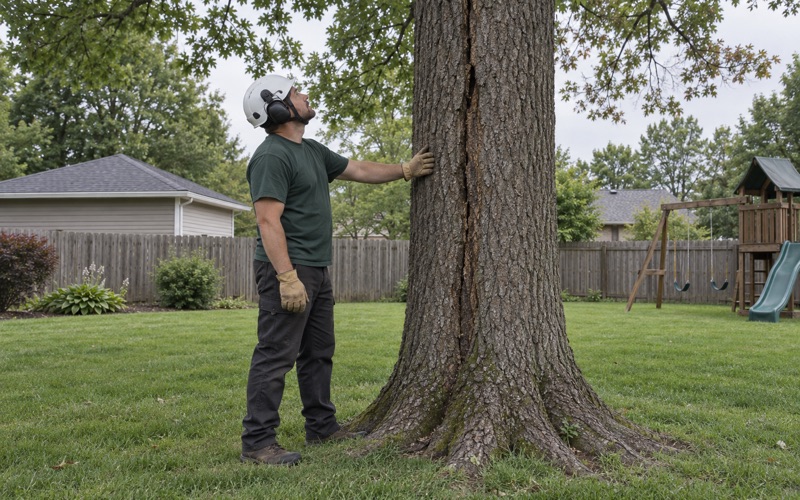
So we work the address, not the name. The on-site assessment is free, what we find goes into a written condition assessment you can hand to an adjuster, and the figure we say out loud is the figure that appears in writing. When a tree is on a roof, a car or a service line, we respond the same day.
One city, four counties, and a warning that covers half of it
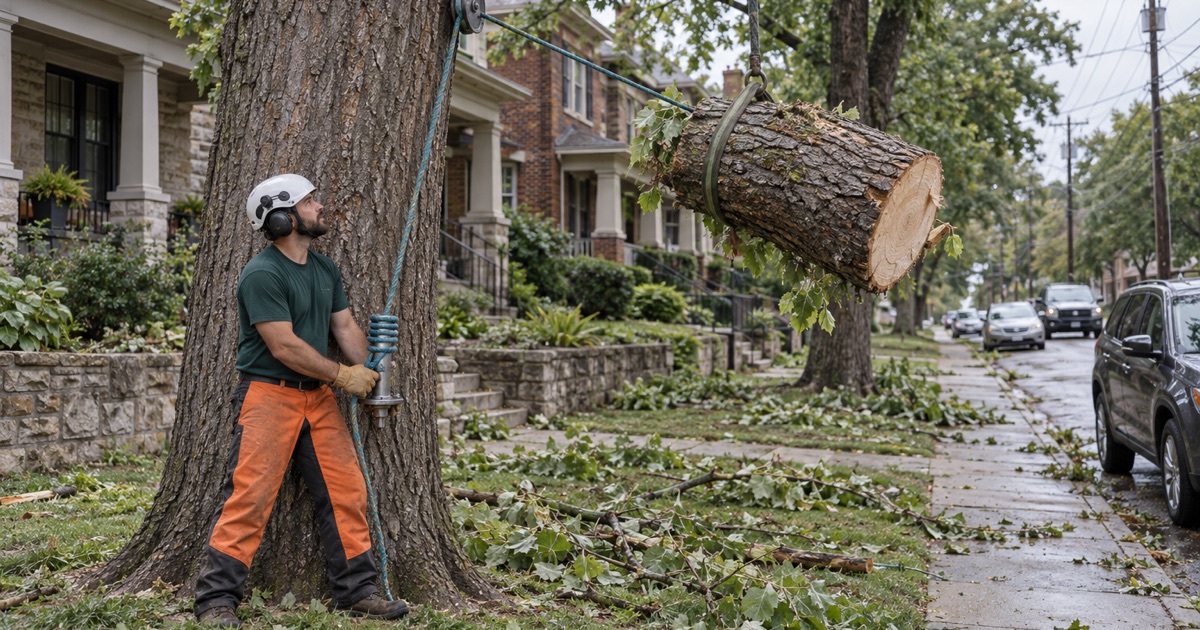
The city limits run across Jackson, Clay, Platte and Cass Counties. One address carries one city code and one of four county authorities behind it, which is why a caller who tells us only that they are in Kansas City has told us less than they think. It is a great deal of ground to be a single city: 245,346 published housing units spread across 314.515 square miles.
The National Weather Service divides it as well. A point query at the city centroid returns forecast zone MOZ037 with Jackson County zone MOC095. A point inside the Clay County portion, a few minutes north of that, returns MOZ029 with county zone MOC047. Both sit under the Kansas City/Pleasant Hill office, and a warning can be in force over part of this city while the rest of it is under nothing at all.
Which storm crossed your zone changes what we look at first
The local office’s own event record reads as convective wind and ice rather than as tornado season. It titles the July 14, 2023 event a wind storm through Kansas City with widespread power outages, roughly 200,000 customers out. It records a May 19, 2024 squall line crossing into Platte, Jackson and Clay with four brief tornadoes, and the February 5 to 7, 2019 ice storm at one-eighth to one-quarter inch accretion.
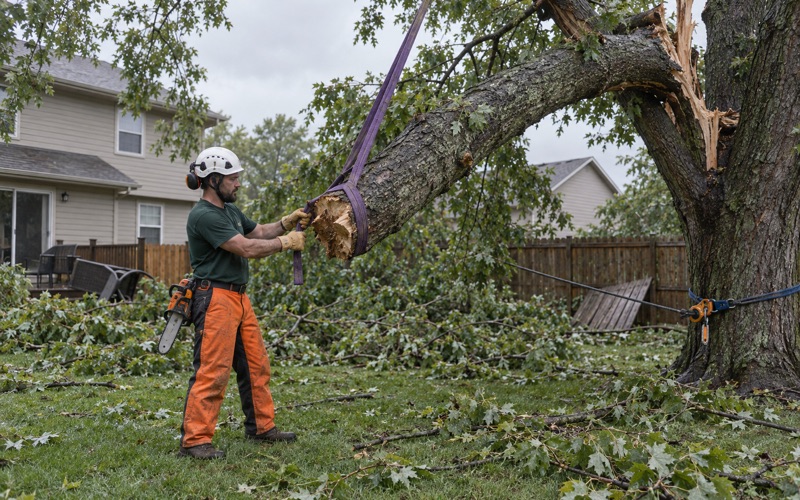
Straight-line wind and ice break trees in different places. Wind splits co-dominant stems where included bark has kept the union from ever knitting, and tears limbs out past the drip line. A quarter inch of ice loads an entire crown at once and finds heartwood decay, old topping wounds and the epicormic sprouts that grew out of them.
Looking for tree-removal closer to Gardner? See Tree-Removal in Gardner.
Which Evergy company feeds your meter, and what that decides
The Missouri Public Service Commission’s utility locator lists this city twice. “Kansas City (All Except Eastern)” is shown with electric service from Evergy Missouri Metro; “Kansas City (Eastern)” is shown with electric service from Evergy Missouri West. That is a reading of the state commission’s locator rather than anything the city itself publishes, and it is the most useful thing on this page to settle before you need it. Gas is Spire Missouri, Inc. and water is municipal across the whole boundary.
Both Evergy entities are investor-owned operating companies, and that fact decides a legal question that gets answered wrong all over this market. RSMo 537.340.3 defines an “electric supplier” as a chapter 394 rural electric cooperative, a cooperative-plan corporation, or a chapter 91 municipally owned electric power system. An investor-owned electrical corporation matches none of those three.
So the fourteen days’ notice before a utility removal at 537.340.2(6), and the written right at 537.340.2(7) to demand that a partially trimmed tree be removed at the supplier’s expense when it dies within three months, do not attach at any address inside these city limits. Property owners hear about those rights from relatives on cooperative lines and reasonably assume they travel. Here they do not.
The line from the pole to your meter is yours
Evergy puts the boundary in one sentence: “Vegetation impacting the line that runs from a pole to your meter are the customer’s responsibility.” That service drop is the conductor a limb most often ends up lying across after a storm, and it is the one nobody is dispatched to clear for you. We scope service drop clearance as its own item and leave everything upstream of the meter to the utility.
The trim cycle here is on file, twice
Missouri regulates investor-owned vegetation management at 20 CSR 4240-23.030, under which each utility files an annual report. The cycle, the miles scheduled and the clearance guideline are therefore public record rather than rumor. Because two different operating companies serve inside one city limit, two separate filings cover this city, so a street cleared last year and a street across town still waiting is a real difference rather than a complaint.
Three kinds of ground under one municipal boundary
Point queries against the EPA’s Level III and Level IV ecoregion service, run in the same pass as a control point that correctly returned the Flint Hills, place three different Level IV ecoregions inside these city limits. The centroid falls in 47d, Missouri Alluvial Plain, because the Missouri River runs through the middle of this city rather than around it. The Platte County portion near the international airport returns 47f, Rolling Loess Prairies. A point in the southern part of the city returns 40c, Wooded Osage Plains, which belongs to a different Level III region than the other two.
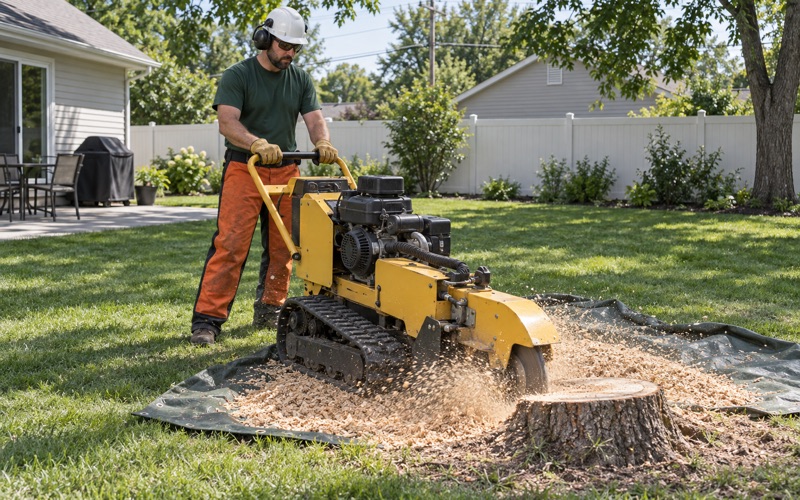
In working terms that is deep river alluvium in the bottoms, wind-laid loess on the bluffs and the northern uplands, and limestone-and-shale bench country to the south. The difference announces itself as soon as a tooth wheel drops below the root flare.
Only one of the three is where stone is likely
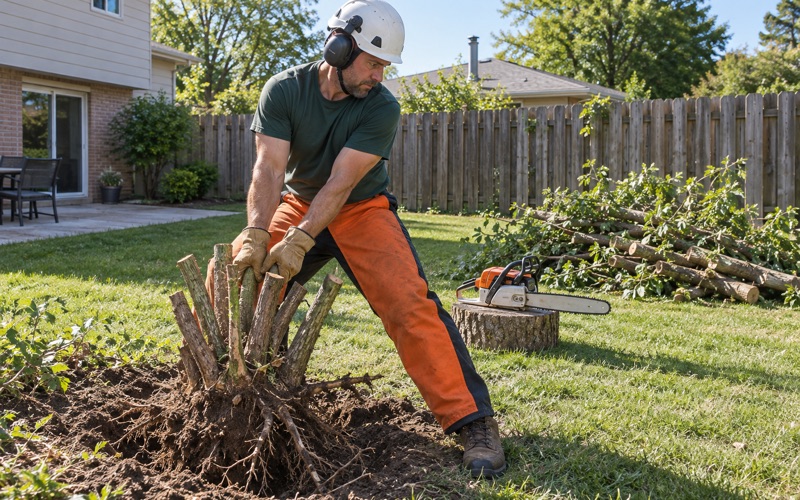
The southern bench is the one part of this city where rock plausibly reaches a grinder inside its rated cut. In the bottoms and on the loess the limiting factor is usually the root plate and whatever fill somebody buried decades ago, not stone. That is a tendency and not a promise, and which soil series is mapped under a specific address is not something this build established, so we do not commit to a below-grade cut depth on a stump we have not stood over. The depth arrives with the rest of the written figure, after the assessment.
Missouri One Call before the wheel turns
Every stump we grind and every root collar excavation we open begins with a locate through Missouri One Call at 1-800-344-7483. In a city where 21.31 percent of the housing stock was built in 1939 or earlier, a larger cohort than any whole decade since, what is buried in a parkway strip is regularly not where memory puts it.
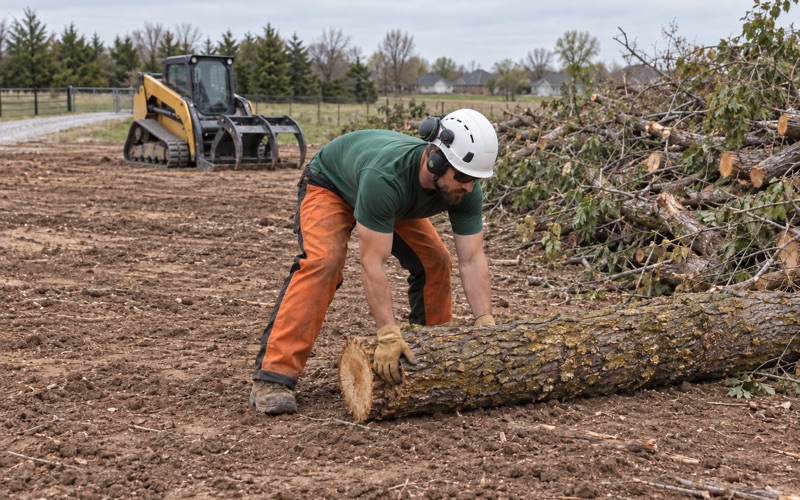
Where the wood and the grindings go is settled before the saw leaves the truck. RSMo 260.250 keeps yard waste out of a Missouri solid waste disposal area, which is why every outlet in reach of this city is a composter, and composters here commonly refuse stumps arriving with dirt and rock attached. That is a plain reason grinding beats pulling on a finished lot, and every stick leaves with us either way.
What to have ready when you call us about a Kansas City tree
Order matters more in a four-county city with two electric suppliers than it does anywhere with one of each. A conductor on the ground, a conductor arcing, or a limb bridging conductors is 911 first, then the electric utility’s outage line, and the line you want depends on whether that address is served by Evergy Missouri Metro or Evergy Missouri West. The city does not operate the electric system and cannot de-energize anything, so a live wire reported to 311 spends time you do not have.
311 is exactly right for the other half of the problem. A tree blocking a public street, a limb over a public sidewalk, or a tree the city may own goes there. The city’s own guidance is that residents request a removal through a 311 request, that the City Forester reviews it and recommends next steps, and that where a sidewalk block is identified for repair the trees on that block are inspected by the Parks and Recreation Forester’s Office.
On a finished lot there is no permit to wait for
No tree removal permit exists for a private tree on a finished, previously platted single-family lot in this city, and no diameter threshold sits above which a homeowner needs approval. The threshold that circulates online under this city’s name comes from the code of a different Missouri municipality entirely and appears nowhere in the ordinance here. What Kansas City adopted, as Ordinance No. 220961 passed in March 2023, lives in Chapter 88, the Zoning and Development Code, and it is a development rule: land disturbance of an acre or more, development and project plans, special use permits and preliminary plats, and building permits disturbing more than 10,000 square feet. Storm work is exempted in its own words, as removal “due to storm damage, accidental causes, or to ensure public safety when pruning is impractical, as determined by the city forester.”
Where the ordinance does bite, it asks for a signature
On a commercial or subdivision job the plan and its certification come before the permit rather than after it, and the code names who may sign one: an SAF certified forester, an ISA Certified Arborist, a professional landscape architect, or a professional engineer registered in the State of Missouri. Neither Missouri nor Kansas issues any license for tree work, so on a development site inside this city that named signature, and not a state card, is what the permit turns on. We will tell you which of those a job needs and where it fits in the sequence.
What shows up at the address
Proof of insurance reaches you before a crew sets foot on the property. We do not top trees, whatever the tree looks like and whoever else has offered to, and where cabling and bracing or a crown reduction keeps a sound tree standing we price that work instead of a removal and show you the union or the decay that made the call. Across 111,217 owner-occupied one-unit detached houses in this city, most of what we do is one tree at one address, answered from what we checked there.
- 20+ Years in Johnson County
- Insured, Proof Sent First
- Free On-Site Assessment