Shawnee Tree Removal has been doing tree removal in Lansing for more than twenty years, and the first thing we look at on an address here is not the tree. It is the year the house behind it went up, because in this city those two dates are usually the same date.
Very little about a removal here is an access problem. Lots are generous, subdivision streets are wide, and a chip truck can usually park within a rope’s length of the trunk. What we are working against instead is a calendar: a whole planting cohort that went in behind the builders is reaching failure age at once, on blocks where the houses are all the same age too.
That changes what a useful quote looks like. We walk the lot, tell you which trees are on that schedule and which have years left in them, and hand you a figure in writing at the end of the walk. The assessment itself costs nothing.
The trees coming down here were planted with the houses
The current five-year ACS estimates put 28.93 percent of every housing unit in Lansing in the 1980s alone, and 58.26 percent of the stock between 1980 and 2009. Two-thirds of the city, 67.12 percent, postdates 1980 entirely. Those are the years in which a builder finishes a street and then plants it, which is why the trees on a given block tend to share a birthday with the roofline behind them.
The shape of the ground reads the same way. There are 3,723 housing units spread over 12.3 square miles, roughly 303 to the square mile, and 84.31 percent of them are one-unit detached houses. That is a landscape of individual yards holding individual yard trees, put in three or four to a lot inside one decade, rather than a remnant canopy that a subdivision was cut into.
One old corner, and it is small
Lansing does have older ground. 413 units, 11.09 percent of the stock, were built in 1939 or earlier, and on those blocks the mature-canopy story is the true one: heavy trunks, real heartwood decay, root plates that have been under pavement for eighty years.
That is a corner of the city and not the city. Advice written for an old canopy is simply wrong on the two-thirds built after 1980, and advice written for young subdivision stock is just as wrong on the pre-war blocks. We read the block you actually live on before we say anything about what your tree is likely doing.
Looking for tree-removal closer to Eudora? See Tree-Removal in Eudora.
What a builder plants, and how it ends
A 1980s planting is forty to forty-five years old now, with the 1990s and 2000s cohort close behind it. That is the age at which the species chosen for cheapness and speed stop being an asset and start being a liability with a due date on it.
Callery and Bradford pear is the plainest case. The K-State Research and Extension Master Gardeners brochure for metropolitan Kansas City is blunt about it, stating “DO NOT plant Bradford cultivar; severe splitting occurs on 10-15 year old trees,” and that is a Johnson County Extension document written for this metro rather than a Leavenworth County publication. A pear planted the year a street was finished has been through that window three times over.
The same brochure states the rule underneath it: “Many fast growing varieties are brittle with narrow crotch angles that can lead to severe breakage during storms.” A narrow crotch angle means co-dominant stems with included bark pressed between them, which is a seam rather than a joint. Trees built that way do not shed a limb, they come apart down the middle.
The screen row that outgrew its spacing
The conifer screens set along a new rear lot line went in six to eight feet apart, against species that reach seventy feet. Four decades later that spacing has produced a row of thin, one-sided trunks propping each other up, and taking one out is a rigging problem rather than a felling problem, because the two beside it were relying on it.
The pines and spruces planted for that same job have their own endings. Pine wilt nematode takes Scotch and Austrian pine outright, and Rhizosphaera needle cast strips a Colorado blue spruce from the bottom up across several seasons. Neither one is a storm event, and both leave a dead screen standing on a property line where it is visible from the street.
The weather this particular ground gets
The National Weather Service places Lansing in forecast zone KSZ103, county zone KSC103, served by the Kansas City/Pleasant Hill office. That is a different zone from the Johnson County and Wyandotte County zones to the south, so a wind advisory or an ice accretion forecast issued for it was written for this ground rather than borrowed from the metro core.
Nobody on our crew works a tree near an energized conductor during a thunderstorm, a high wind, or a snow or ice storm, which is what clause 4.1.16 of the ANSI Z133-2017 safety standard requires. When a tree is on a roof, a car or a service line you get us the same day, and when a conductor is involved the utility gets the call before we do.
Wide lots, manufactured ground, and what sets the price
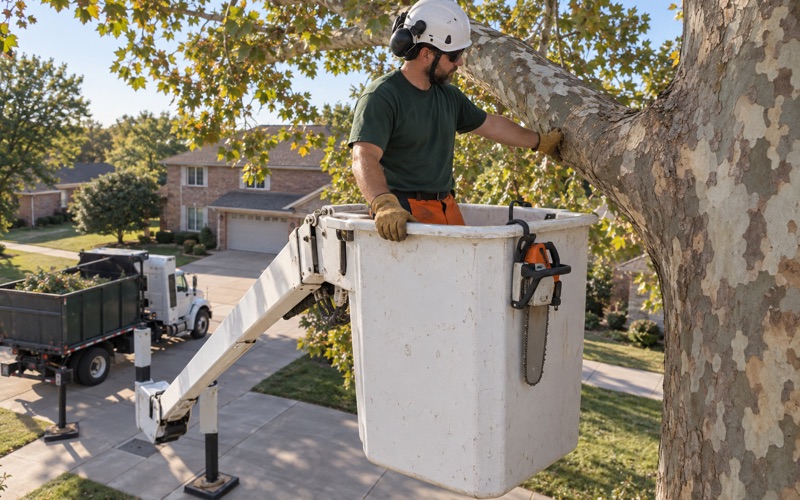
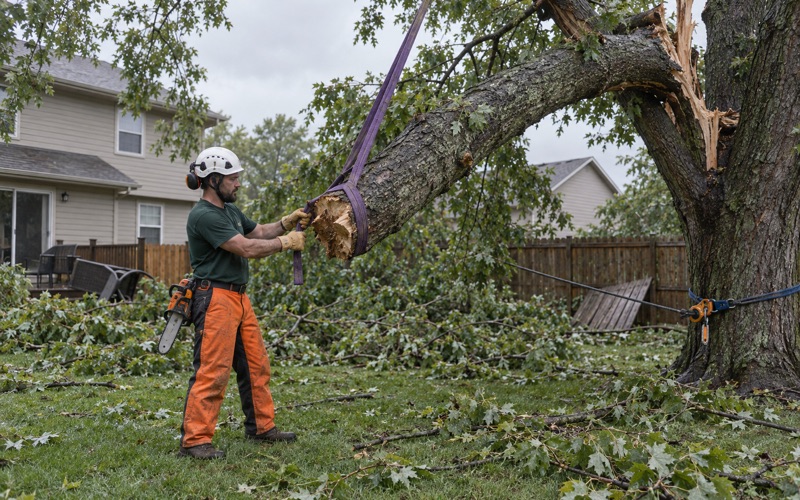
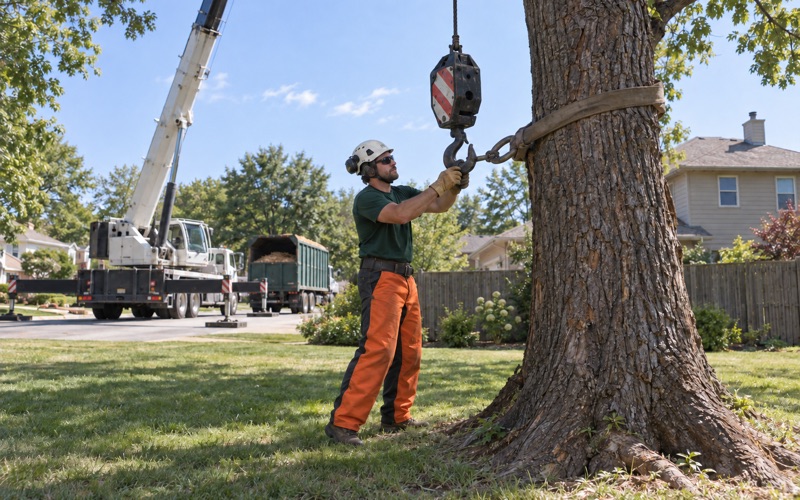
Because access is rarely the constraint here, the quote is driven by the volume of wood and where it has to go rather than by how far it has to be carried. A driveway that will take the weight of a chip truck, a front yard that will take crane outriggers on mats, and a rear gate that actually opens: that is the ordinary case in this city, and it is why crane-assisted removal is often the cheaper method rather than the exotic one.
What is not ordinary, and what nobody can see from the curb, is the ground underneath. With 58.26 percent of the stock built between 1980 and 2009, a large share of these lots sit on subdivision grading, which means imported fill, a compacted subgrade, and a topsoil layer that was stripped and put back rather than left where it formed.
No soil survey describes a graded lot
The series this landscape draws on run deep. The USDA-NRCS description of Pawnee, formed in till, is written to 203 centimeters with no bedrock and gives “Rock fragments: 0 to 5 percent by volume”; Kennebec, a silty alluvium, publishes “Depth to carbonates–more than 200 centimeters” and no bedrock either.
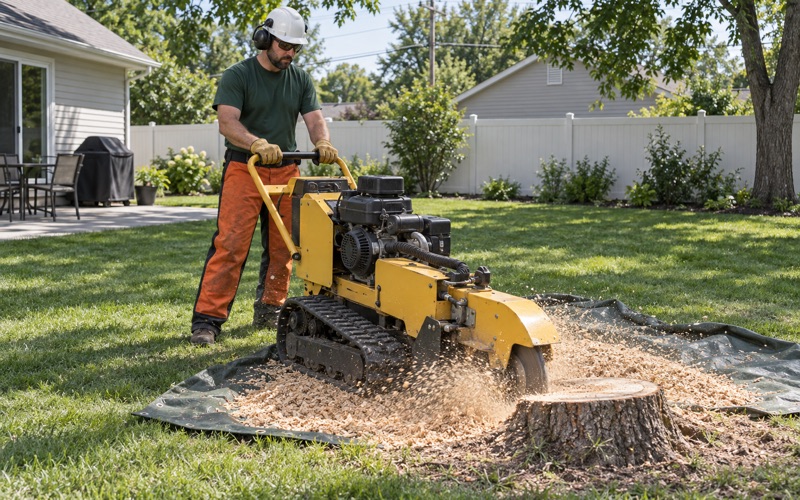
Which is mapped under your parcel is a question we have not answered, and on a lot whose profile was manufactured in the middle of a building decade the survey is describing something that is no longer there. So we will not promise you a grinding depth on a stump we have not stood over. The machine’s own stop is what usually limits the cut on this ground, but buried construction rubble is not a thing anyone predicts from a map.
Kansas 811, and the three lines it will not find
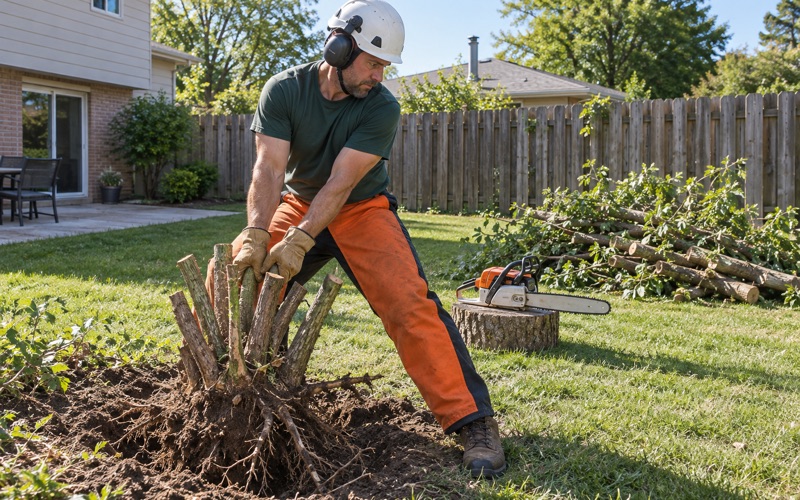
Kansas 811 gets called before the tooth wheel touches anything, without exception. On a subdivision lot that call is the start of the conversation rather than the end of it, because irrigation laterals, low-voltage landscape lighting and invisible-fence wire are none of them locatable utilities, and no locator is going to mark them.
The homeowner is usually the only person who knows where that trenching went, often because they watched it happen. We ask about all three before we grind, and you hear where the wood and the grindings are going before the saw comes out of the truck.
The nearest public gate is not in this city
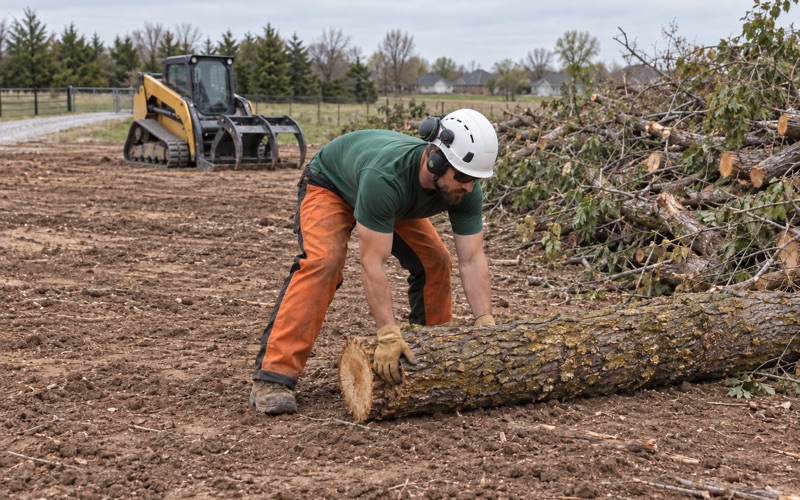
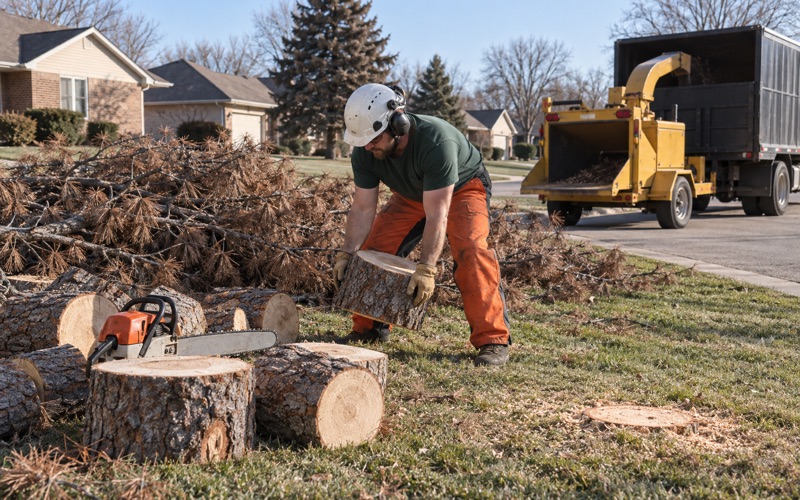
Everything we cut leaves with us, and nothing gets stacked at a curb waiting on a truck that is not coming for it. That matters here, because the nearest public outlet is the Leavenworth County Transfer Station at 300 Walnut Street in Leavenworth, open Monday through Friday from 8:00 a.m. to 5:00 p.m. Brush is accepted there for a fee, and the published rule is that “Brush does not need to be bundled but must be free of trash and processed wood.”
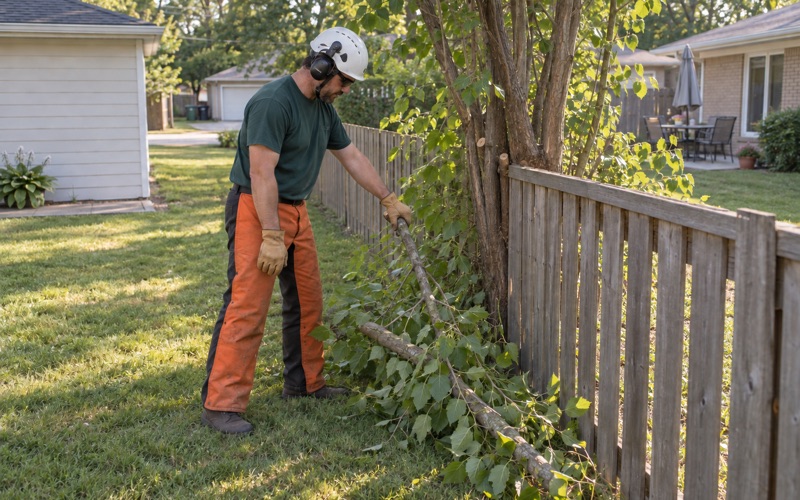
Worth knowing if you are handling a small job yourself: the other brush gate in that area is restricted to one city’s own residents and to loads that originated inside that city. A load leaving a Lansing address fails both of those tests.
The 30-day letter, and what goes back in the hole
The deadline homeowners in this city are actually working against is not an abatement process, it is a letter. Under Lansing Ordinance No. 1143, upon notice from the code official the owner shall remove the dead or dying tree or other plant material so specified within 30 days from legal notice. That clock starts when the notice is served, not when you start collecting quotes.
If that letter is on your counter, call the day it arrives rather than in week three. We will look at what was cited, tell you whether it is one tree or the whole screen row, and put the condition assessment in writing in a form you can hand back to the code official or to an adjuster.
What we can and cannot tell you about the city’s rules
No tree removal permit for private property is published by the City of Lansing on any page we have been able to reach. We are not going to dress that up as a reading of the ordinances, because the official code host and the city’s own site have refused every request we made for the text. The Lansing Tree Board advises the Governing Body on trees in public spaces, which is not a permit authority over the tree in your back yard, and City Hall sits at 800 First Terrace.
On licensing the city is explicit, and it names this trade by name. Its New Business Guide states that “By City Ordinance, Arborist/Tree Trimming and Lawncare businesses are also required to obtain a Business License,” and the City Clerk handles it at 913-727-3036. That is a City of Lansing business license and nothing more, because Kansas issues no trade credential for tree work of any kind, so anybody claiming a state one is describing something that does not exist. Proof of insurance reaches you before a crew sets foot on the property.
What to plant back, and how close to the wires
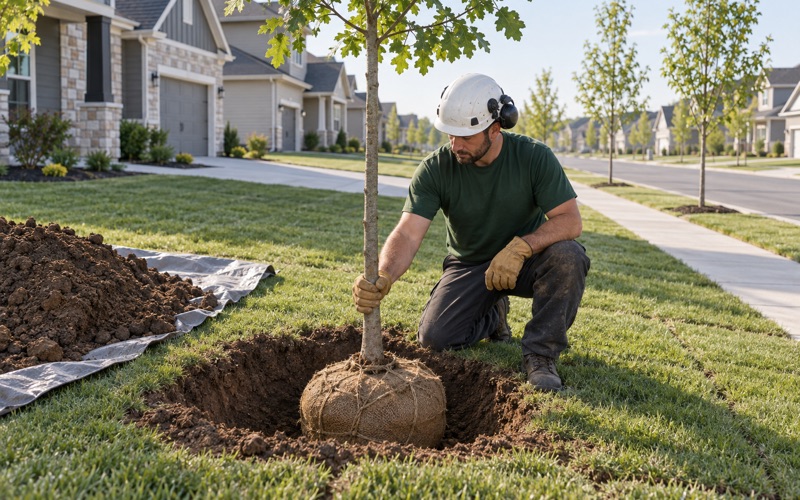
The replacement conversation is where a removal on this kind of lot earns its money, and there is a sourced number for the hard part of it. “Preferred Trees for Northeast Kansas”, published by the Kansas Forest Service with K-State Research and Extension, the USDA Forest Service, the Kansas Nursery & Landscape Association and the Kansas Arborists Association, states that “Trees with mature height 20 feet or less can be used within 15 feet on either side of utility lines.” The same guidance notes that “Multi-stemmed forms are more likely to be damaged from snow, ice, or wind,” which is the short version of the pear that just came out of your yard.
Away from the wires the field is wide open, and the natural model for this ground is not a secret. The EPA’s published potential natural vegetation for this ecoregion is upland forest dominated by shagbark hickory, bitternut hickory, red oak, white oak and black oak, with Ohio buckeye, American bladdernut and pawpaw common in the understory. Those are slower trees than a builder would choose, and the ones still standing when the roofline behind them gets replaced.
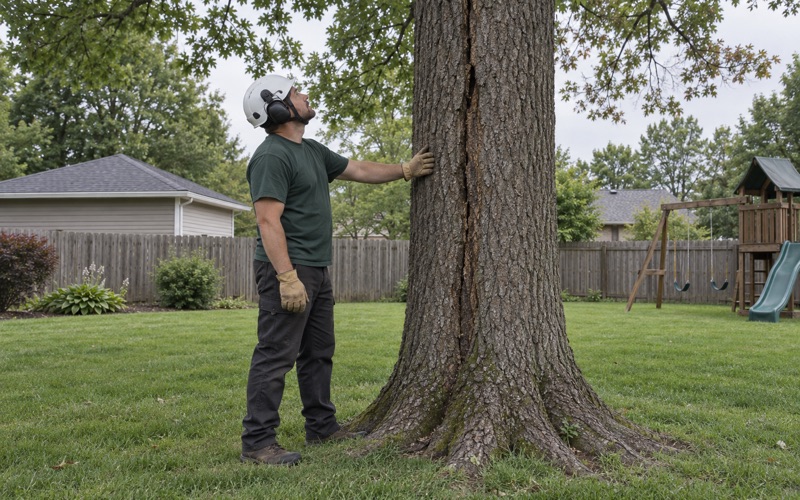
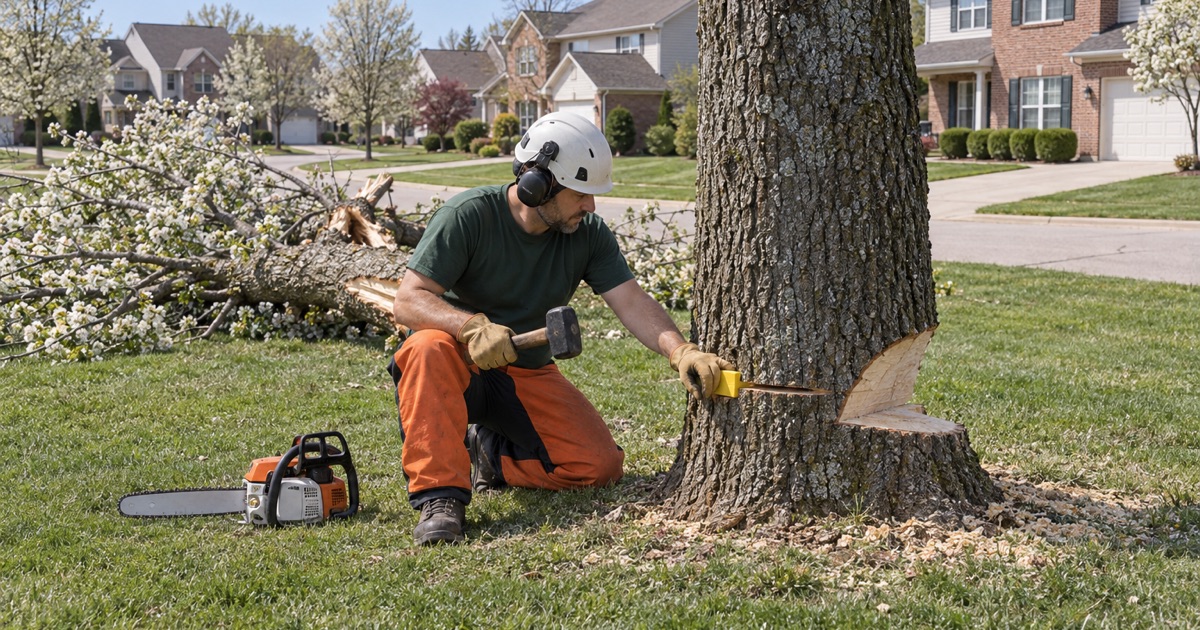
Not every tree on a 1980s lot has to come out, either. Where cabling and bracing across a split leader, or a structural pruning cut made in time, will keep a sound tree standing, we price that work instead and show you the reasoning behind it. We do not top trees, for anyone, at any price.
- 20+ Years in Johnson County
- Insured, Proof Sent First
- Free On-Site Assessment