Shawnee Tree Removal has been taking trees down in Leavenworth for more than twenty years, and this is the one city on our map where the first question worth asking is not about the tree at all. It is about the crew. Leavenworth licenses the people who hold the saw, and the city keeps a public list you can read before anyone parks a chip truck at your curb.
That reverses the usual arrangement in this metro. Neither Kansas nor Missouri licenses tree work at the state level, so almost everywhere else a homeowner has nothing official to check a company against. Here there is a filed application, an insurance certificate on record with the City Clerk, and an annual renewal date that either has been met or has not.
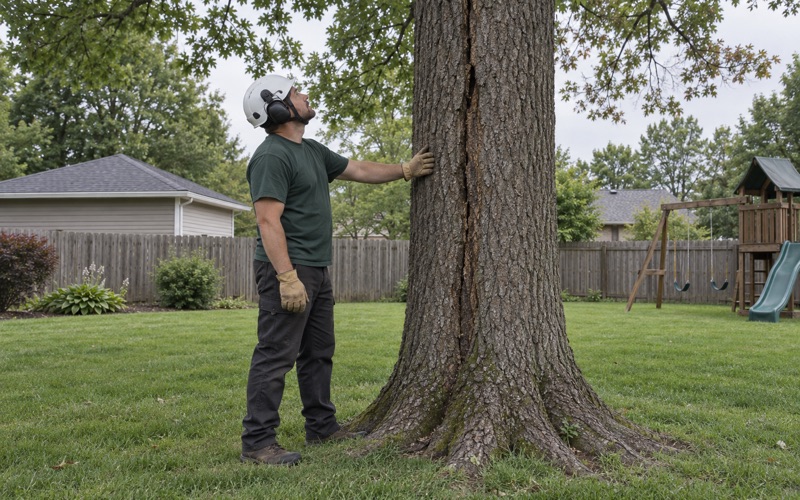
What that changes for you is practical rather than ceremonial. You get a free on-site assessment, a written condition report you can hand to a neighbor or an adjuster, and a figure that does not move between the driveway and the invoice. Proof of insurance reaches you before we set foot on the property, and we tell you where the wood and the grindings are going before the first cut.
The city licenses the crew, and the list is public
The City of Leavenworth publishes the requirement in plain words: “Any person or business trimming or cutting trees in the City is required to obtain a license and provide proof of insurance.” The City Clerk maintains a Licensed Tree Trimmers listing that anyone can request, from the Office of the City Clerk at 100 N. 5th Street, 913-682-9201. That single document is why a compliance conversation here starts with who is doing the work instead of with what is being cut.
What has to be on file before the license issues
The license is issued under the Code of Ordinances, Chapter 12 Businesses, Article X, at $50.00 new and $50.00 to renew. Before it issues, the applicant files a certificate of liability insurance from a company authorized to do business in the state, carrying $1,000,000.00 per occurrence for bodily injury or property damage and $2,000,000.00 aggregate.
The certificate has to be written a particular way, not merely exist. Its description of operations must include the words “tree trimmer” and must state that “City of Leavenworth its assigned, affiliates and officers are additional insured on a primary and non-contributory basis,” and the policy must provide that the city is notified of any change or cancellation.
What the list tells you, and what it does not
Every tree trimmer license in the city expires February 28th of each year, fees paid are not prorated, refundable or transferable, and a lapse in coverage suspends the license until current insurance reaches the City Clerk. So a name on that list is a statement about paperwork and a live policy on a particular date, and nothing more than that.
The city says as much itself. Its listing page carries the disclaimer that it “does not constitute an endorsement of such licensees or a representation as to their services, the quality or cost thereof, or availability,” and warns that license status may change without the page catching up. A filing tells you nobody is working uninsured; it tells you nothing about rigging discipline, and nothing about whether the outfit quoting you intends to top your tree. We do not top trees, and if somebody offers to, we will show you on your own trunk what that answer costs you later.
Looking for stump-grinding closer to Lee’s Summit? See Lee’s Summit Stump-Grinding.
When the city’s tree rules reach your lot, and when they do not
The instrument people expect to find here is Sec. 6.09 Tree Preservation in the Development Regulations, revised in 2024, and its own applicability sentence settles most questions before they start: “The standards in this subsection shall be applied during review of any development or building permit application.” No development, no building permit, no Sec. 6.09 review. An owner taking a failing tree off a finished lot is not filing anything with the city over the tree itself.
Two things are worth saying carefully. The section also states that nothing in it requires a property owner to keep a dead or dying tree, while a middle sentence about the Director determining a tree’s status carries no development qualifier of its own; both readings sit on the page, and we will not sell you either one as settled. There is also no city forester and no tree board here, so the authority the section names is the Director of Planning and Community Development.
Significant trees, and replacement counted in inches
Where a permit does put the section in play, a significant tree is one of at least 24 inches caliper deciduous or 18 inches evergreen, and those “shall be preserved to the maximum extent feasible.” When one cannot feasibly stay, replacement is by total caliper inches replanted on the same site, and the regulation supplies its own worked example: remove a 24-inch caliper sugar maple, replant 24 total caliper inches.
The Director can reduce that where site limitations prevent full replacement, but “This reduction may not exceed 50 percent of the total caliper inches removed.” On a lot carrying a building permit that arithmetic is a cost line, which is why it belongs in the conversation before a machine moves rather than after.
Fencing is dimensioned, and one clause buys a document
Tree protection fencing under Sec. 6.09(F) is specified rather than left to judgment. It “shall extend at least one foot in distance from the edge of the tree for each inch of Diameter at Breast Height (DBH) to a maximum of ten feet, but in no case closer than five feet to the trunk,” standing at least four feet high in plastic mesh or chain link at the drip line, inspected and approved before any land-disturbing activity begins.
Encroachment into that root zone is allowed “only in rare instances,” and then the regulation requires that “Written verification is prepared by a qualified arborist of the tree’s condition before and after the encroachment.” That is a separate purchase written into the code, and it is not the same document as the plain-language condition assessment we hand you with a quote.
The eight historic districts, where a healthy tree can be protected
Historic property is the one place in Leavenworth where a tree can be protected with no development project attached to it. Development Regulations Article 9, in the section titled Retention of Accessory Structures and Landscaping, says that “Existing characteristics such as trees, walls, stairs, paving materials, fencing, walkways, and other site features that reflect the landmark’s or district’s significance shall be retained and protected from demolition or alteration,” and adds that landscaping shall be appropriate to the scale and feature of the landmark or district.
The route through it is a review rather than a refusal. The city publishes that “Any proposed changes to a property listed on the National or State Historic Register, within a registered Historic District, or a Local Landmark requires a state law review and/or issuance of a Certificate of Appropriateness,” citing the Kansas State Preservation Statute, K.S.A. 75-2724, with the Leavenworth Preservation Commission taking Major and Minor certificates at a meeting held the first Wednesday of the month at 6:00 p.m. as needed. Eight districts and neighborhoods carry that status: Downtown, Arch Street, North Esplanade, South Esplanade, North Broadway, Union Park, Third Avenue and the Historical Industrial District.
Ask the city about that section by its title rather than by its number. The adopted 2024 document numbers it 9.17 in the body text and 9.18 in its own table of contents and running headers, and the offset continues through the rest of Article 9 — a small thing that turns one phone call into two.
Where the wood goes, and what the street map does to a quote
Three refusals at the city brush site
The City of Leavenworth Brush Site at 1803 S 2nd Street takes branches for a fee and takes whole trees only on conditions: “Trees must be free of dirt and less than 12 inches in diameter, no roots or root systems still attached.” Leaves and grass clippings go in free, while household waste and construction material are refused outright.
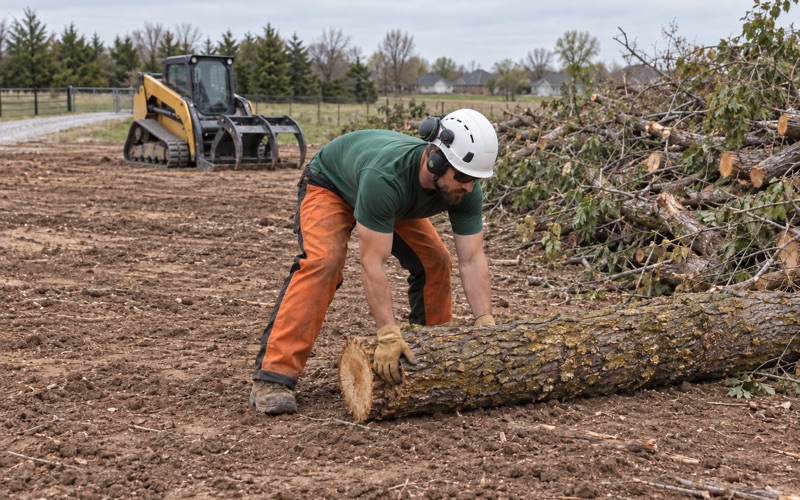
Read those together and three refusals shape the price of a removal — a diameter cap, a no-root-systems rule and a dirt-free rule. The butt log off a mature shade tree and a grubbed root plate have no home at that gate at any price, so where they go is decided before a number reaches you. Every stick leaves with us either way; nothing is stacked at a curb the city will not collect.
Access there is proof-based, and cash only
A resident shows proof of a current City address, either a photo ID or a utility bill. A contractor instead shows “proof that the load is from the City of Leavenworth such as an invoice or work order,” which is a paperwork step a homeowner never sees and a crew plans around. Fees run by vehicle class, from $2.00 for a car or van and $5.00 for a pickup up to $15 for a flatbed or single axle and $25 for a dual axle or chipper, cash only, with no bills larger than a twenty accepted.
Hours narrow in winter, and that matters for storm work. The site runs Tuesday through Saturday, 8 a.m. to 4 p.m. from March through November with the last drop-off taken at 3:50 p.m., then Saturdays only from December through February.
Mixed housing, and the chipper is the limit
This is not a uniformly old city or a uniformly new one, and the citywide average is not a working number for anybody. About 27.79 percent of the housing stock predates 1940 and 62.19 percent predates 1980, yet 37.81 percent of it went up after 1980, and 33.19 percent of all units are attached, multifamily or mobile rather than one-unit detached.
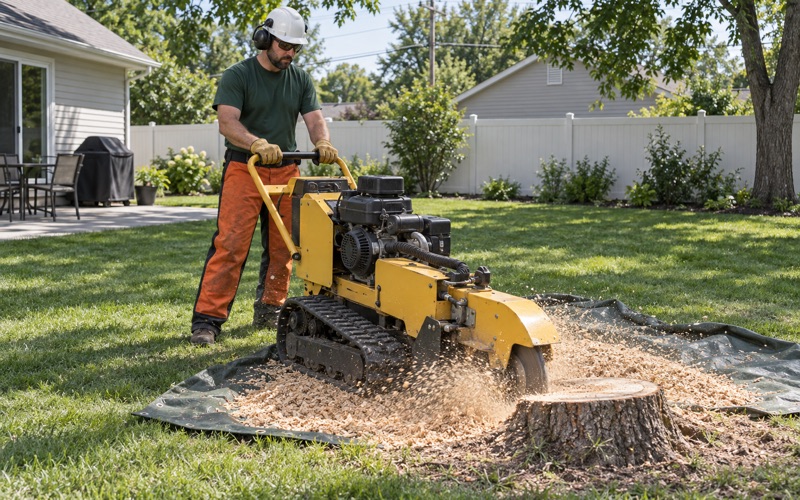
That last figure is the one that moves a bid. Shared drives and common-wall setbacks are where brush handling and carry distance decide the number, because a compact grinder in the narrow-access class still passes a 35-inch gate and a pedestrian-gate machine passes 25 inches, while a full-size chipper never goes through a gate at all. Kansas 811 gets called before any grinding, every time, and we will not name a below-grade cut depth until the locate flags are in the ground.
One forecast zone, and it belongs to this city
Leavenworth sits in NWS forecast zone KSZ103, published under the zone name Leavenworth, with county zone KSC103, served by the Kansas City/Pleasant Hill forecast office. That is a different zone from the ones covering the counties to the south, so a wind advisory or an ice accretion forecast issued here was written for this ground rather than borrowed from the metro core.
We read those advisories the way the ANSI Z133 safety standard asks us to, since it forbids work near energized conductors during thunderstorms, high winds, snow storms or ice storms. When a tree is on a roof, a car or a service line we respond the same day, and the first call on a downed conductor goes to the serving utility rather than to us.
- 20+ Years in Johnson County
- Insured, Proof Sent First
- Free On-Site Assessment