Shawnee Tree Removal has been handling tree removal in Leawood for more than twenty years, and the work here starts with a question that has a legal answer rather than an aesthetic one: where exactly is the trunk standing, and has a clock already started running on it? Leawood writes more of its tree ordinance as a deadline and a flat prohibition than as a form to file. Two separate sixty-day windows and one outright ban shape what an honest removal quote in this city has to contain.
That changes the estimate before anything is climbed. The stump grind sits inside the scope of the removal here rather than being a line you can defer to spring, and reduction by heading cuts is not something we will price at any address in this city. When somebody else offers to top a tree instead of taking it down, we will walk you through the cuts and show you why the offer is worth less than it sounds.
Our on-site assessment costs nothing, and the number we say out loud is the number that reaches you in writing. Proof of insurance lands with you before a truck parks at the curb, and we tell you where the wood and the grindings are going before the first cut. If cabling and bracing or a real pruning plan keeps the tree standing, that is what we price instead.
Topping a street tree is an offense here, not a style choice
Municipal Code 13-406 does not discourage topping, it forbids it: “It shall be unlawful for any person, firm or entity to perform Tree Topping or otherwise to top any Street Tree.” Section 13-401(b)(g) defines the practice tightly enough that there is nothing to argue about — reduction using heading cuts that leave stubs, shortening limbs or branches to a size not large enough to assume a terminal role. What grows back out of those stubs is epicormic sprouts anchored in wood that has already started to decay, which is the whole reason the prohibition is written the way it is.
Whose tree the ordinance is talking about
A Street Tree in Leawood is “any tree with any portion of the trunk within the right-of-way,” under 13-401(b)(e). On an ordinary residential street here the right-of-way commonly runs well behind the curb, so the tree a homeowner has always read as theirs is frequently the city’s business, with the adjacent landowner or homes association named as the Responsible Party who has to deal with it. We establish where the trunk actually sits before we quote, because a removal on that side of the line runs through a right-of-way permit and a replacement plan.
The exemption exists, and it is narrow
The Superintendent of Parks can exempt a tree severely damaged by storms, or one growing under utility wires “where other pruning practices are impractical.” That is something a city official grants, not a default a crew can assume on a Saturday morning. Everywhere else, the honest options are crown cleaning, crown raising, a genuine reduction made with natural target pruning, or the removal itself.
What you still owe on the tree you keep
Section 13-407(a) puts a standing pruning duty on the owner: clear space of 10 feet above the surface of the sidewalk and 14 feet above the surface of the street at the curbline. Section 13-407(b) is broader still, requiring the owner to remove all dead, diseased or dangerous trees and any broken or decayed limbs that constitute a danger to the public. Enforcement under 13-407(c) runs on a ten-day notice cycle, and the penalty at 13-413 is a fine of not less than $100.00 nor more than $1,000.00, with each day a violation continues counted as a separate offense.
Looking for tree-removal closer to Riverside? See Riverside Tree-Removal.
Two sixty-day clocks, and they start on different events
Leawood puts a hard date where most cities put a recommendation. Section 13-410 is a single sentence: “All stumps of Street Trees shall be removed below the surface of the ground within 60 days of tree removal.” It fixes the timing and the direction without naming a depth, which is the correct reading of it — the code wants the stump under the surface, not a number on an invoice.
The stump clock starts the day the tree comes down
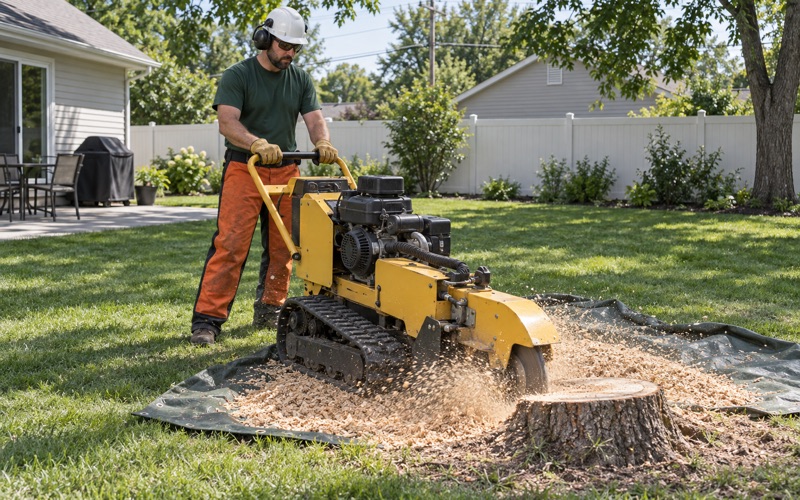
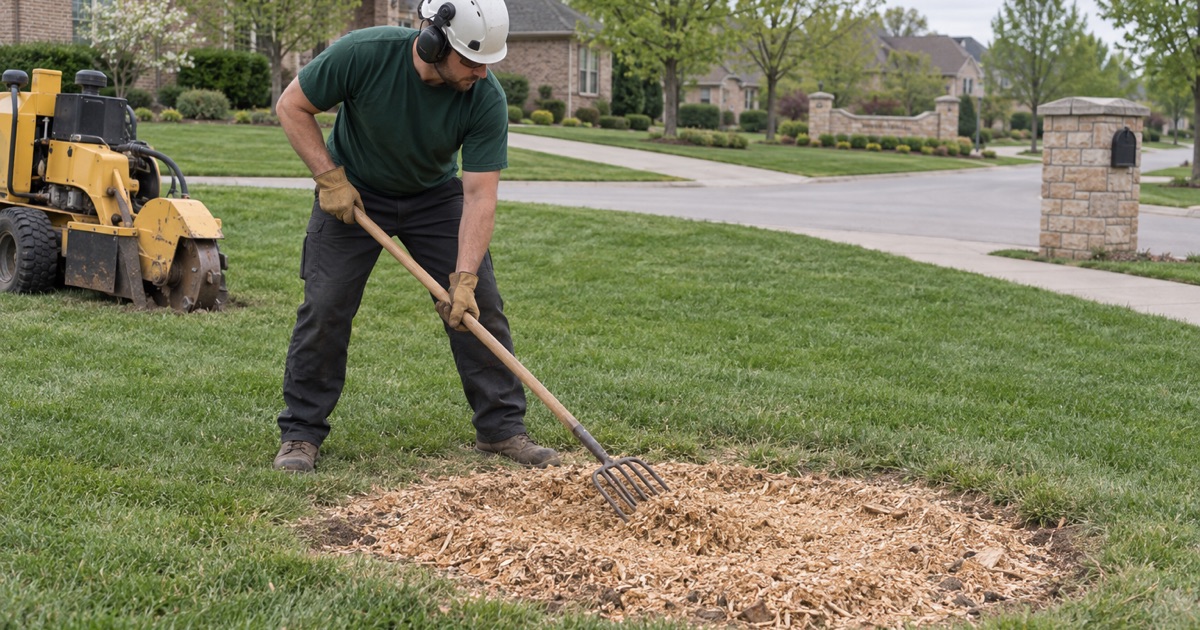
Because those sixty days run from the removal and not from any notice, the grind belongs to the same job rather than to a decision revisited later in the year. We schedule it against the takedown, and we book the 811 utility locate before the tooth wheel goes anywhere near the root flare. A stump left standing proud of the grade in October is a violation by the first week of December, and each of those days counts on its own.
The other clock starts at a mailing date
Section 13-408 reaches inside the lot lines. Where a dead or diseased tree on private property constitutes a hazard to life and property, or harbors insects or disease threatening other trees, the city notifies the owner in writing, and “Removal shall be done by the owners at their own expense within 60 days after the date of mailing of such notice.” The postmark is the start of it, not the day the envelope gets opened.
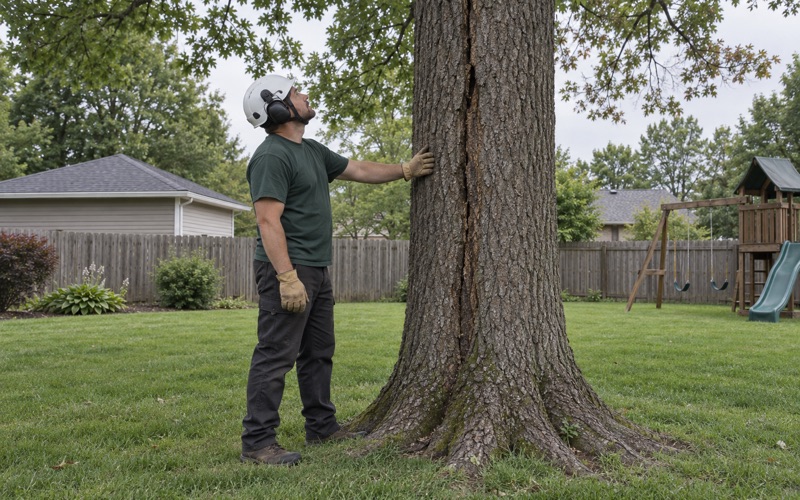
Section 13-409 is what happens when those sixty days pass: the city may do the removal itself and certify the unpaid cost to the County Clerk for the tax roll. If a letter like that has arrived, the first thing you need is a written condition assessment rather than a verbal opinion, with the defects named — heartwood decay, a conk at the base, a compromised root plate — in a document you can hand to a neighbor or an adjuster. Where the tree is defensible we will put that in writing just as readily.
What actually decides how deep a stump can go on your lot
Machine width is a width class, not a capability class
The number that decides whether a grinder reaches your back yard and the number that decides what it does once it gets there are unrelated to each other. At an identical 35-inch working width, a Vermeer SC552 is rated to cut 25 inches under the surface and a Rayco RG37 to 12. Add the SC552’s dual-wheel option and the same machine measures 56 inches across, while the SC802 — largest above-ground cut in its line at 35 inches — is 79.8 inches wide and fits through no residential gate at all.
A crew that has answered “will it fit” has therefore not answered “what will it do,” and on the large detached lots common here, where the drop zone and the setback bind long before the side yard does, those two questions come apart quickly. We tell you which machine is coming and what it is rated for before you sign anything.
The soil is the other half of the answer
The loess-derived soils across much of this part of the metro are deep. Knox carries depth to carbonates greater than 180 centimeters and Sharpsburg greater than 150, both far past anything a grinder is rated to reach, so on those the machine’s own stop is what binds first.
The residual series formed over eastern Kansas’s interbedded limestone and shale behave nothing like that. Vinland is classified “Loamy, mixed, superactive, mesic, shallow Typic Hapludolls,” with solum thickness and depth to bedrock of 25 to 51 centimeters — roughly 10 to 20 inches — and the USDA describes it as extensive in eastern Kansas; there the rock stops the wheel every time. Oska sits at 51 to 102 centimeters to bedrock over residuum derived from limestone and shale, which brackets the machine rather than beating it outright.
Which series is mapped under any particular Leawood address is not something we will guess at from the curb, so we promise no figure sight unseen. Residuum is likeliest to show on the ravine shoulders along Tomahawk Creek and the Blue River, and that is where we plan for the wheel to find rock. What we do commit to is the code’s own standard: the stump finishes under the surface, inside the window.
The ground under Leawood is not the ground next door
Oak woodland and prairie, not the cuesta
An EPA point query places this city in Level IV ecoregion 40c, the Wooded Osage Plains, inside Level III region 40, the Central Irregular Plains. The same layer returns 40b, the Osage Cuestas, for points in the cities immediately north and west of here, and the EPA’s own potential natural vegetation for 40c reads “Little bluestem-sideoats grama prairie, big bluestem-Indiangrass prairie, cordgrass wet prairie, and oak woodlands.” That is oaks and grassland, not the mixed hardwood and understory list the agency attaches to the region next door, so species copy written for the cuestas describes the wrong place at this address.
A first-cycle city, whatever the plat date suggests
Leawood was platted in 1937-38 according to the Johnson County Historic Resources Survey, and that date misleads nearly everyone who quotes it, because the city was built out with the outer ring rather than the post-war inner one. In the ACS 2020-2024 five-year estimates, 33.90 percent of the housing stock predates 1980, against 57.99 percent built between 1980 and 2009 and 8.11 percent since 2010, with 2000-2009 the largest decade at 21.26 percent. Only 16.18 percent went up before 1960, and that small north end is the one part of the city where an older tree population is the norm.
The rest of Leawood is a first-removal-cycle city. At 91.03 percent owner-occupied, 83.97 percent one-unit detached, and 11,135 owner-occupied single-family detached houses, the tree we are usually called to take down was planted with the house and is now roughly 25 to 45 years old — old enough for co-dominant stems and included bark to have turned into a failure, young enough that nobody was expecting it yet.
The Johnson County K-State Research and Extension Master Gardeners brochure “Recommended Landscape Trees for Metropolitan Kansas City” is the local authority on why, and its bridging line is blunt: “Many fast growing varieties are brittle with narrow crotch angles that can lead to severe breakage during storms.” It refuses silver maple for weak wood, pin oak for soil issues, green ash for emerald ash borer, and box elder, Siberian elm, Lombardy poplar, willow and Bradford pear outright — “DO NOT plant Bradford cultivar; severe splitting occurs on 10-15 year old trees.” Those are the species we are called out to most often, and they are the ones the brochure told the builders not to plant.
Where the wood and the grindings end up
Leawood runs no city collection and no municipal yard-waste gate, and the curb rule at 15-403(e) is tight: “Tree limbs less than four inches in diameter and brush shall be securely tied in bundles not larger than 48 inches long and 18 inches in diameter when not placed in storage containers.” Almost nothing off a removal fits inside that. Every stick leaves with our crew instead, and you will know which private composting gate it is bound for before the saws come out, so no part of the job ends as a pile at a curb nobody will collect.
- 20+ Years in Johnson County
- Insured, Proof Sent First
- Free On-Site Assessment