Shawnee Tree Removal has been doing stump grinding in Lee’s Summit for more than twenty years, and the question that opens most of those calls is whether the city has to sign off before the grinder comes off the trailer. On a finished residential lot, it does not. Nothing stands between a property owner here and the stump in their own back yard except scheduling and a utility locate.
That is worth saying flatly, because this city does have tree provisions and they are real. They simply do not attach to ownership. Nothing here regulates a tree because it is a tree — what triggers the paperwork is disturbing ground, and the only place in the ordinance where a rule could ever reach a tree for its height is a zoning overlay the city wrote over the public airfield it owns.
So the work of a stump job in this city is not a trip to city hall. It is the locate window, the ground under the stump, and a straight answer about where the grindings and the wood finish up. The on-site assessment is free, and the number we give you standing in the yard is the number that goes in writing.
Do you need a permit to grind a stump in Lee’s Summit?
No. The tree provisions in the Unified Development Ordinance sit on the development side of the book rather than the property side, and they are triggered by land disturbance rather than by who owns the tree. A homeowner taking out a dead pin oak in a finished back yard is not the person those sections were written for.
They live in Article 8, Subdivision 2, titled “Landscaping, Buffers and Tree Protection Plans, Installation and Maintenance,” running from Section 8.720 to Section 8.780. The grouping tells you most of what you need before reading a word of the text: tree protection is filed alongside landscaping and buffers, as part of what a site plan has to show a reviewer.
The rule that bites here is about grading, not cutting
Section 8.740 is titled “Tree conservation plan,” and its trigger is the moment ground is opened. A plan goes to the Department before a site is graded, bulldozed or otherwise stripped of existing vegetation where a protected area is affected, and a companion standard puts a floor of three inches of caliper on newly planted trees. That is an activity trigger rather than a possession trigger.
We treat the exact wording as something to confirm against the printed ordinance rather than recite, because the city’s online code reader is not dependably reachable. On a builder’s parcel that distinction is the entire job. On a finished yard it never comes up.
One acre, and where the state’s own permit starts
The city operates its own Land Disturbance Permit, and that is the document a clearing job here actually answers to. At one acre or greater the Missouri Department of Natural Resources may require a separate land disturbance permit in addition to the city’s — two agencies, two files, one site.
So the first questions we ask a builder are acreage and grading sequence, not tree count. A lot-clearing quote and a single-stump quote in this city are governed by different bodies of rule entirely.
For most addresses none of that is live. Owner-occupied households make up 73.41 percent of occupied units, and 27,250 of them are one-unit detached houses — the largest owner-decided pool of yards on this side of the metro. In nearly all of them, the person who decides the tree comes out is the person standing next to it.
One vegetation standard does reach a private yard, and it is a lawn rule rather than a tree rule: Neighborhood Services, at 816-969-1200, enforces a ten-inch standard on weeds and plant growth. Height is regulated in this city — just not the height of a tree.
Looking for tree-removal closer to Platte City? See Tree-Removal in Platte City.
The airport the city owns, and the overlay written over it
Lee’s Summit owns a public-use airport. In the FAA’s own record it is Kansas City/Lee’s Summit Regional Airport, identifier LXT, with the City of Lee’s Summit at 220 SE Green listed as owner of record. It is no longer “Lee’s Summit Municipal Airport,” and a contractor page still using that name is repeating something nobody has checked in years.
That ownership is why a height question can exist here at all. Missouri never passed a general statute handing airport zoning to cities, so a Missouri city’s airport overlay exists only where that city adopted one under its ordinary zoning power at RSMo 89.020. Lee’s Summit did: the Unified Development Ordinance carries an Airport Hazard Overlay District at Article 5, Overlay Districts, Division I.
We describe it as exactly that and no further — an overlay a city adopted over its own airfield. We have not read the text, so we will not tell a homeowner near the field that a back yard tree falls under it, and we will not quote a figure out of a document we have not seen. Whether a particular parcel sits inside the overlay is a question for planning staff at the site plan stage, not something a tree crew settles at the curb.
For a stump already on the ground, none of it changes anything. It is worth knowing anyway, because knowing where a rule stops is as useful to an owner as knowing where it starts.
What actually changes about grinding a stump here
Missouri 811 comes first, and its two windows do not agree
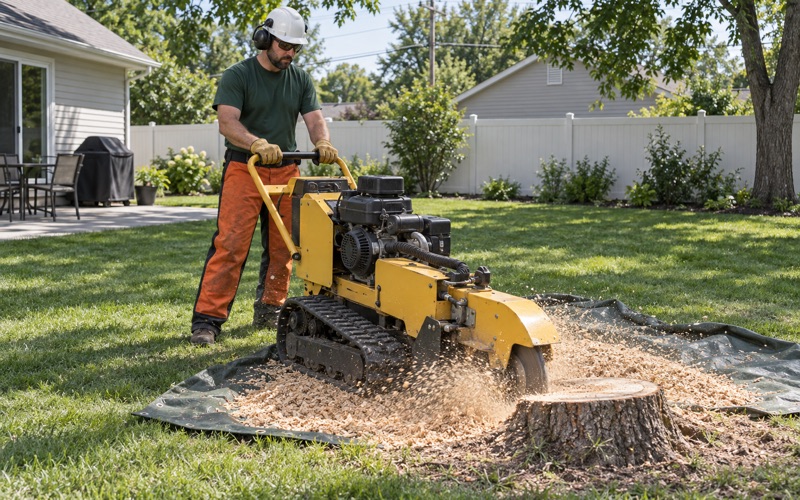
Grinding is excavation, and Missouri law treats it as such. RSMo 319.026 sets the notice to Missouri 811 at no fewer than two working days and no more than ten working days before the work begins, while Missouri 811’s own site asks for at least three full working days. The two do not line up, so we schedule to the longer request and stay inside the statutory ceiling.
The legacy number, 1-800-DIG-RITE, still reaches it. The locate is not a formality on a stump: a stump tends to sit exactly where an irrigation line, a gas service and a low-voltage run converge, and the wheel works below the surface where none of them can be seen.
The ground under a Lee’s Summit stump
These are deep loess and loess-over-residuum soils. The Sibley series, whose USDA typical pedon is placed in Jackson County, Missouri, carries a solum of typically 50 to 60 inches, with 30 to 35 percent clay through the upper twenty inches of the argillic horizon. On undisturbed ground a grinder runs out of travel long before that profile runs out of soil.
Because these are silt loam over silty clay loam rather than cherty profiles, there is no rock story to tell here and no dramatic wear on a tooth wheel. What loads the machine in this city is clay, and what moves the job week to week is water: the same stump behaves differently after a wet stretch than it does in a dry September.
One profile in the association is shallow enough to change the answer. Snead reaches a paralithic contact at 20 to 40 inches over gray shale, shallow enough that the shale is what the wheel finds first. That is the exception, and it is why we set the depth on site with the stump in front of us rather than over the phone.
The footprint, and what happens to the grindings
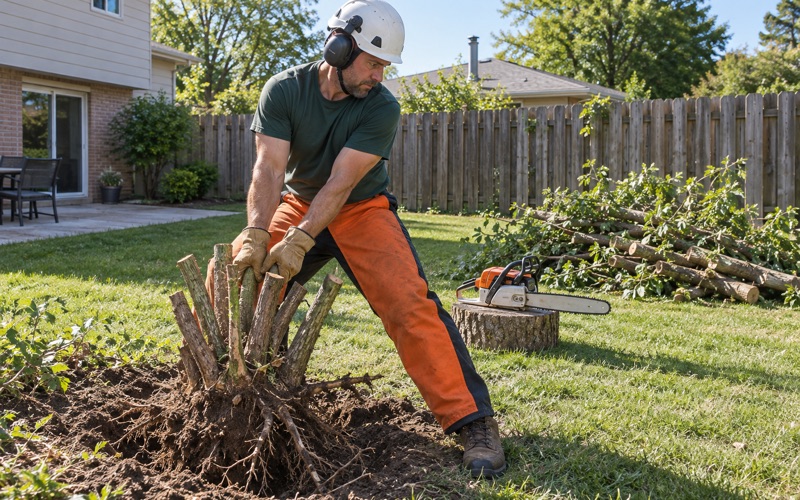
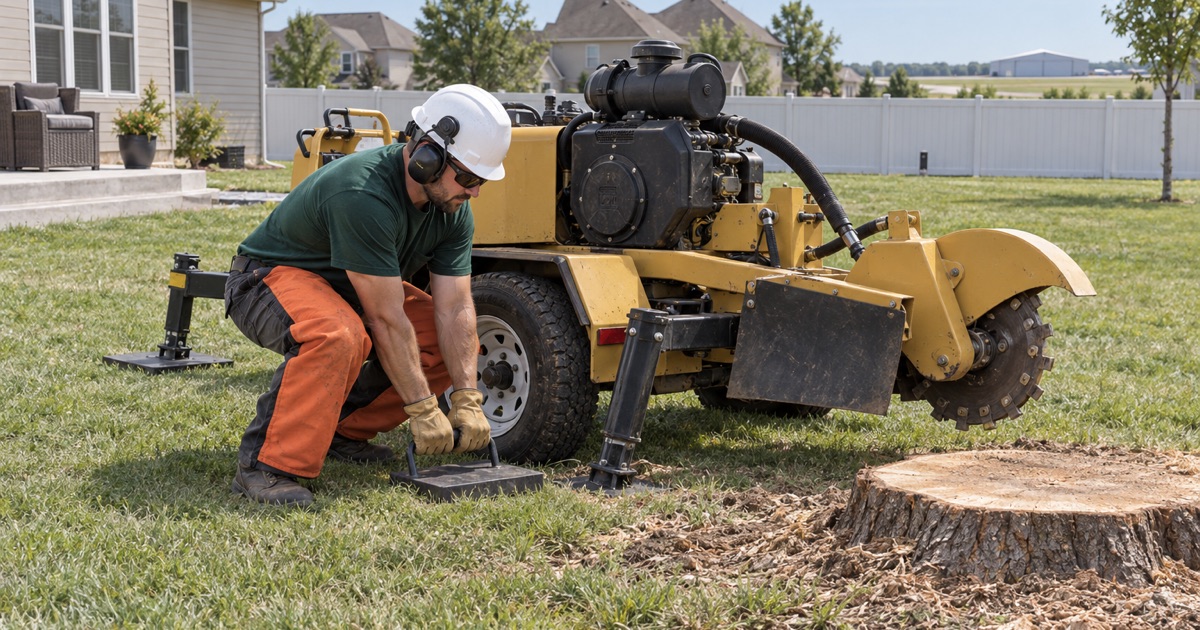
A stump is the visible part of a root plate, and the flare spreading out from it is usually wider than an owner expects. We agree the footprint before starting — how far past the flare we take material, whether surface roots running toward a walk are taken out as well, and what the finished grade should look like when the crew leaves. The grindings are a decision too: back into the hole, where a fresh mound settles noticeably as it breaks down, or onto the truck, which is what most people want if they are about to sod or reseed.
What we settle before quoting a Lee’s Summit stump
Where the grindings and the wood actually go
The city runs its own Resource Recovery Park on SE Hamblen Road — public disposal, household hazardous waste and yard waste — and there is no fee for Lee’s Summit residents. Unusually for this metro, contractors are not shut out of it. They are priced, on a published schedule.
That schedule runs by volume and by vehicle rather than by weight: bags at $2, $6.50 per cubic yard, pickup loads priced by whether they are level or heaped over the cab, trailers by length, then chip trucks, tandem axles and roll-offs. No gate we have found anywhere in this area prices yard waste by the ton. We are deliberately not printing a street number for the park — the city and operator schedules give one address and the regional directory gives another, and the two have never been reconciled.
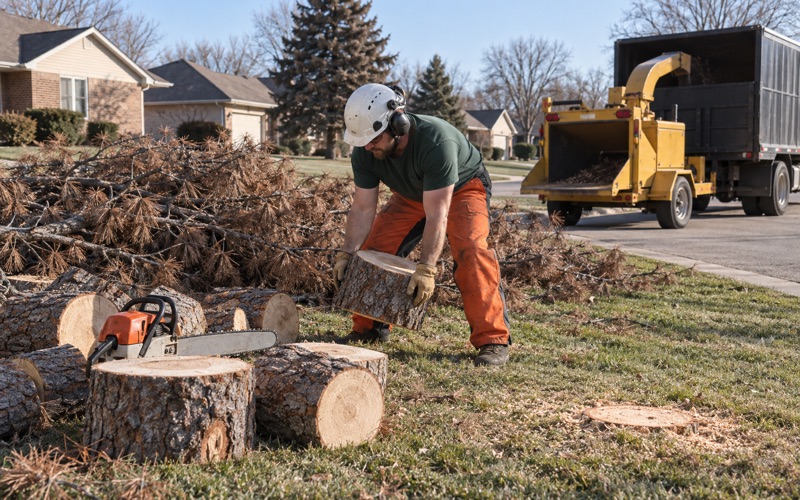
The effect is that the take-the-wood-or-leave-it conversation is honest arithmetic here rather than a trap. A resident hauling their own limbs pays nothing at that gate; a crew hauling the same material pays a quotable line item by vehicle. We tell you which of those we are doing before we start, and every stick leaves with us instead of waiting at a curb for a collection that was never coming.
One geographic note matters at the southern edge of town: roughly 97.46 percent of the city’s land area sits in Jackson County and 2.54 percent in Cass County. Two jobs three miles apart can sit behind different county answers on disposal and on permitting.
Whether the tree should come out at all
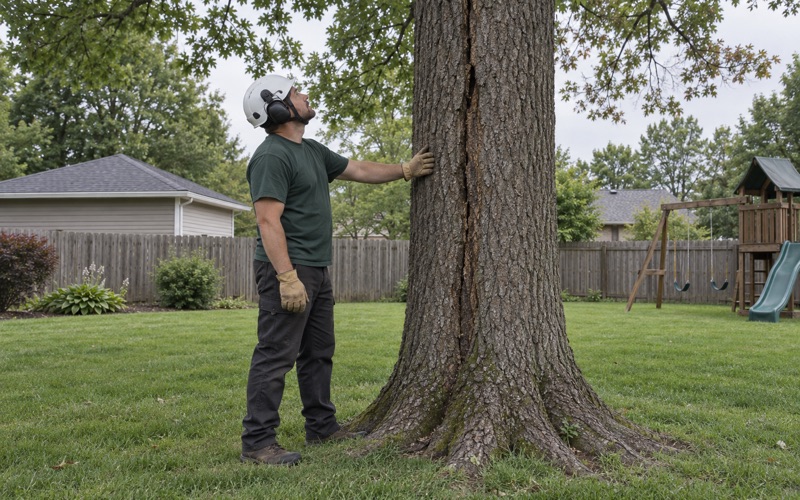
Where a tree is still standing and the real question is removal rather than a stump already down, we work from thresholds that have a Missouri owner. University of Missouri Extension’s G6867 asks whether at least 50 percent of the crown is still intact, and says that with more than half the crown gone the tree has lost its survival edge.
The same publication holds that a 2- to 3-inch wound on a 12-inch diameter limb will seal over, and that bent trees and branches larger than 6 inches in diameter should be handled by someone with more experience. Numbers that circulate in this trade with nobody’s name behind them stay out of our assessments. If cabling or structural pruning buys the tree another decade, we say so and price that instead of a removal.
The credential question, and what reaches you first
There is no Missouri tree-work license to check. The state issues no license or certification for this trade, and Kansas does not either, so a license number is not the thing to screen a company on. What does exist is ISA certification, current general liability coverage and workers’ compensation.
Proof of insurance reaches you ahead of the truck rather than being produced at the curb, and the condition assessment comes to you in writing — a document you can hand to a neighbor or to an adjuster, not a figure on the back of a card. Missouri and Kansas answer the neighbor’s-tree question differently, and at a Lee’s Summit address it is Missouri’s answer that applies.
- 20+ Years in Johnson County
- Insured, Proof Sent First
- Free On-Site Assessment