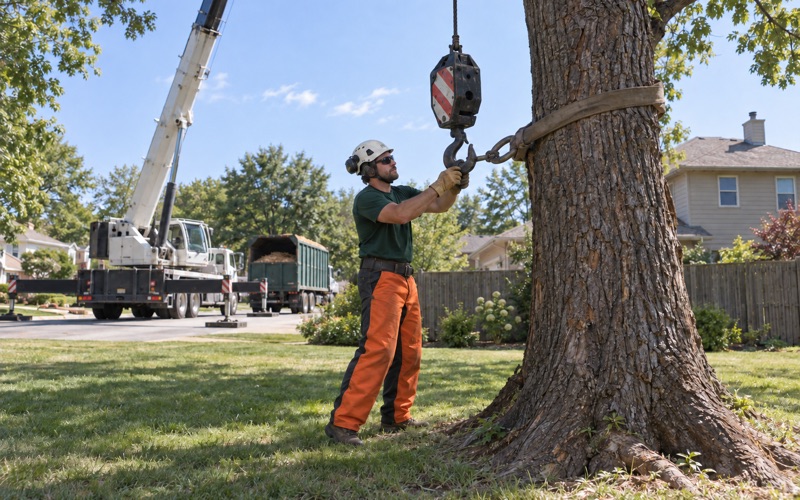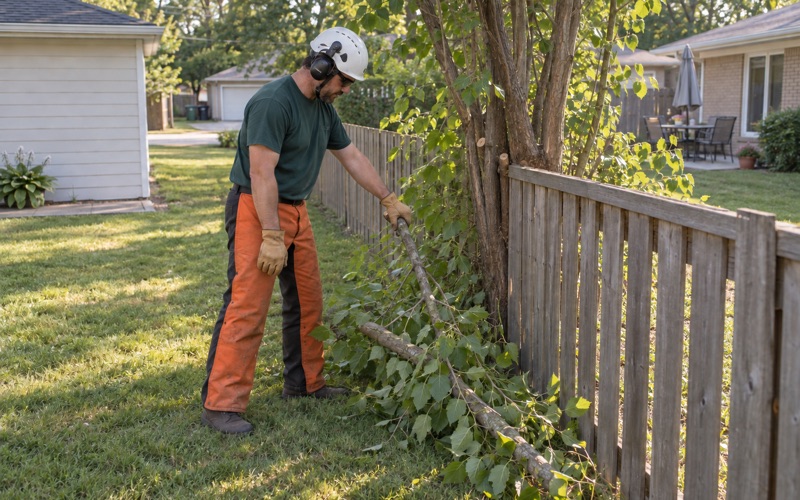
Shawnee Tree Removal has been handling tree removal in Lenexa for more than twenty years, and the job here starts with something most homeowners never hear: the tree giving you trouble at the curb was almost certainly not chosen by anyone who has ever lived in your house. It was selected by the City, planted by the City, and spaced by a rule written into the development code.
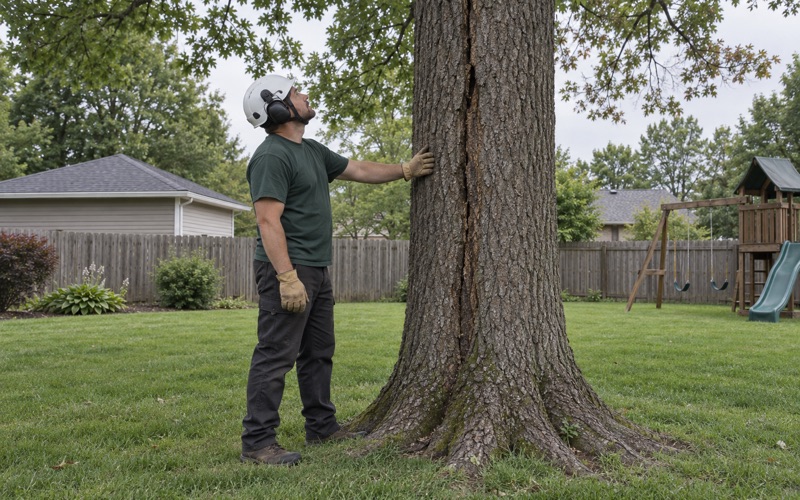
That changes the conversation on a driveway. When a species fails, it rarely fails alone on one lot. Our first visit is a free on-site assessment, and what comes back to you is a written condition assessment you can hand to a neighbor, an association board or an adjuster, not a number scrawled on the back of a card. The figure we quote is the figure that appears in writing.
We also tell you where the wood and the grindings are going before the saw comes out of the truck, because in Johnson County that answer is neither obvious nor free.
Who picked the tree standing at your curb
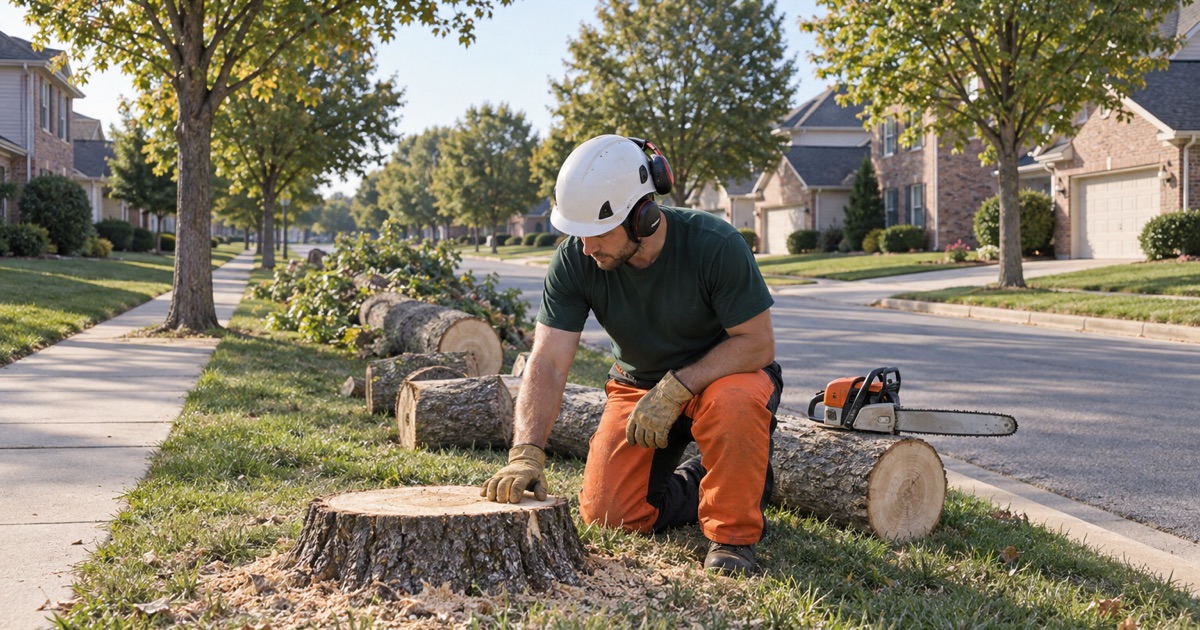
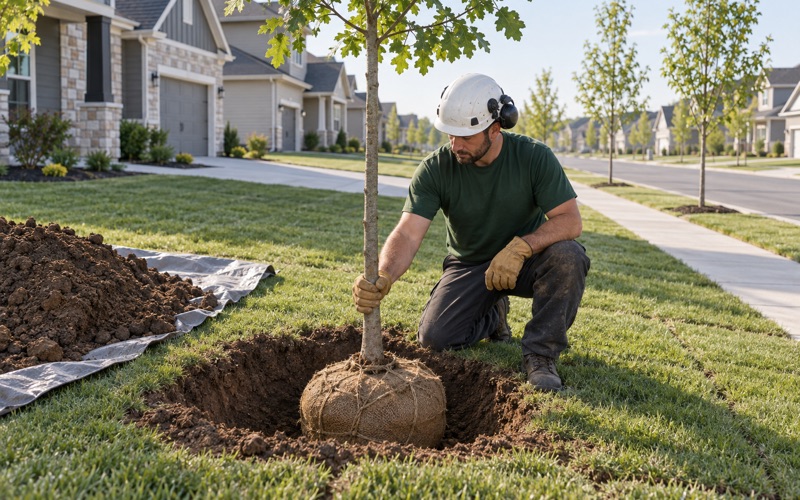
The City does its own planting here, and the code says so plainly. Unified Development Code 4-1-D-2-J reads: “Street trees shall be provided and planted by City in all single-family and duplex subdivisions with average lot sizes of under 1 acre.” The stated intent at J(1) is “that one (1) street tree shall be planted for every 40 linear feet of public or private street frontage.”
The species is not the builder’s call either, and it is not yours. Under J(3), “The Parks and Recreation Director shall determine the botanical name of the street trees to be planted, giving consideration to input from the property owner.” Whoever buys the house a decade later inherits both decisions, the species and the spacing, without having been in the room for either.
The City’s pick, your responsibility
Lenexa’s homeowner page is equally direct about where the work lands: “Trees that are on your property and located in the public right of way are your responsibility as the homeowner,” and that right of way “typically extends approximately 11-15 feet from the back of the curb.” On the tree itself: “If you have a dead or dying tree on your property, it is your responsibility to remove it before it becomes hazardous.” The City adds that you are not required to replace a street tree if you remove one.
Section 4-1-D-2 is a development-standards section, its requirements attaching at plat and plan approval rather than to a finished, occupied lot, so nothing in it stands between a Lenexa homeowner and a dead tree at the curb. What it does explain is why that dead tree has three identical neighbors.
The credential question, answered straight
The City tells residents to “Contact insured contractors with certified arborists on staff.” Kansas issues no license for tree work at all, so that word means nothing in this trade here and we will not use it about ourselves. What exists instead are things you can verify on any bidder: the ISA Certified Arborist credential, the Kansas Arborists Association, and a current certificate of insurance. What we commit to is the insurance half of that sentence, and our proof of coverage reaches you before a crew sets foot on the property.
Looking for tree-removal closer to Edwardsville? See Tree-Removal Services in Edwardsville.
The Street Tree Fund, its formula, and the three zones it spends inside
The City plants the trees; the developer pays for them, on terms that are not negotiable. Under J(5), “At the time of final plat or final plan approval, the landowner shall provide the City with total payment as calculated by the formula set forth below. The fee shall be deposited in the Lenexa Street Tree Fund.” The formula sits in the code verbatim: “Total linear feet of public or private street frontage divided by 50. The resulting number shall be multiplied by a dollar amount adopted by the City Council, which amount shall represent the costs to the City of acquiring and planting the street trees.”
Look at the two numbers together. The planting intent is one tree per 40 feet, while the money is collected on a divisor of 50, and the code states its own reason: the larger divisor is used “in an effort to prevent the accrual of surplus funds in the Lenexa Street Tree Fund.” Payments, the code adds, “are nonrefundable even if the number of trees planted is less than the number identified in the street tree formula.” The dollar figure itself is adopted by Council and appears nowhere in the code, so anyone quoting you a rate per foot of frontage is guessing.
Three zones, drawn on the city’s own lines
J(8) splits the fund geographically, verbatim: “Zone #1: East of Renner to the east City limits and area west of Renner, south of K-10. Zone #2: West of Renner (north of K-10) to K-7. Zone #3: K-7 west to City limits.” Surplus in a zone may be spent on other street tree plantings inside the zone the money was collected in, or on replacing street trees damaged by severe weather or by national or regional tree diseases.
That is the only municipal tree map in this part of the county. It is worth knowing which side of Renner Boulevard, K-10 or K-7 you sit on when a storm takes out a run of street trees rather than a single one.
One year of warranty, and the edge of what we will tell you
Under J(9), street trees the City plants “shall be covered by a one year warranty period,” and if within that year they die or become diseased and need replacement, “they shall be replaced one time by the City at no cost to the adjacent property owner.” That is a real protection, and it is narrow: one year, one replacement.
Past that point the code hands the cost question to Article 3-5-J of the City Code. We have not read that article, so we do not tell customers what is in it. If yours is a City-planted street tree beyond its first year, put the who-pays question to the City’s Landscape Supervisor directly; we will quote and schedule the work either way.
Two more trees per lot, and a street that ages all at once
Street trees are only half the planting. UDC 4-1-D-2-K adds that “In addition to required street trees, 2 deciduous trees will be required for each single-family or duplex lot. At least one of the required trees must be a shade tree and at least one tree must be located in the front yard,” with existing trees creditable if they are of code-compliant size, type and location. The City also takes a 15-foot deep landscape easement along all right-of-way lines in the single-family and duplex projects that require street trees.
Put those rules together and a subdivision arrives with a manufactured canopy: a short list of species, a set spacing, one planting season, ground graded the same month. Four decades on, they do not fail one at a time. They fail as a cohort, and the honest answer to “should this one come down now?” is usually a sequence spread across two or three seasons rather than a single visit.
Two cohorts, with a gap between them
The census figures make that timing legible. ACS 2020-2024 five-year estimates put 3.58 percent of Lenexa’s 25,751 housing units before 1960 and 28.21 percent before 1980, against 50.66 percent built between 1980 and 2009 and 21.13 percent built 2010 or later. The peak decade is the 1970s at 20.01 percent, with the 1980s at 19.69 and the 2010s at 18.18. There are 13,077 owner-occupied one-unit-detached houses spread over 34.075 square miles, at 756 units per square mile.
Those are two different jobs. The 1970s and 1980s houses carry trees planted with the houses, now forty to fifty-five years old and squarely in a first removal cycle. The newest fifth carries young stock, tight access between finished houses, and drop zones over new hardscape.
Where the removals actually come from
There is a standing disagreement worth knowing about. The City’s recommended street tree species include bald cypress, elm, ginkgo, red and white oak varieties, sugar maple and tulip tree. Johnson County K-State Research and Extension’s Master Gardeners brochure, “Recommended Landscape Trees for Metropolitan Kansas City” (Rev.01-09), refuses Silver Maple for weak wood, Pin Oak for soil issues and Green Ash on account of emerald ash borer, and puts Red Maple and White Ash in a plant-with-caution column.
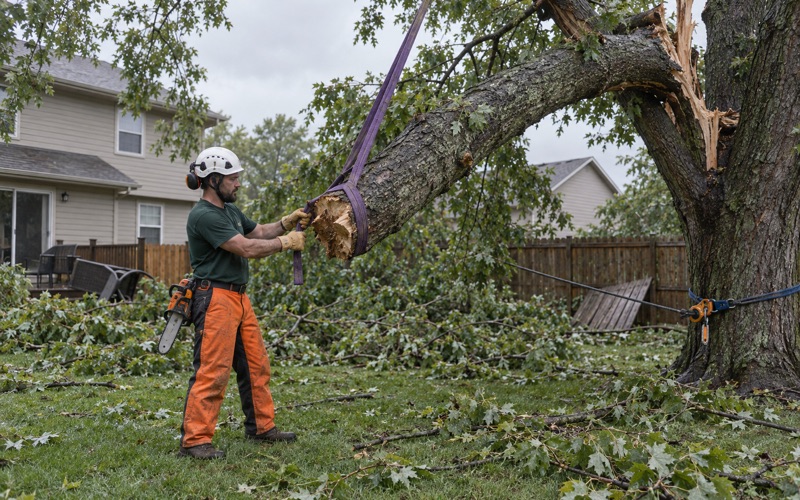
The brochure’s own bridging line describes what we find on a storm call: “Many fast growing varieties are brittle with narrow crotch angles that can lead to severe breakage during storms.” A narrow crotch angle is co-dominant stems with included bark, and included bark is the first defect we look for in a tree risk assessment. It is what turns a squall line into a split leader lying across a driveway.
Grinding a stump in ground somebody else built
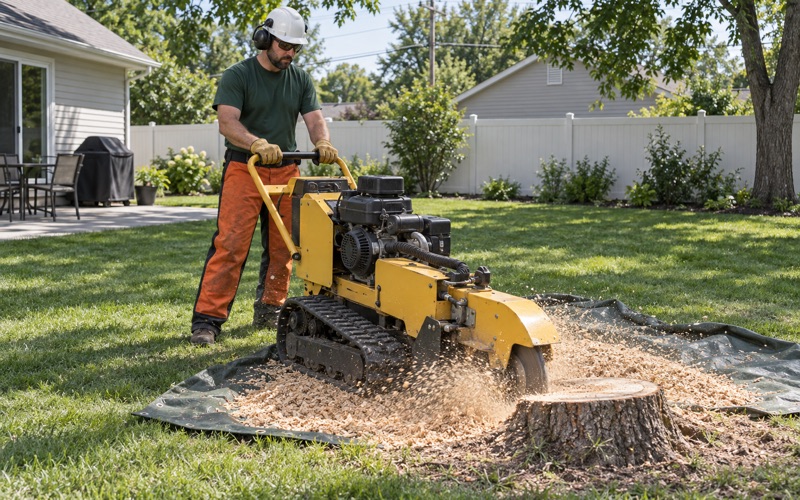
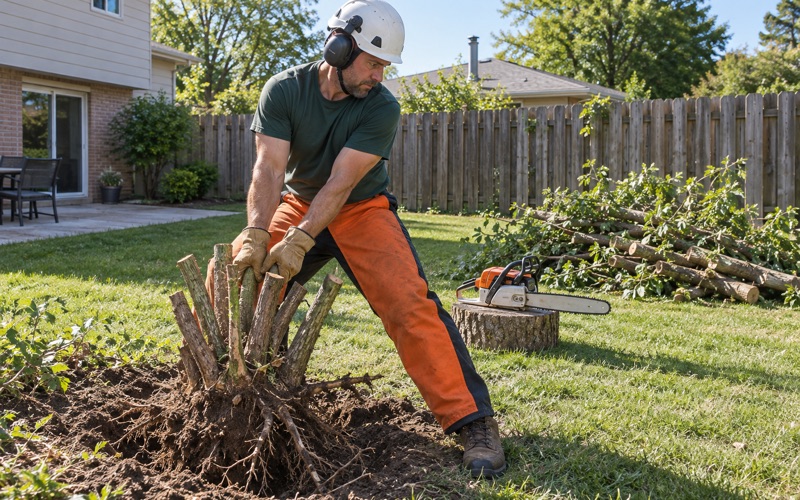
On the newest fifth of the city, the material under a stump is not the mapped soil at all. It is imported fill and compacted subgrade, and the soil survey does not describe engineered ground; it describes what was there before the scrapers. Older residual ground carries the opposite constraint, since the shallow eastern Kansas series sit on interbedded limestone and shale, with the Vinland series mapped at 25 to 51 centimeters of solum over rock. Either way, below-grade cut depth is a site finding, and we will not name one for a stump we have not stood beside.
Before the wheel turns
Kansas 811 is the state one-call center, at 811 or 1-800-DIG-SAFE, and the locate happens before any grinding, excavation or root work rather than after it. A public locate does not reach private irrigation or low-voltage lighting runs, so we walk those with you and mark them ourselves.
Where the wood and the grindings go
Curbside will not absorb a removal, and the city’s own rule shows why. Yard waste must go out “securely bundled not longer than 48 inches, 18 inches in diameter and weighing no more than 65 pounds each,” collection is “limited to six bags or bundles per pickup,” and it runs weekly March through November but only monthly from December through February, which is exactly the stretch when storm limbs are most likely to be lying in a yard. Hauling here is private subscription, and the City’s own instruction is “Contact your hauler for more details about what is accepted.”
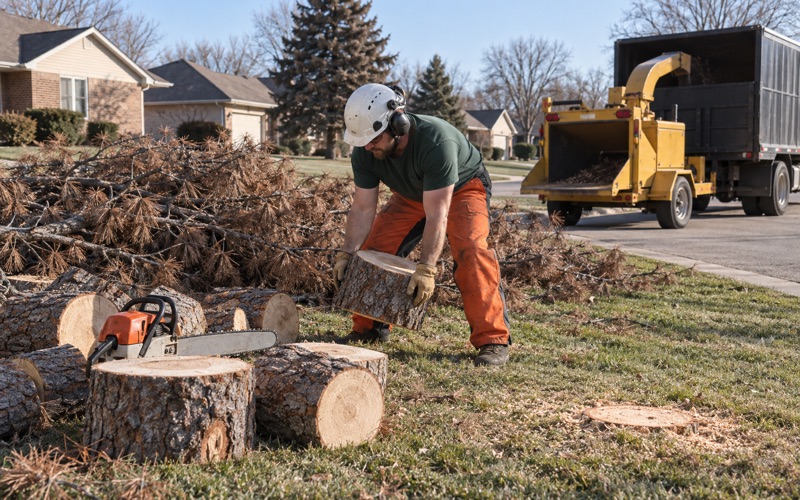
We do not leave that problem in your driveway; every stick leaves with us. Grinding rather than pulling a stump is also the economical choice in this market, because the regional recyclers that take brush and logs by the cubic yard refuse stumps with dirt on them. A pulled stump becomes a disposal problem that a ground one never is.
The neighbor’s tree, and what a written assessment does
Kansas and Missouri answer the neighbor question in opposite directions, and Lenexa sits firmly on the Kansas side. Kansas follows the nuisance rule under Pierce v. Casady, 11 Kan. App. 2d 23 (1985): a landowner may cut back what overhangs the property line but may not enter the neighbor’s land, and where a tree does substantial harm or presents an imminent danger, one landowner may compel the neighbor to abate that nuisance or seek damages for injury the tree causes. Missouri runs the other way, leaving self-help at your own cost for a healthy tree.
That difference is why our assessment is written down rather than spoken. On this side of the state line a documented defect is leverage, and it is what a board or an adjuster acts on. If cabling and bracing or a crown reduction saves the tree, we say so and price that instead of a removal, and we do not top trees, a point we are glad to walk you through when somebody else offers to.
- 20+ Years in Johnson County
- Insured, Proof Sent First
- Free On-Site Assessment