Shawnee Tree Removal has been taking trees down in Merriam for more than twenty years, and tree removal in Merriam starts with a fact most homeowners here have backwards: the tree standing between your sidewalk and the street is ordinarily one you are allowed to act on yourself. Merriam is the outlier among the Johnson County cities around it, and that is the most useful thing we can tell a caller before anyone quotes a number.
Every job opens with a free on-site assessment, and what comes back is a written condition assessment you can hand to a neighbor, an adjuster or a council clerk, not a figure scribbled on a card. The number we quote is the number that appears in writing, and proof of insurance reaches you before a crew sets foot on the property.
We also say no. We do not top trees, and we will walk you through the decay and the epicormic sprouts that follow if somebody else offers to. Where cabling and bracing or a structural pruning cycle saves the tree, we price that instead of a removal and say so plainly.
The curb strip in Merriam is yours to act on
Merriam Code Sec. 47-223, “Abutting landowners; permitted deviations,” lets an owner whose property abuts city rights-of-way, easements, alleys and parks “prune, spray, plant, or remove trees” in the abutting portion not used for public travel, so long as the work stays within the article and the approved plan. Written approval from public works and from parks and recreation is required only in order to deviate from that standard.
Read that carefully and the default flips. We do not tell a Merriam homeowner to go find permission for the curb-strip tree. We tell them the permission is already there, and that the approval question arises only when the plan calls for something the standard does not cover.
What counts as a deviation
The standard is the geometry the article sets out: Sec. 47-241 on distance from a paved surface, Sec. 47-242 on sight distance and fireplugs, Sec. 47-243 on traffic islands and thoroughfare rights-of-way, and Sec. 47-244 on overhead utilities. Work departing from those is the deviation, and that is where both departments sign.
Sec. 47-247 supplies the other half of the bargain. The same article that hands an abutting owner latitude in the right-of-way also places a duty on that owner to maintain it. The permission and the obligation arrive in the same breath.
Four neighbors, four different answers
In Prairie Village all Area 1 street trees are prohibited from removal without the Building Official. In Roeland Park the right-of-way is Covered Property and the work needs City Arborist authorization. In Fairway a right-of-way tree runs through the Community Tree Manager and carries a Tree Fund payment. In Overland Park the City Forester directs the removal outright, and notice to the abutting owner is not required.
Merriam grants what those four withhold. It also means advice written for an address a mile away is wrong at yours, which is why we settle the jurisdiction before a crew is scheduled rather than after.
Looking for tree-removal closer to Mission? See Tree-Removal Services in Mission.
When the city moves on the tree first
The section runs both directions. Sec. 47-246 lets the city remove or trim trees in the right-of-way, but absent an immediate hazard it must first give at least thirty days’ written notice by certified mail or personal delivery. That notice has to state the property, the tree, the reason for the action and the relocation options, and it carries a right to a hearing before city council.
The bill lands on the abutting owner
Under the same section the abutting owner ordinarily bears the cost of a city-ordered removal, payable within thirty days, and an unpaid amount becomes a lien under Sec. 41-29. At that point the charge has stopped being a bill and become an encumbrance on the parcel.
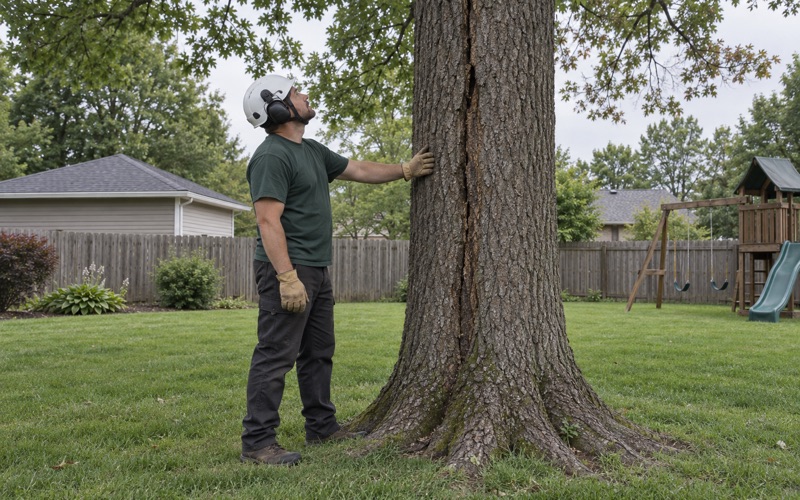
Thirty days is enough time to get an independent read, and a hearing is a place where documentation counts. A dated write-up of DBH, root flare condition, any conk or heartwood decay found, and the co-dominant stems or included bark driving the concern is something a council can actually weigh. We write ours to be read by someone who never stood under the tree.
None of that thirty-day machinery applies when a tree is already on a roof, a car or a service line. That is a same-day call, and we treat it as one.
Vegetation on a line is not your bill
Sec. 47-246 sends vegetation interfering with a utility to the utility itself, at no cost to the city or to the owner. On an assist Evergy Kansas Metro removes all limbs within ten feet of energized conductors and leaves any debris at the worksite, so a crew is still needed for the cleanup and for whatever is left of the tree. The service drop from the pole to your meter is the customer’s, which puts that one back in private hands.
Kansas adopts the National Electrical Safety Code by reference and publishes no vegetation-management plan, so unlike the Missouri side the trim cycle here is not a public document. During a thunderstorm, high wind, snow or ice, ANSI Z133 keeps everyone away from energized conductors, and we hold that line whatever the caller is looking at.
What Chapter 47 reaches, and who runs it
Sec. 47-189 does the defining, and the definitions decide what the article touches. Large trees are those with a mature height of 55 feet and over, medium 25 to 55 feet, small under 25 feet. A “tree” needs a well-defined stem or trunk, a definite crown, a mature height of at least 8 feet and a mature trunk diameter over 2 inches. “Street trees” means trees, shrubs and all other woody vegetation located within public rights-of-way, shrubs included. “Property owner” is fixed by reference to the Johnson County Register of Deeds.
Nobody in Merriam holds the title of arborist
There is no city arborist and no forester post on the payroll here. Authority sits with the Merriam Tree Board, established at Sec. 47-219, coordinating with public works and parks and recreation. Even the city’s Residential Tree Grant is administered with Heartland Tree Alliance foresters rather than city staff. On private ground, Sec. 47-248 places the removal and proper disposal of dead trees and limbs on the owner or occupant.
Two housing cohorts, two kinds of removal
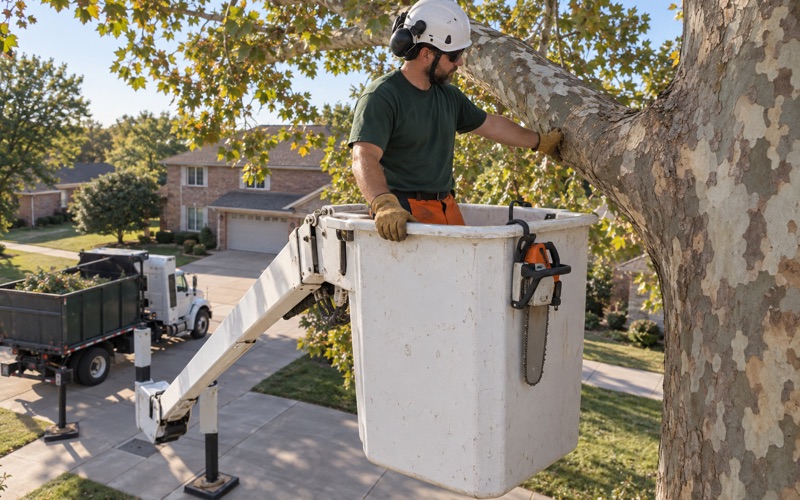
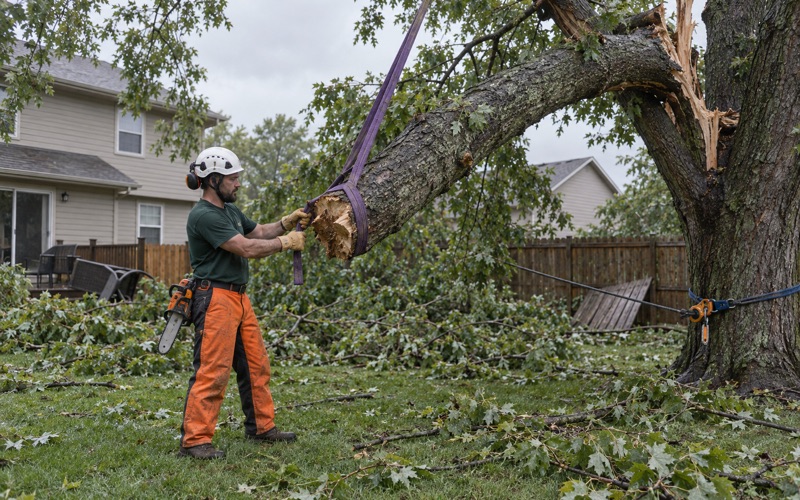
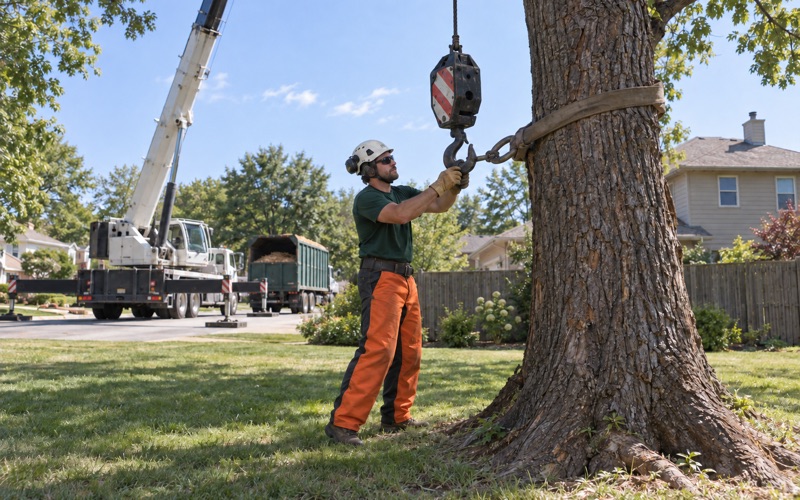
Merriam is not a uniformly mature city. About a quarter of its housing stock went up in the 1960s and another 27.76 percent between 1980 and 2009, and those two halves generate different work. The older half brings mature canopy over a tight lot, where the answer is rigging with a bull rope and a Port-a-Wrap friction device, or crane-assisted removal when the drop zone simply is not there.
The later half is on its first removal cycle, and much of it is the pear that came with the house. Johnson County Extension is blunt about the Bradford cultivar, warning that severe splitting occurs on ten- to fifteen-year-old trees, and the pears planted alongside those homes are long past that window. Kansas’s Callery pear quarantine takes statewide effect on January 1, 2027, prohibiting the sale and movement of all seeds, plants or parts, which is a constraint on where that debris may go and one we settle before the job rather than at the gate.
A stump on a Turkey Creek sideslope is a different job
Merriam sits astride the Turkey Creek valley, and the steeper sideslopes are exactly where this county’s shallow soil series get mapped. The Johnson County soil survey puts depth to a restrictive feature at 4 to 20 inches for Sogn and 10 to 20 inches for Vinland, against no bedrock restriction stated under Sharpsburg. Which series lies beneath a given parcel is not something anyone reads off the street.
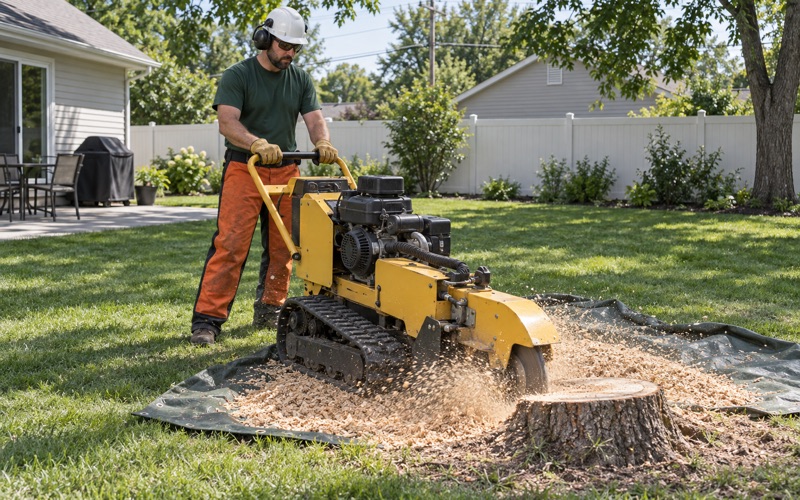
So we will not promise a below-grade cut depth before we have seen the flare and the ground holding it, and a stump grinder tooth wheel meets limestone on a sideslope more often than it does on the flat. An 811 utility locate goes in before the wheel turns, every time.
A brush rule written to include rather than exclude
Merriam publishes a minimum where its neighbors publish a maximum. The spring tree limb pickup states that “any tree limb or brush larger than a pencil will be collected,” with no upper diameter, no length cap and no contractor exclusion stated anywhere in it. Roeland Park caps an individual limb at 2 inches and Prairie Village at 3, so one trunk section is collectible at one curb and refused at another a few minutes up the road.
What the city service actually covers
City-provided collection through GFL Environmental begins November 1, 2026, at $22.87 per month for 2027, and the charge appears on your property tax bill rather than on a separate utility invoice. Weekly yard waste runs to 10 bags, bundles and/or rigid containers, with two amnesty weeks and up to three bulk items each month, and large-item pickup falls in the third full weeks of April and October.
Behind the curb there is nothing in county
Johnson County operates no public yard-waste gate, and the county landfill caps landscape waste at 3 inches in diameter. Olathe’s compost site verifies Olathe residency and states that businesses and landscape companies are not permitted to use it. Removal wood crosses the state line to Missouri Organic Recycling in Kansas City, Missouri, at $10.00 per cubic yard for brush and $7.00 per cubic yard for lawn debris, taking logs up to 40 inches in diameter if they are under 5 feet long and refusing stumps with dirt still on them.
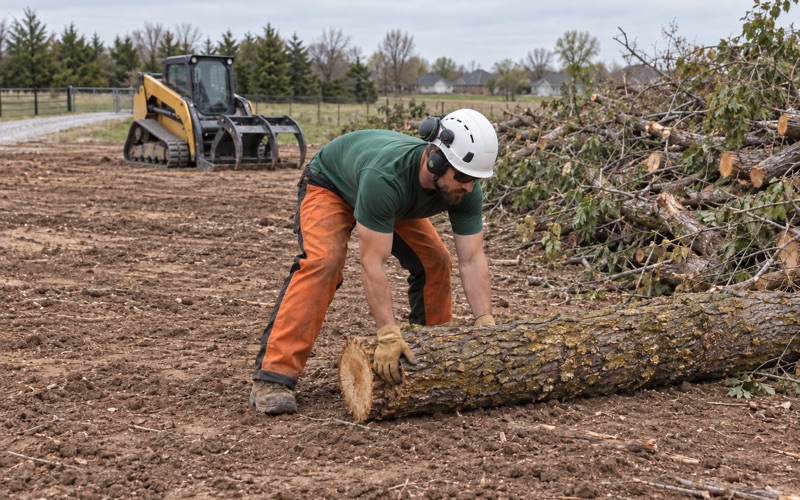
That gap behind the curb is why we tell you where the wood and the grindings are going before the saw leaves the truck. Every stick leaves with us, and nothing gets stacked at a curb on the assumption that somebody else will carry it away.
- 20+ Years in Johnson County
- Insured, Proof Sent First
- Free On-Site Assessment