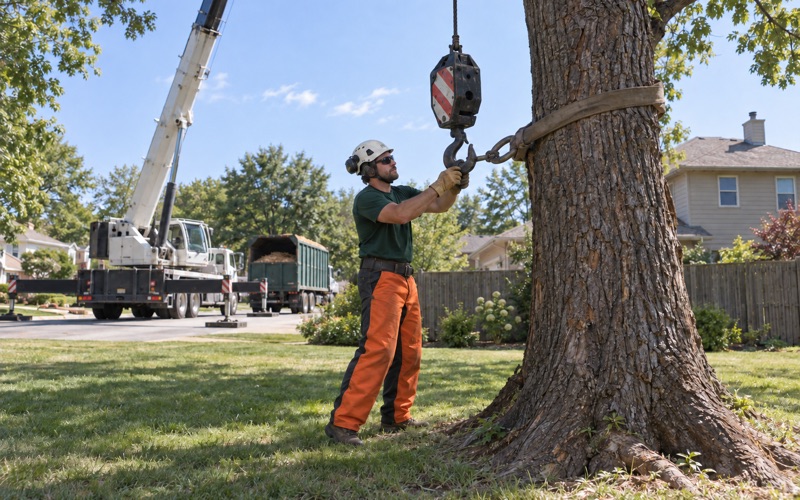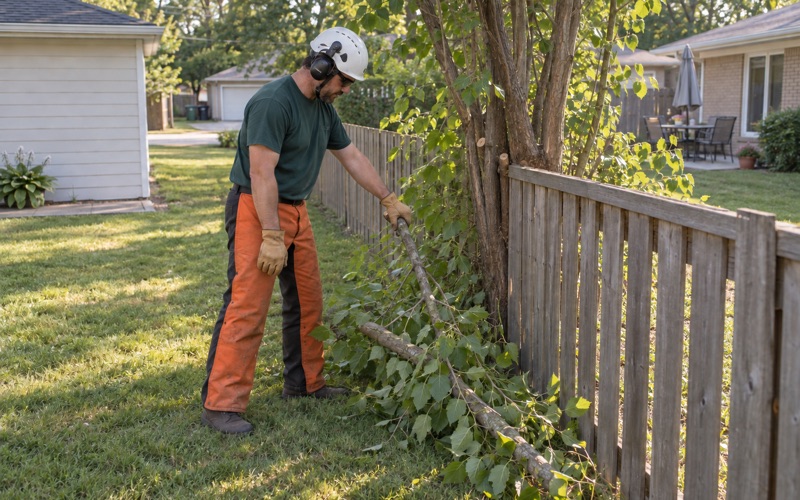
Shawnee Tree Removal has been taking trees down in Mission for more than twenty years, and tree removal in Mission starts for us with a question most towns never raise: what species is it? The city’s code names the trees that may not be planted or grown inside the corporate limits, and the names on that list are the ones our phone rings about.
On a finished, occupied lot with no construction project attached, a private removal here does not need a city permit, because Chapter 240’s tree protection and removal procedures open on a demolition or construction trigger. That answer is true and it is also incomplete, since the same chapter still governs which species may be grown, what may go back in on the street side, and who owns the debris after a utility crew has been through.
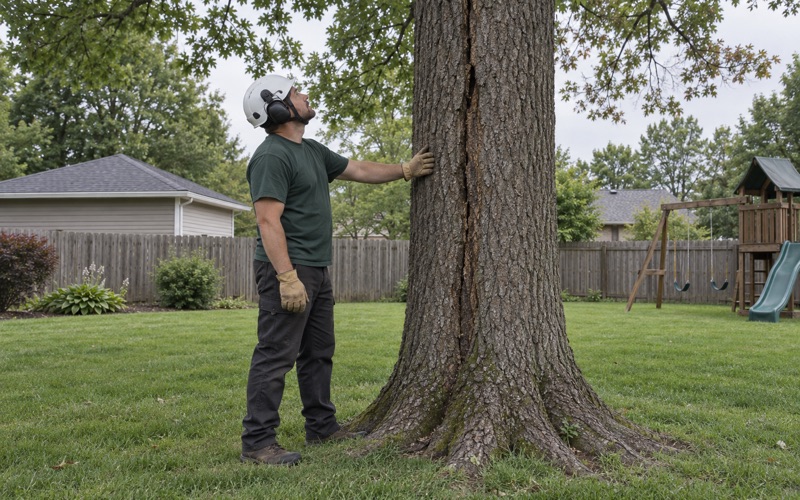
What you get from us is the whole picture before a saw is started: a free on-site assessment, a written condition assessment you can hand to a neighbor or an adjuster rather than a number scribbled on a card, proof of insurance in your hands before the crew arrives, and the quoted figure held in writing. We do not top trees, and if cabling or pruning saves the tree we price that instead and show you why.
The list Mission wrote into its own code
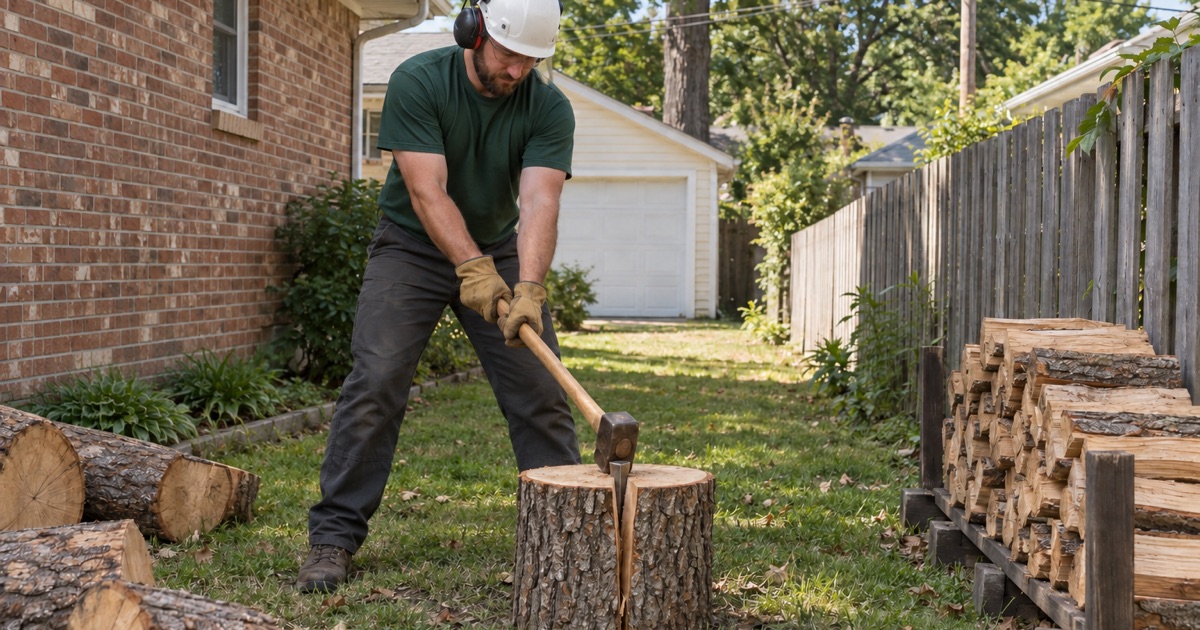
The current chapter is young. Ordinance No. 1617 was passed and approved by the City Council on November 20, 2024, and it did not amend Chapter 240 of the Municipal Code so much as replace it: the ordinance deleted the chapter in full and substituted a new Chapter 240, “Trees and Shrubs.”
The heart of it is Sec. 240.250, “Prohibited Trees,” which opens: “The following is a list of tree species that may not be planted or grown within the corporate limits of the City of Mission, Kansas.” Ten entries follow: Ulmus spp. (elms, except Ulmus parvifolia and Ulmus americana), Ailanthus altissima (tree of heaven), Acer negundo (boxelder) and Acer saccharinum (silver maple), Fraxinus (the entire genus of ash), Pyrus calleryana “Bradford” (Bradford pear), Pinus nigra (Austrian pine) and Pinus sylvestris (Scotch pine), Populus alba (silver poplar) and Populus nigra (Lombardy poplar), Populus deltoides (cottonless cottonwood), Betula pendula (European white birch), and Salix spp. (willows).
Planted is one word; grown is another
Most municipal species lists govern planting. Mission’s governs planting or growing, and that second verb is why this page exists: a mature silver maple, ash, Bradford pear or Austrian pine already standing in a Mission yard is a species the adopted text says may not be grown within the corporate limits. No order compelling anyone to take down a healthy listed tree appears anywhere in the chapter, and we will not tell you the city is coming for yours. What the wording does settle is the replanting half of the conversation, because once one of these comes out it does not go back.
The chapter that runs on a clock
The same evening, Ordinance No. 1621 rewrote Sec. 220.010, and subsection (A)(6) now makes an unlawful nuisance of “All dead trees, dead shrubs, diseased trees, or diseased shrub on any property, whether vacant or occupied.” Chapter 240 Article III carries the enforcement: a written statement from a competent City, State or Federal authority, based on a laboratory test or other supporting evidence, then notice from the Code Enforcement Officer allowing not less than ten days to treat or remove. Sec. 240.500 sets the penalty at not more than one thousand dollars ($1,000) or six months jail time, or both, with each day a violation continues counted as a separate offense.
Looking for tree-trimming closer to Kansas City? See Kansas City Tree-Trimming.
Silver maple, ash, Bradford pear and the two pines
Set the list beside the Johnson County K-State Research and Extension Master Gardeners brochure “Recommended Landscape Trees for Metropolitan Kansas City” (Rev. 01-09) and the overlap is close to line for line. That document’s not-recommended column refuses silver maple for weak wood, pin oak for soil trouble, green ash for emerald ash borer, and Austrian and Scotch pine for disease, and it warns that “Many fast growing varieties are brittle with narrow crotch angles that can lead to severe breakage during storms.” Mission’s ordinance reads like that horticultural advice with legal teeth attached.
Silver maple
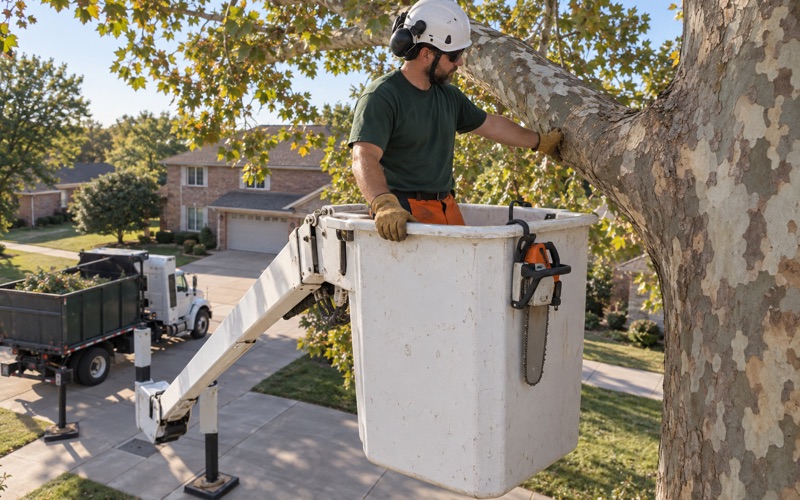
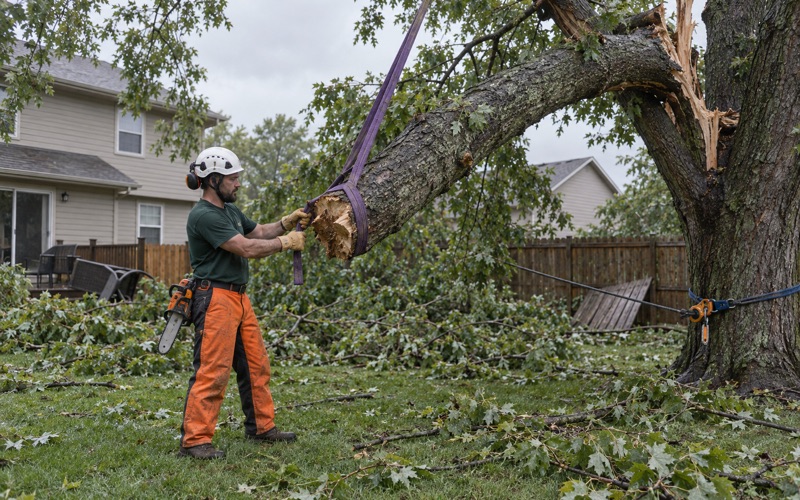
The engineering is blunt: silver maple carries 56 percent of sugar maple’s modulus of rupture. The fiber gives up at a little over half the load, on a tree that grows fast, forks into co-dominant stems and hides included bark inside the union. On this species we plan the rigging before the climb, with a bull rope, a Port-a-Wrap friction device and a three-cut method over anything that matters, because the wood cannot be trusted to hold a hinge the way an oak does.
Ash and the Bradford pear
The whole genus Fraxinus sits on the prohibited list, and the brochure’s own pest note has aged out from under it: the text records emerald ash borer as not yet found in Kansas or Missouri, while the state’s first confirmed detection came in 2012, in Wyandotte County. For Pyrus calleryana “Bradford” the extension wording is unusually direct, “DO NOT plant Bradford cultivar; severe splitting occurs on 10-15 year old trees,” which is a ten-to-fifteen-year failure window nobody else publishes. Missouri banned the sale of Callery pear effective January 1, 2025, and the Kansas restriction on the sale and movement of all seeds, plants or parts carries the date January 1, 2027, a dated future rule rather than one operating today. Mission did not wait for either: Sec. 240.250 prohibits growing the cultivar at all, and Sec. 240.240 keeps it off the street side.
The two pines
Austrian and Scotch pine are both named, and K-State publication L722 explains the reasoning: “Scots pine plantings in eastern Kansas have been devastated,” with Austrian pines “affected in recent years.” A pine killed by the pine wilt nematode holds its dead brown needles for up to a year, and the cut face shows reduced or absent resin, which is how a homeowner can tell a dead pine from a drought-stressed one before we ever reach the driveway.
What Sec. 240.230 lets you put back at the curb
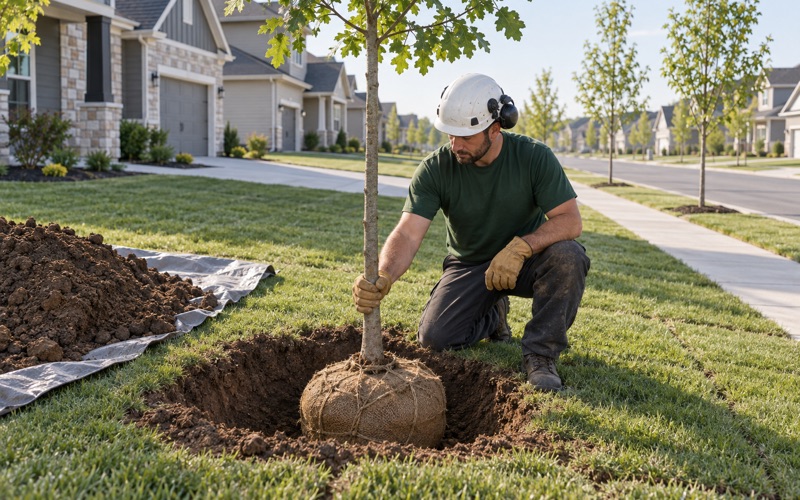
A removal in this city usually ends on the same question, and the code answers it. Sec. 240.230 lists twelve permissible street and park trees: Norway maple (Acer platanoides), redbud (Cercis canadensis), Amur flame maple (Acer ginnala), “American Redmond” linden (Tilia americana), serviceberry (Amelanchier x grandiflora), “Greenspire” little leaf linden (Tilia cordata), western soapberry (Sapindus drummondii), chinkapin oak (Quercus muehlenbergii), shingle oak (Quercus imbricaria), bur oak (Quercus macrocarpa), ginkgo (Ginkgo biloba) and bald cypress (Taxodium distichum). The Parks, Recreation and Tree Commission may authorize other species.
Sec. 240.240 runs the other direction with sixteen species prohibited as street trees. It repeats silver maple, ash, Bradford pear and willow, then adds fir, mimosa, persimmon, Russian olive, fruited or thorned Osage orange, mulberry, spruce, pine as a whole genus, London plane-tree, sycamore, cottonwood and edible fruit trees. A tree can be entirely legal in a back yard here and still refused at the street side, which is worth knowing before the nursery stock is paid for.
A word about bur oak
Bur oak sits on the permissible list, and what it deserves is a caveat rather than a warning. Johnson County Extension records it as not known for fall color, and in the published strength tables it is the weakest of the white oaks: specific gravity 0.64, yet a modulus of elasticity of 1.03 million psi, which is less stiff than silver maple while carrying about a third more density, and a modulus of rupture of 10,300 against white oak’s 15,200. It is a durable street tree the code allows, and it simply does not behave like white oak under load.
Before anything at the curb gets quoted, we establish whose right-of-way it stands in. Sec. 240.100 defines street trees as woody vegetation within the right-of-way of the City, Johnson County, or the State of Kansas, so on a county or state corridor the city is not the authority in the conversation at all.
The debris, the easement, and where the wood goes
Sec. 240.270 settles a question most cities leave to argument. Planting, care, maintenance including trimming, and removal of anything inside a utility easement belongs to the property owner; the utility or its agents may trim or remove within the easement without notice and at no liability for the loss; and then comes the sentence that costs money, “Debris left behind after a utility has trimmed or removed any trees is the responsibility of the property owner to remove.”
That is a municipal code agreeing with Evergy Kansas Metro’s own published practice. On a line clearance assist Evergy takes all limbs within ten feet of energized conductors and “Any debris is left at the worksite,” working to ten feet of clearance at 600 to 50,000 volts and leaving the service drop from pole to meter to the customer. Kansas adopts the National Electrical Safety Code by reference at K.A.R. 82-12-2 and the Kansas Corporation Commission publishes no vegetation-management plan, so on this side of the state line the trim cycle is not a public document, while the pile left in the yard is documented and it is yours.
The curb will not take a removal
Mission’s published yard-waste rules, collected by GFL, accept limbs less than 2 inches in diameter, bundled with string or twine in lengths no more than four feet long and 18 inches in diameter, with nothing over 40 pounds, a limit of ten bags or bundles, and no plastic bags. Nothing that comes off a removal fits inside those numbers. Leaving it stacked is not the alternative either, since Sec. 220.010(A)(1) makes “tree limbs, wood” left deposited on any lot, vacant or occupied, an unlawful nuisance.
Where it actually ends up
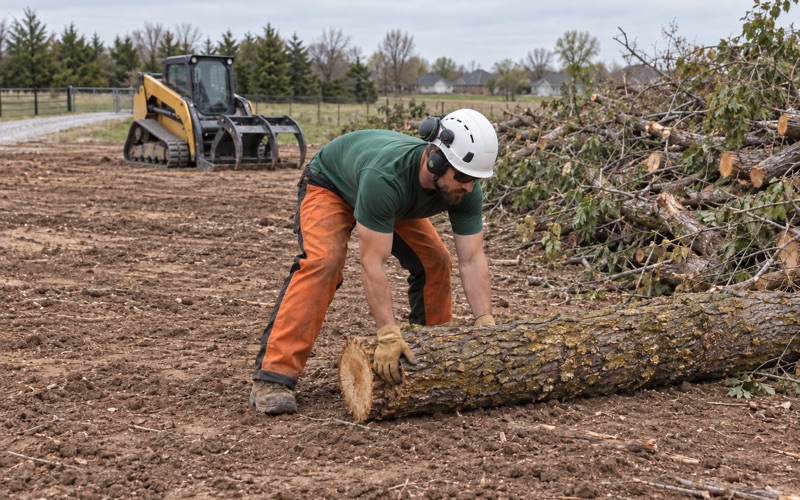
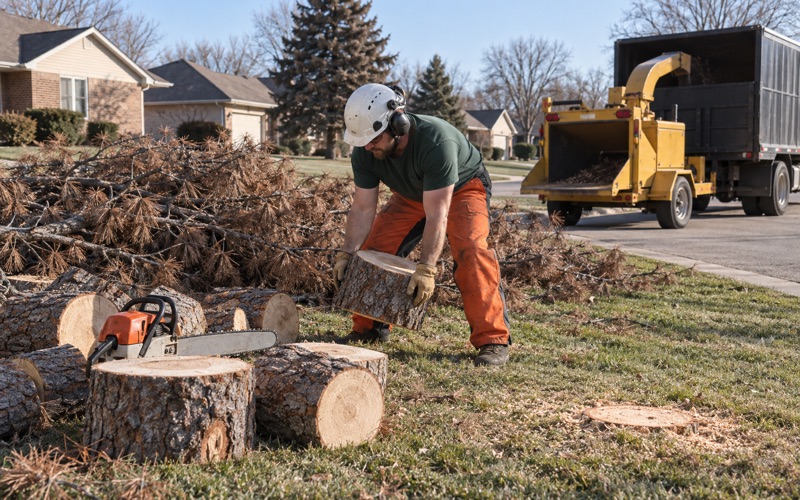
Johnson County operates no public yard-waste gate, and the county landfill caps landscape waste at three inches in diameter, so removal wood crosses the state line to Missouri Organic Recycling in Kansas City, Missouri, at $10.00 per cubic yard for brush and $7.00 per cubic yard for lawn debris, taking logs to 40 inches in diameter if they are under five feet long and refusing stumps with dirt on them. That haul is a priced line on the estimate rather than a favor, and you hear the figure before the saw comes out of the truck. Every stick leaves with us, and nothing is stacked at a curb the city will refuse.
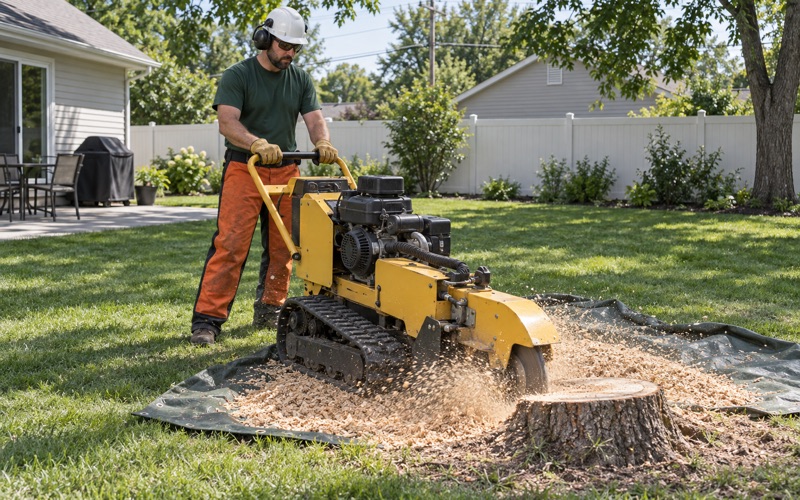
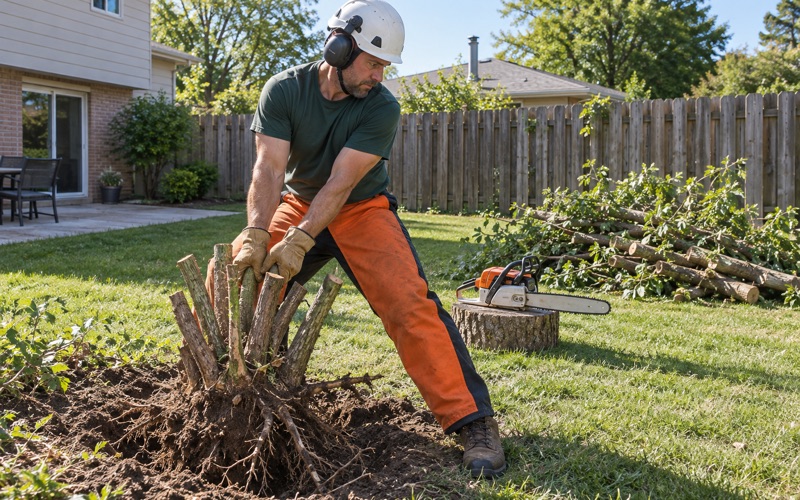
Stumps get an 811 utility locate before the grinder tooth wheel turns, and how far the below-grade cut can go is decided standing at the stump, never over the phone. This is a cuesta landscape of alternating limestone and shale benches, where mapped Johnson County soils such as Vinland run 10 to 20 inches to a paralithic contact and Sogn as little as 4 inches to bedrock, and the grindings go where we tell you they are going before the work starts.
- 20+ Years in Johnson County
- Insured, Proof Sent First
- Free On-Site Assessment