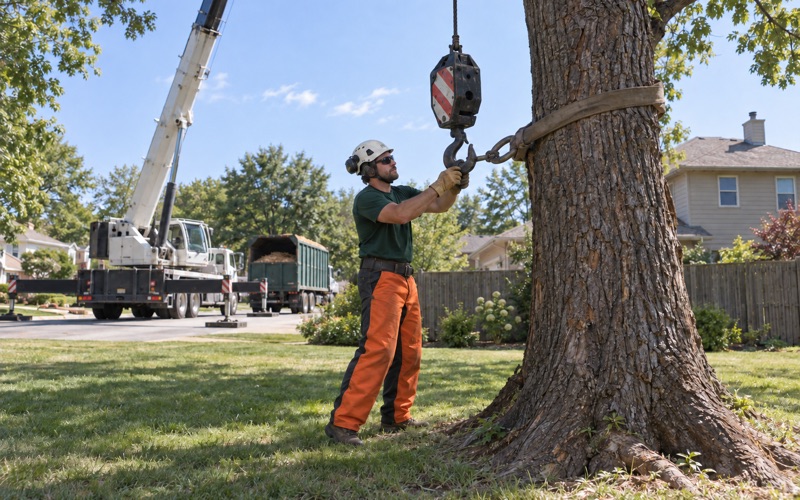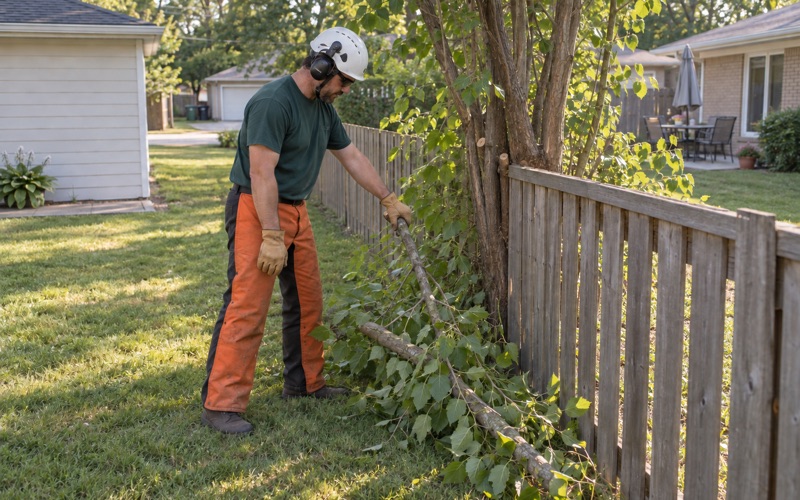
Shawnee Tree Removal has run removals across this metro for more than twenty years, and tree removal in North Kansas City is the rare job that does not end when the trunk is on the trailer. The city counts what came down in caliper inches and expects the same total back in the ground.
That makes a removal a two-part cost. There is the work itself, and then there is replacement stock at a set size, a planting plan that may have to carry several species, a year of responsibility for every tree that goes in, and a notice that lands on the property record for whoever owns the ground next.
We price both halves before anything is cut. The on-site assessment is free, the figure we quote is the figure you get in writing, and where cabling, bracing or a structural prune keeps a sound tree standing we say so and price that instead — a tree that stays puts no inches on anyone’s replacement account.
The permit is where this starts, and it is this city’s own
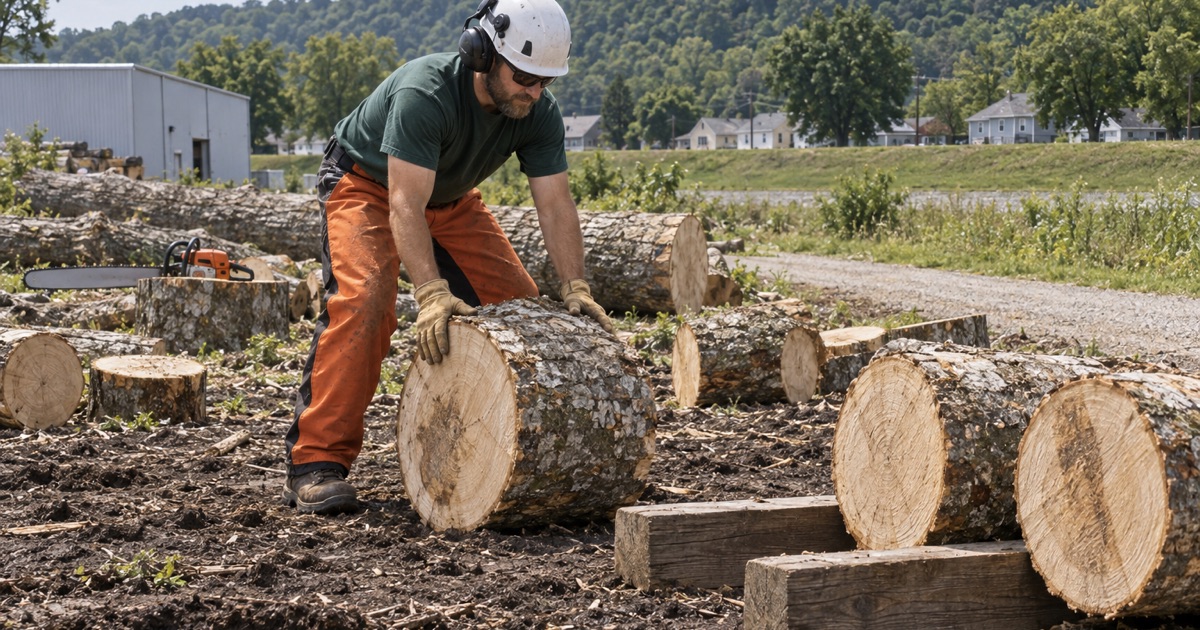
North Kansas City is a separate, independent municipality with its own council, its own code and its own officers. It sits enclaved inside a much larger city that shares part of its name, and nothing about that larger city’s tree rules describes what happens inside these limits. A crew that has worked the Northland for years can arrive with confidently wrong answers.
The rules live in Chapter 15.60, Vegetation, created by Ordinance No. 8446, Bill No. 6647, passed and approved February 23, 2010. Article I of that chapter is cited in its own text as the City Tree Preservation/Tree Abuse Ordinance, and it is the article that decides what a removal costs after the removal is finished.
The filing fee is the small number
The permit fee is published as a two-line table keyed to the cost of work: $20.00 for work up to and including $5,000, and $40.00 for $5,001 and up. Where a certified survey and site plan are required, a plan review fee of fifteen percent of the equivalent building permit fee is added to that. The filing fee is not refundable and cannot be moved to another application.
The survey threshold is worth knowing before anyone applies, because the code carves small jobs out of it: “in no case shall a tree survey be required when five (5) or less trees are to be removed from the property within any twelve (12) month period.” Six trees inside a twelve-month window and a survey enters the picture. Five and it does not, which is a real argument for sequencing a large planned clearance rather than doing it all at once.
What the application itself signs you up for
Section 15.60.045-D is easy to skim past: applying for a tree removal permit “constitutes consent by the property owner or applicant for the city to conduct site inspections in furtherance of this article on the subject property.” The permit is then good for the property for not more than one year, with a single extension of up to six months.
That window matters less than people assume, because the obligation attached to the permit runs on a different clock — one that does not start until the new stock is in the ground.
Looking for emergency-tree-removal closer to Kansas City? See Kansas City Emergency-Tree-Removal.
No loss of total caliper inches, measured at 54 inches
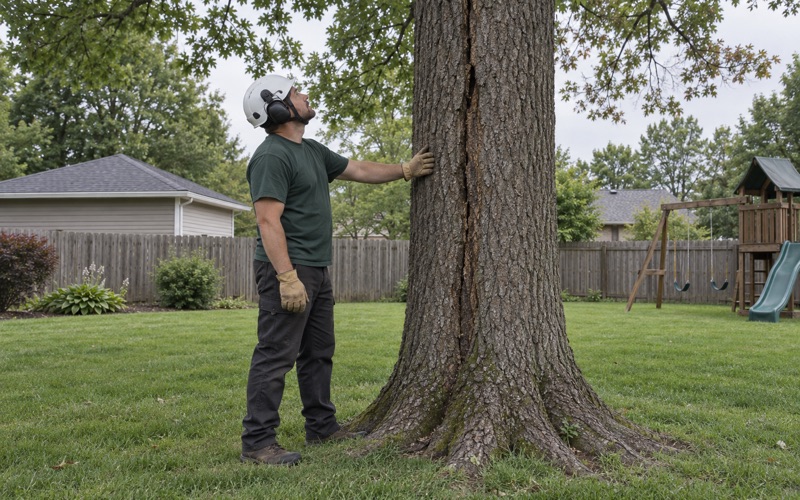
Section 15.60.060-A sets the standard in a sentence: trees that are removed and not relocated “shall be replaced so that there is, at a minimum, no loss of total caliper inches at the time of replacement. Performance bonds may be required to be posted.” Existing caliper is taken at 54 inches above grade, so the governing number exists before a saw comes out of the truck. We measure it during the assessment rather than reconstructing it afterward from a stump.
The arithmetic surprises people. One mature shade tree can carry more caliper than anyone would replant by choice, and the requirement scales to the tree rather than to the lot, the budget or what the ground can reasonably hold.
Relocation is the one lever that moves the total. A tree relocated on site counts fully toward equivalent replacement, while the same tree relocated off site counts as half credit. Where something can be lifted and reset instead of chipped, that call is worth making early, because keeping it on the property is worth exactly twice what sending it away is.
The stock has to match what left
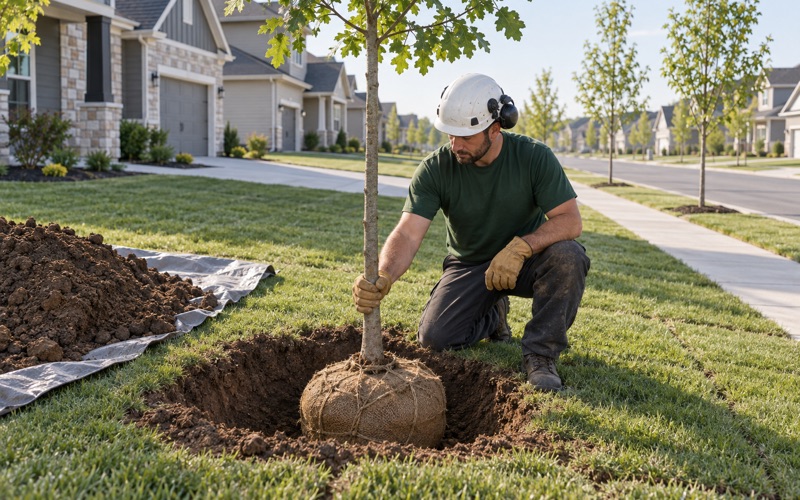
Replacement is like for like, by type and by size. A shade or canopy tree must be replaced by a shade or canopy tree of at least 2.5 inches DBH standing 12 to 14 feet overall, depending on species. A pine is replaced by a pine at a minimum of seven feet overall. All of it has to be “a minimum quality of No. 1 grade or better as applied to trees growing in Missouri.”
That is graded nursery stock at nursery prices, and on a job of any size it is routinely the largest line in the total. Knowing it before the removal is quoted is the difference between a budget and an unpleasant discovery.
How many species you have to plant
The code will not accept a monoculture, and it steps the requirement up as the count grows. One to five replacement trees require one species. Six to ten require two. Eleven to twenty require three. Twenty-one to fifty require four. Fifty-one or more require five.
Past a certain size, replanting stops being a purchase order and becomes a planting plan. The species mix has to be settled before the stock is ordered, and the availability of graded material in five species is not the same problem as finding it in one.
The year you stay responsible for every tree you plant
Section 15.60.070 holds the permittee responsible for the health of each replacement or relocated tree for one year from planting. At the end of that year the condition of every tree has to be determined, and that determination submitted to the city for approval within thirty days.
A tree that dies or enters unnatural decline inside the year has to be replaced within sixty days — and the one-year monitoring period begins again on the tree that replaces it. The clock restarts rather than running out. Where a second-year replacement is found not viable, the code allows payment into the tree preservation fund in place of a third attempt, and failing either to replace or to pay inside the sixty days is itself a violation.
There is a second edge to that same one-year idea. The code treats a tree driven into unnatural decline within a year of the act as destroyed, whatever anyone intended — root damage from heavy machinery, a grade change over the root plate, canopy taken off past what the tree can carry. A retained tree that fails that way is a removal, and its caliper inches come due like any other.
Planting decisions that have to survive twelve months
Siting is not decorative under a rule like that. This is river-bottom ground, deep alluvium rather than the rock bench south of the river, and a floodplain water table is a genuine variable from lot to lot. Species choice and planting depth are what decide whether year one passes quietly or turns into a second sixty-day scramble.
Protecting what stays is the same calculation from the other direction. Barriers belong at the drip line and have to be sturdy material rather than flagging, with nothing stored or driven inside that line. Where roots must be disturbed near a tree that is staying, ANSI A300 calls for mitigation to be recommended once damage falls within six times the trunk diameter.
We also do not top trees, and we will show you why when somebody else offers to. This city’s code has its own defined term for the practice, and being on the wrong side of it is not a style disagreement.
Where the wood and the grindings actually go
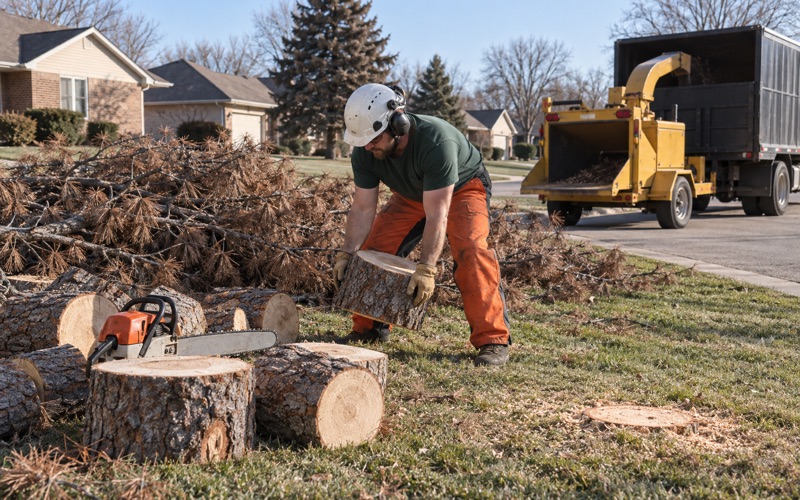
Every stick leaves with us. GFL collects here on Tuesdays and takes up to ten biodegradable paper bags of yard waste a week, which is a leaf-and-clipping service rather than a trunk service.
The commercial composting gate in the Northland prices brush by the cubic yard, refuses stumps with dirt and rock still attached, and caps both log length and diameter. Its free Saturday drop-off is gated behind a Kansas City, Missouri identification that an address in this city does not satisfy. Missouri law bars yard waste from a solid waste disposal area outright, so a dumpster is not the quiet alternative it looks like.
All of that is priced work rather than an afterthought, and none of it is guesswork on the day. We tell you where the wood and the grindings are going before the saw comes out of the truck.
The notice that goes on the property record
Section 15.60.060-B.3 is the sentence most people miss, and it outlives everyone involved in the job. Replacement trees may not themselves be removed or effectively destroyed without a valid tree removal permit — and “the original permittee and owner of any property on which trees have been replaced or relocated shall place on record a notice that shall inform subsequent purchasers, assigns and occupants of the replacement site that trees on the replacement site may not be removed without a valid tree removal permit.”
That is a recorded notice about trees, running with the property. A replanting done this spring is a disclosure at the next closing, and a buyer here can inherit a restriction that already has a paper trail behind it.
Which is why the record of what was planted, where, and at what size is worth keeping in a form somebody can actually produce years later. Every job we do leaves a written condition assessment behind it — something you can hand to a neighbor, an adjuster, a buyer or the city, not a number scribbled on a card.
Who actually orders this work
Most of this is not single-family work, and the housing numbers say so plainly. The American Community Survey records 633 owner-occupied one-unit detached houses in the entire city, 74.06 percent of occupied units rented, and only a third of the stock one-unit detached — two thirds of it attached or multifamily.
So the name on a permit application here is usually a property manager, a commercial owner, an owner’s agent or a developer, and the code contemplates exactly that: an owner’s agent, a lessee, an optionee, a contract purchaser or the holder of an easement may all apply. Proof of insurance reaches you before a crew sets foot on the property, every time, on a managed portfolio as much as on a single address.
There is no license to look up
Neither Missouri nor Kansas licenses tree work, so there is no state card in this trade for anybody to produce on request. What stands in its place is ISA certification on the technical side and verifiable general liability and workers’ compensation coverage on the business side, and you should ask for both from anyone quoting this work.
The rest of the answer is twenty years of removals on both sides of State Line Road. Missouri and Kansas do not write these rules the same way, and knowing which set applies at a given address is most of what keeps a replacement obligation from becoming a surprise.
- 20+ Years in Johnson County
- Insured, Proof Sent First
- Free On-Site Assessment