Shawnee Tree Removal has worked as an arborist in Olathe for more than twenty years, and on an Olathe job the first thing we settle is not how the tree comes down. It is where the tree goes afterward.
Olathe runs a free compost gate that takes exactly the material a removal produces, and closes it by written rule to the company doing the removing. That is why haul-off here is a priced leg of the work rather than a short trip down Hedge Lane, and why our estimate says where the logs, the chip and the grindings are going before the saw leaves the truck.
The on-site assessment costs nothing, the number we quote is the number you get in writing, and proof of insurance reaches you before a crew arrives. You also get a written condition assessment you can hand to a neighbor, a board or an adjuster, and where cabling and bracing or structural pruning saves the tree, we price that instead of a removal.
Do you need a permit to take down a tree in Olathe?
Not for a tree on private ground. Olathe publishes no permit requirement for private removal, and the shape of the code shows why: Chapter 12.16, Trees and Shrubs, sits inside Title 12, Streets, Sidewalks and Public Places. Its four sections are 12.16.010 Damaging Prohibited; 12.16.020 Trees Overhanging Public Property, Trimming Required; 12.16.030 Trees and Shrubs on Public Property, Duty of Adjacent Property Owner; and 12.16.040 Traffic Hazard, Removal Notice. There is no permit section in that chapter, no diameter threshold, no application and no fee.
The duty here runs the other way
All four sections govern the interface with public space, and together they invert the usual conversation. An owner has to trim growth overhanging a sidewalk or street where it impedes traffic, has to take down a dead tree that has become likely to fall across a public way, and carries a maintenance duty for trees and shrubs on public property adjoining the lot. Section 12.16.040 is the traffic hazard removal notice, the city’s route for compelling work that has not happened.
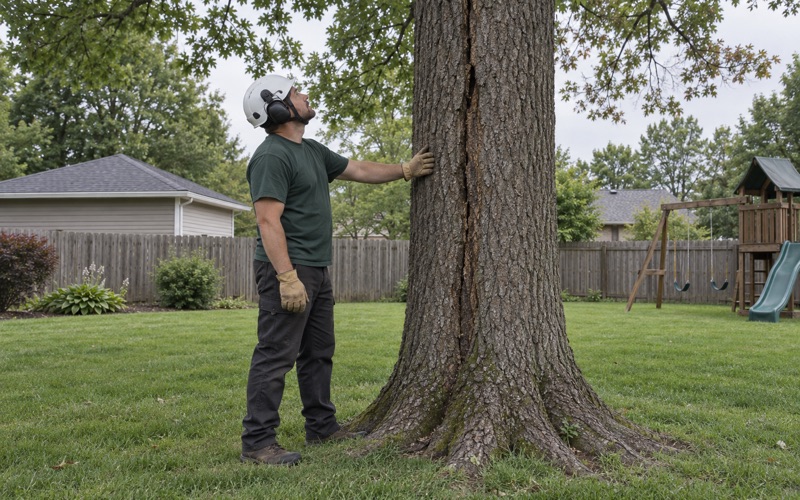
The exposure in Olathe is not felling a tree you were not allowed to fell. It is leaving one up until the city notices it first. When a street-side tree carries a conk at the root flare, or included bark in a co-dominant union over the walk, we would rather measure and photograph it now than read the notice later.
The provisions that do bind run with development rather than with a homeowner. The Unified Development Ordinance carries a landscaping and screening section and a tree preservation section, and the preservation credit there covers hardwoods and evergreens between 2.5 and 8 inches in caliper measured 4.5 feet above ground, a far smaller tree than a removal usually involves. If your work sits inside a plan review, the Planning Division is the desk that reads them.
A city arborist, and a plan that covers public trees only
Olathe has a City Arborist in Parks and Recreation and a $1 million federal Urban and Community Forestry grant behind a five-year plan, Fostering Forestry, aimed at canopy cover, resiliency and the long-term maintenance of the urban forest on public land. City Arborist Jared Doran said Olathe was one of just two Kansas cities selected.
Read that scope before it worries you: a public-land planting and maintenance program creates no permit over a private lot. What it creates is a counterparty who actually exists, so when the tree in question is a street tree or a park tree rather than yours, the city arborist is the right call and we will tell you so.
Looking for tree-removal closer to Fairway? See Tree-Removal Services in Fairway.
The free compost gate at Hedge Lane, and why we cannot use it
The Olathe Community Recycling Center at Hedge Lane and 127th Street is open Monday through Saturday, 8 a.m. to 4 p.m., free of charge. Residents drop off yard waste, compost food waste and recycling there and take home compost and mulch, one load per customer per day, and the site accepts limbs and brush larger than four inches in diameter and four feet in length. That is precisely what a removal produces.
Two published conditions close it to us. Customers have to stop and check in to verify Olathe residency with a valid ID, and the city states that businesses and landscape companies are not permitted to use the facility. A contractor who tells you your tree is going to the city compost site is making a promise that fails at the check-in lane.
Where curbside ends and a removal begins
The city runs its own trash, recycling and yard waste collection, and its published limits draw the line for you. Yard waste goes out within eight feet of the curb before 7 a.m. on the collection day with a ten bag or bundle limit, and clippings, leaves and small trimmings have to be in compostable paper yard waste bags or a 95-gallon green City Yard Cart.
Limbs and brush over four inches in diameter and four feet long are not collected on that route at all. They go to the recycling center behind a resident’s own ID, or onto a scheduled bulk waste pick-up where limbs may not exceed 15 feet in length and 2 feet in diameter. The four-inch mark is a fair working definition of where a pruning job ends and a removal begins: below it the city still takes the material, above it the trip is yours or ours.
Nothing gets stacked at a curb that will refuse it
We do not leave a pile behind and call it your problem, and the arithmetic is the reason. One mature removal is dozens of bundles against a ten-bundle weekly limit, and most of the wood is over both published dimensions anyway. If you want firewood held back, say so at the estimate, because what stays changes the volume we move.
Villa and townhome takedowns on a zero-lot line
Most of Olathe is generous ground to work on: 54,594 housing units at roughly 848 to the square mile across 64.41 square miles, 71.65 percent of them one-unit detached. On lots like those a removal is rope work and a chipper, and the day runs to plan.
The exception is 9.29 percent of the stock, 5,073 one-unit attached villas and townhomes, where the geometry changes completely. The stem stands a few feet off a party wall, the natural drop zone is the neighboring unit’s roof, and there is no lay-down space for wood on a lot that is mostly building and driveway.
Rigging, not felling
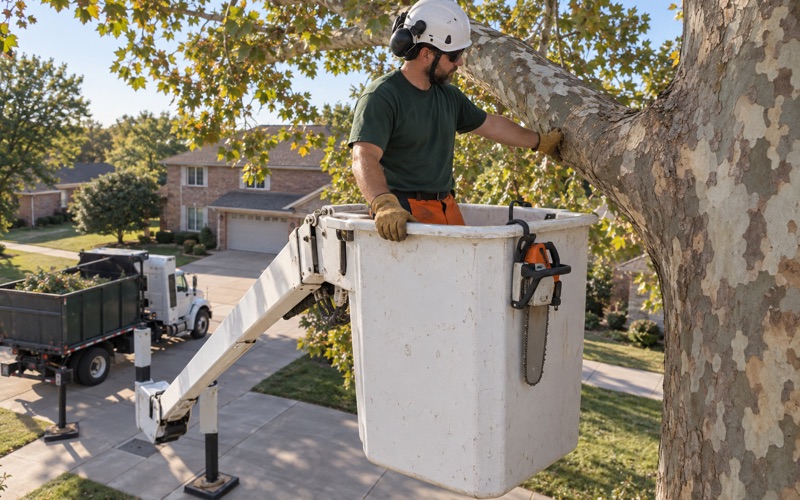
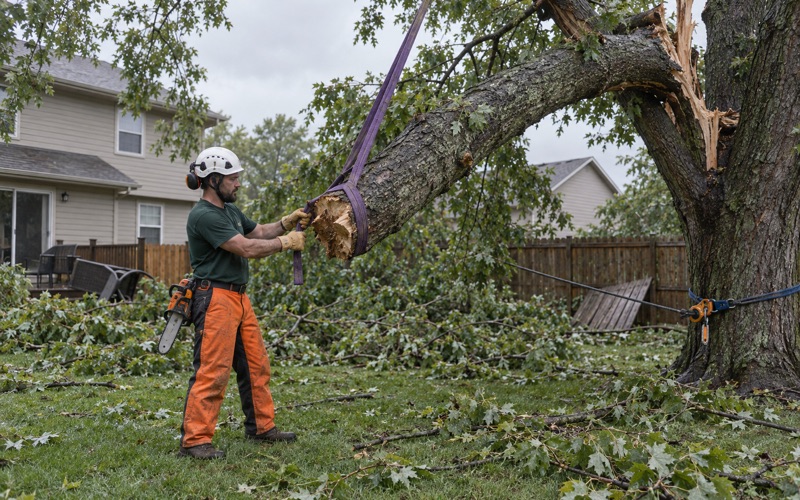
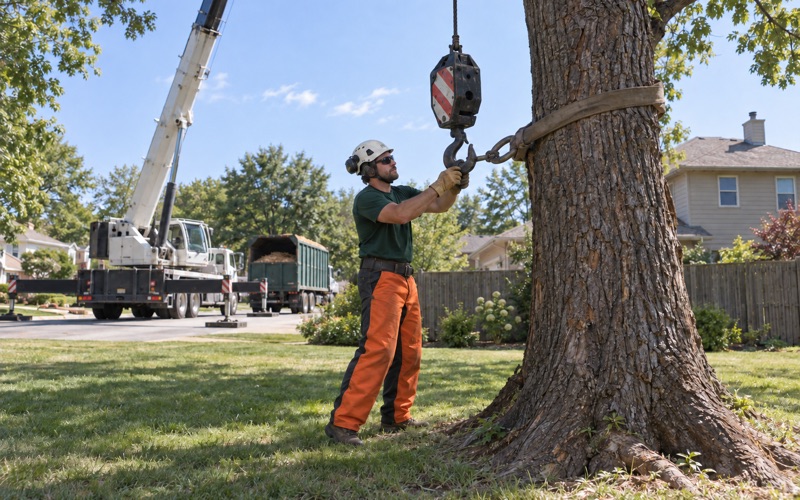
Nothing gets felled there. The tree leaves in pieces on a bull rope through a Port-a-Wrap friction device, with the working load limit matched to the weight of the piece rather than to how it looks from the ground, and the three-cut method on limbs taken by hand so nothing tears bark down the stem. Where a pick is too heavy or the landing too tight to lower into, a crane-assisted removal takes the wood over the roofline instead of past a wall.
ANSI Z133 governs how we work near people and energized conductors, and a tight lot is not a reason to bend it. If wind or ice makes a set-up unsafe we reschedule, because clearance you do not actually have is how a neighbor’s roof ends up on an invoice.
Who signs, and where your side stops
On attached product the signer is often not the resident. Homes associations and property managers routinely carry the tree, on common ground or under a maintenance obligation, and that is worth settling before a crew is scheduled rather than during a takedown.
The neighbor question has a Kansas answer and it is not the Missouri one. Kansas follows Pierce v. Casady: the remedy for branches crossing a boundary is self-help back to the property line, with no right of entry next door and no easement gained in the airspace above it. On a zero-lot line that distinction lives inside a few feet, so we establish where the line runs before quoting and write down what we can cut from your side.
What it costs to get the wood off the property
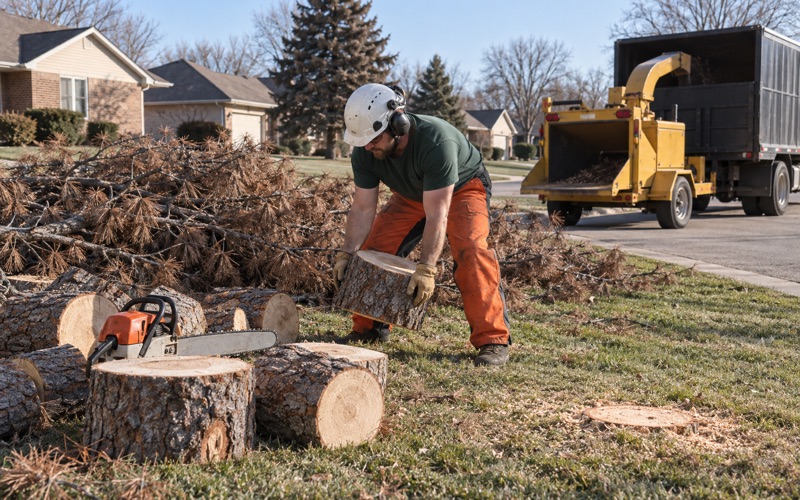
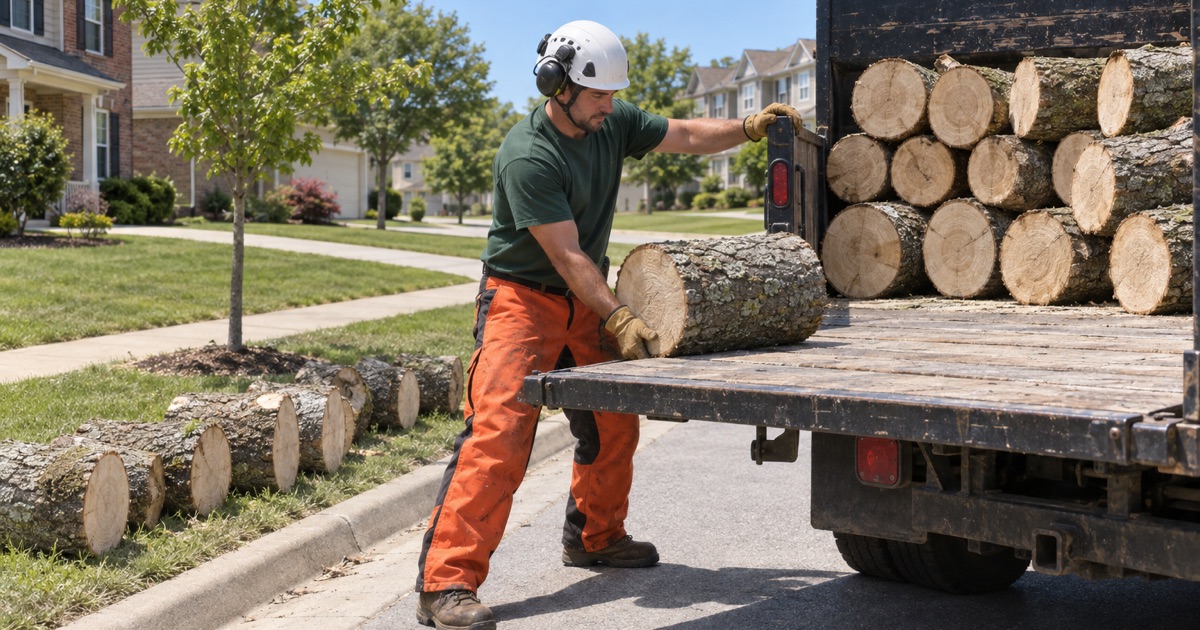
Because the municipal gate is shut to contractors, haul-off is a visible line on an Olathe estimate rather than something folded into a round number. The documented route that does take contractor removal wood is Missouri Organic Recycling in Kansas City, Missouri, at $10.00 per cubic yard for brush and $7.00 per cubic yard for lawn debris. It accepts logs up to 40 inches in diameter if they are under five feet long, and refuses stumps with dirt attached.
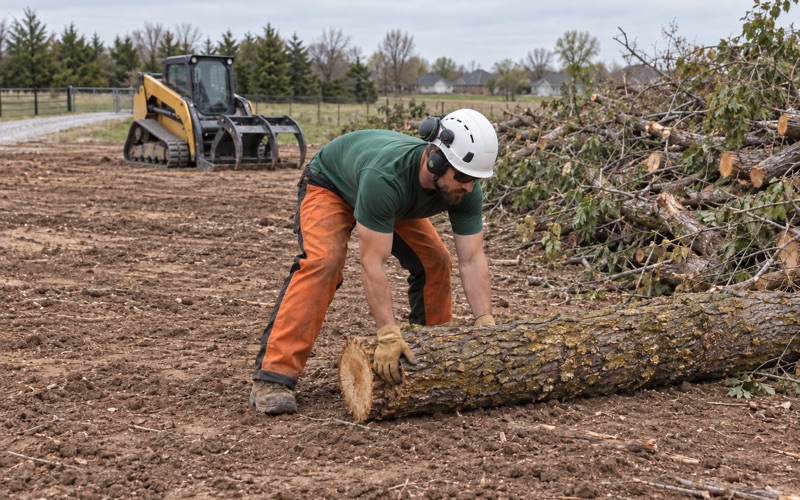
Those two rules shape the cutting, not just the invoice. Wood is bucked to a length the scale house will take rather than to whatever is convenient at the stump, and a stump that comes out whole is cleaned before it is loaded. Volume is the meter, so a crown that chips down small moves cheaper than one carried out in rounds.
The stump, the grindings and the locate
Kansas One Call at 811 goes in before a grinder turns, every time. Water here is the City of Olathe’s own utility rather than WaterOne, so the service crossing the yard belongs to the city itself, which is one more reason to have the locate on paper instead of inferred from where the meter sits.
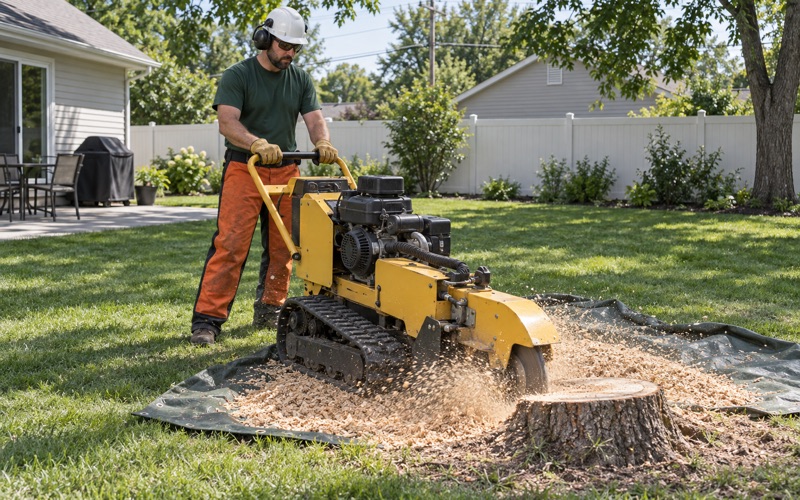
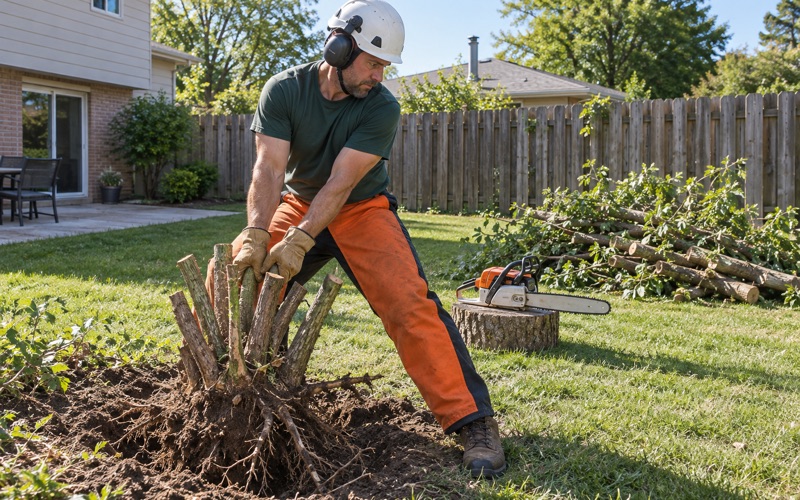
We will not promise a below-grade number sight unseen. This is cuesta ground, limestone and shale in benches, and the soil series mapped across Johnson County run from a restrictive layer at four to twenty inches down to soils with no bedrock restriction stated at all. Angular chert is the quieter problem, since a deep soil full of it wears a stump grinder tooth wheel through the whole depth of a cut without the machine ever meeting rock. Grindings are their own decision at the estimate: backfilled they mound and settle for a season, hauled off they are another volume on the ticket.
One species that carries a date
If the tree is a Callery or Bradford pear, and a fair number here are, disposal has a deadline attached to it. The Kansas Department of Agriculture’s statewide Callery pear quarantine takes effect January 1, 2027 and prohibits the sale and the movement of all seeds, plants or parts, which makes it a debris-handling constraint on the contractor rather than a nursery rule. Johnson County’s Extension brochure has warned homeowners for years against planting the Bradford cultivar because severe splitting shows up on ten- to fifteen-year-old trees, and warns more generally that fast-growing varieties are brittle with narrow crotch angles that break in storms.
That is usually why a pear comes down here: it splits rather than dies. Once one has dropped a leader we would rather quote the removal than sell a reduction that leaves half a failed union standing over a driveway.
- 20+ Years in Johnson County
- Insured, Proof Sent First
- Free On-Site Assessment