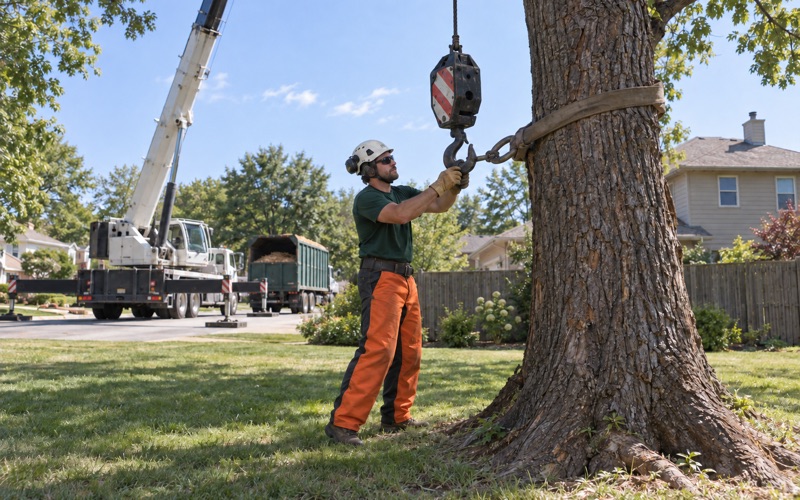
Shawnee Tree Removal has been running tree service in Overland Park for more than twenty years, and the question we field first on almost every driveway here is whether the homeowner needs anyone’s permission before a tree comes down. On a finished residential lot the answer is no. There is one narrow exception, and it surprises people, because it has nothing to do with the species, the spread or the condition of the tree.
That exception is airport zoning. It asks two questions only: how tall the tree is, and where it stands. We work removals across Johnson County and on both sides of State Line Road, where the same tree can sit under opposite rules depending on which state the address is in, so establishing which rule reaches your property is part of the estimate rather than an afterthought.
The rest is ordinary discipline. The site visit and the estimate cost nothing, what you get back is a condition write-up on paper rather than a figure quoted across a tailgate, and that written number is the one we hold to. Disposal is decided before the first cut, because in a city that collects nothing itself the wood has to be going somewhere specific.
No permit on your own lot, and the one rule that ignores that
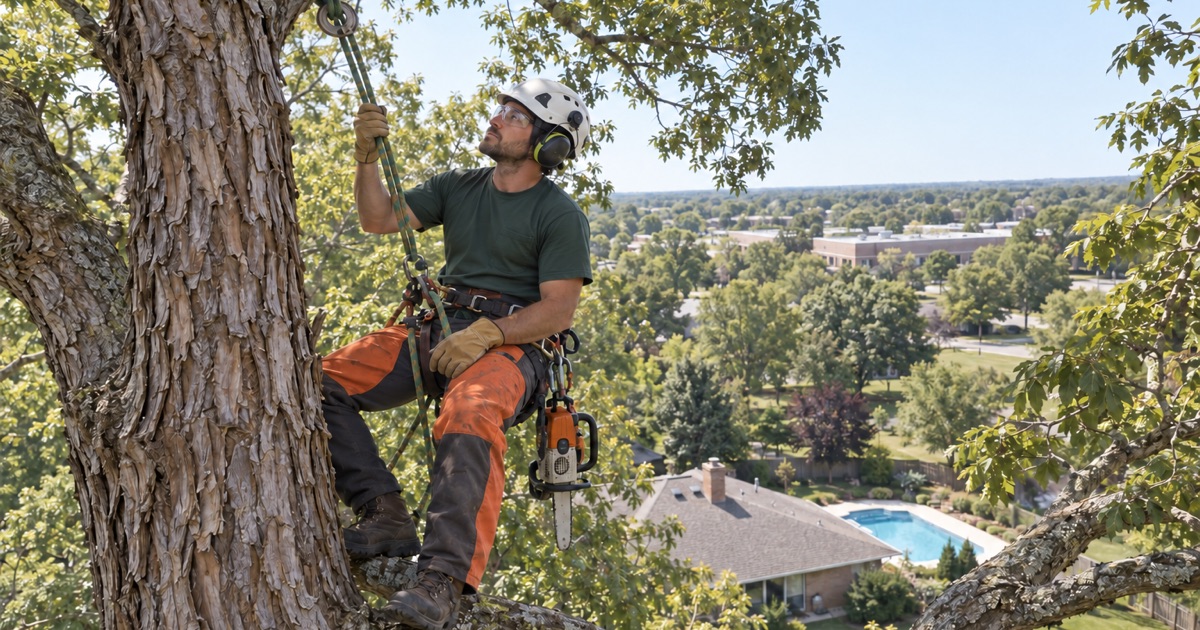
We have found no provision in Overland Park Municipal Code chapter 7.16 that requires a permit to remove a tree standing wholly on private residential property, and nothing in that chapter governs which species you plant on a finished lot. That is a clean answer and we give it as one, with the honest caveat that it rests on the absence of a requirement rather than on a section stating an exemption in so many words.
The curb strip is a different object
A tree in the right-of-way is not the same object in law as a tree in your yard. The city states on its own street trees page that removing a tree from the right-of-way is prohibited unless authorized by the city forester, and the Forestry Division rather than the abutting owner holds that authority. If the tree in question stands between the sidewalk and the curb, that is a short and different conversation; everything else on this page assumes the tree is inside your lot lines.
What decides a removal when no rule does
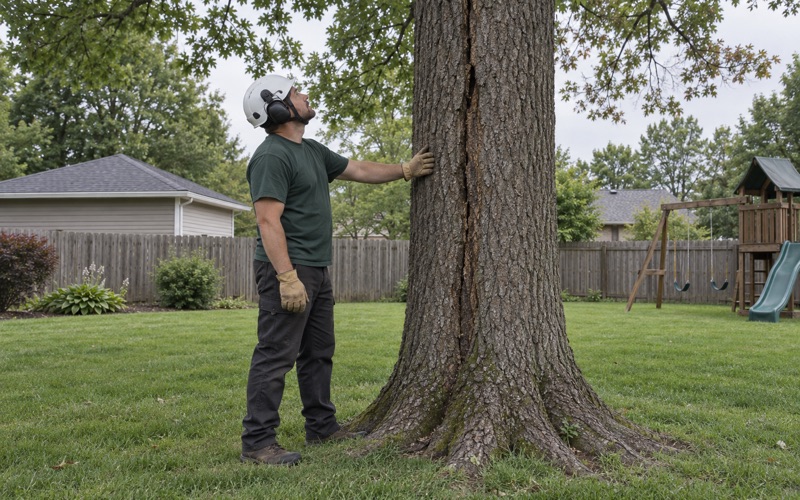
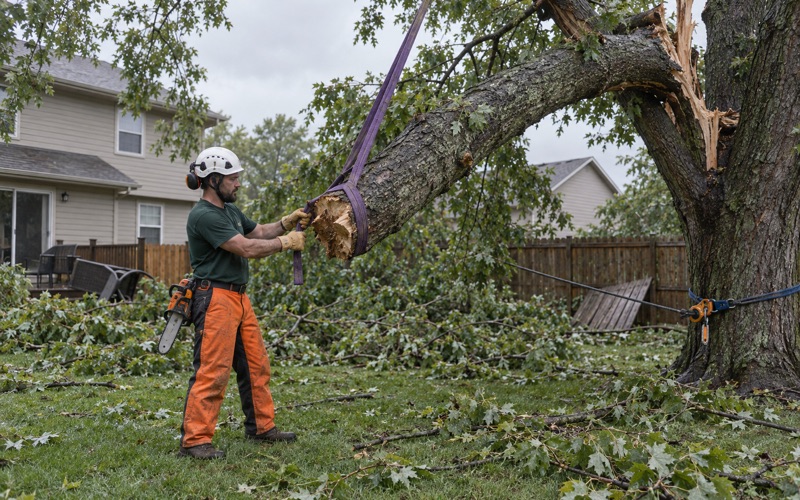
With no ordinance standing between you and the decision, the decision is condition. Evergy publishes the same short list we work from when a homeowner asks what to look for: dead or dying wood, severe lean, weak branches, root failure, cankers, conks and internal decay. On a mature tree those present as co-dominant stems with included bark at the union, a conk at the root flare, or movement in the root plate after a wind event.
None of that is automatically a removal. If cabling and bracing or a structural prune buys the tree another two decades we price that instead, and we do not top trees to make a hazard look smaller.
Looking for tree-removal closer to Leawood? See Tree-Removal Services in Leawood.
The airport overlay, and the three places it actually bites
Kansas adopted the Uniform Airport Zoning Act at K.S.A. 3-701 through 3-713, and the statute is unusually blunt about what a tree is. K.S.A. 3-701 defines “Tree” as “any object of natural growth,” and defines an airport hazard to include “any structure or tree or use of land which obstructs the airspace required for the flight of aircraft in landing or taking-off.” K.S.A. 3-707(1) then binds every local airport zoning ordinance in the state: before a nonconforming tree “may be replaced, substantially altered or repaired, rebuilt, allowed to grow higher, or replanted, a permit must be secured from the administrative agency authorized to administer and enforce the regulations.” Missouri, on the other side of the state line, has no general airport zoning act at all.
The local instrument here is Johnson County Zoning and Subdivision Regulations Article 21, “Airport Vicinity Overlay Districts and Zones,” whose section 15(E) states that the regulations take effect “from and after its adoption by all affected jurisdictions: the City of Gardner, Kansas, the City of Olathe, Kansas, the City of Overland Park, Kansas, and the County of Johnson, Kansas.” Overland Park is a named adopter. Article 2 carries that same definition of Tree, “any object of natural growth,” into the Article, and the two fields behind all of it are Johnson County Executive Airport (OJC) and New Century AirCenter (IXD), both owned by Johnson County.
The 75-foot floor, which is the honest half of it
Most trees in this city never touch the rule. Section 9(C) reads that nothing in the Article prohibits growth of any tree “to a height up to 75 feet above the surface of the land,” and section 9(D)(1)(c) requires no permit in the horizontal and conical zones “for any tree or structure less than seventy-five (75) feet of vertical height above the ground, except when, because of terrain, land contour, or topographic features, such tree or structure would extend above the height limits prescribed for such zones.”
In the large outer rings, then, an ordinary residential shade tree sits below that floor and the overlay is a piece of trivia. We quote the definitions and the permit clause and stop there, and we never put a surface figure into an estimate.
Three places it reaches a finished lot
The first is a tree that is already nonconforming, where the statute’s permit before a tree is “allowed to grow higher” or “replanted” applies whatever the floor says. The Article shuts the same door from its own side: section 9(D)(2) bars any permit that would “permit a nonconforming, structure or tree or nonconforming use to be made or become higher,” and section 12(C)(4) says such a tree “shall not be expanded so as to permit it to be made or become higher.”
The second is a lot inside an approach or transitional zone near a runway, where the protected surface itself drops below seventy-five feet and section 9(A) — that “no structure or tree shall be erected, altered, allowed to grow or allowed to exist” above the applicable limit — starts to matter at ordinary canopy height. The third is a terrain-elevated lot, which the ordinance carves back in expressly through its own terrain and contour language.
The shape of that is backwards from every other tree rule we deal with. Taking the tree down needs nobody’s permission; letting it keep growing may. Section 15(D)(1) is the release valve, letting a landowner apply for a variance to “permit the growth of any tree.”
The ash the city is taking out, and the ash it says it will not
Overland Park is working through its ash street trees, roughly 2,370 to 2,434 of them at a published cost of roughly $865,000 to $980,000, and the city says in the same breath that the project to remove street trees does not include trees on private property. Emerald ash borer does not read a plat. The result is a municipal program that generates private demand and then declines, in writing, to serve it.
Practically, that splits one street into two jobs with two owners: the ash on the curb strip belongs to the city’s program and the ash forty feet behind it belongs to you. The two are rarely scheduled together, and nothing about the public removal moves the private one up any list. If both are coming out, it is worth sequencing them, because one crane setup and one chipper cycle on your property costs less than two.
Two cities inside one city
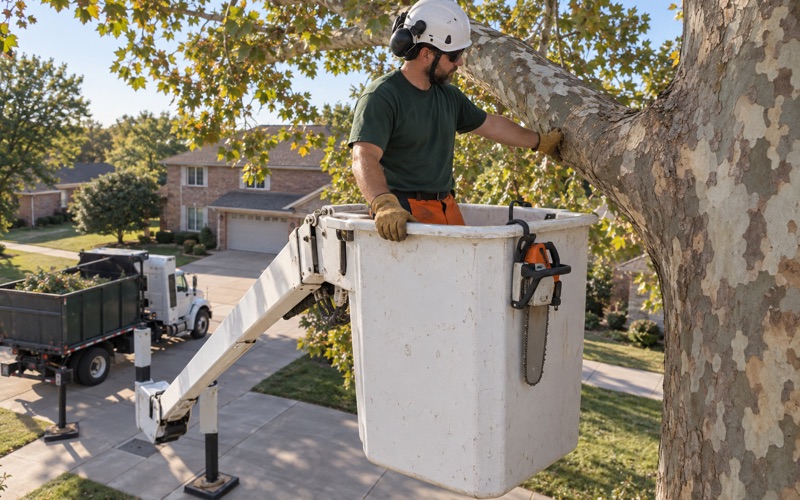
The headline census figures make Overland Park read as a newer suburb: of 89,079 housing units, 10.59 percent predate 1960 and 33.51 percent predate 1980, while 16.02 percent were built in 2010 or later. Underneath that, 11,105 units date from the 1960s and 6,813 from the 1950s, and they sit in the northern third of the city on narrower plats under sixty- and seventy-year-old canopy. On that end the work is crane-assisted removal and rigging between houses standing close together. On the southern edge it is the first removal cycle of trees planted with the house.
The ground is not uniform either
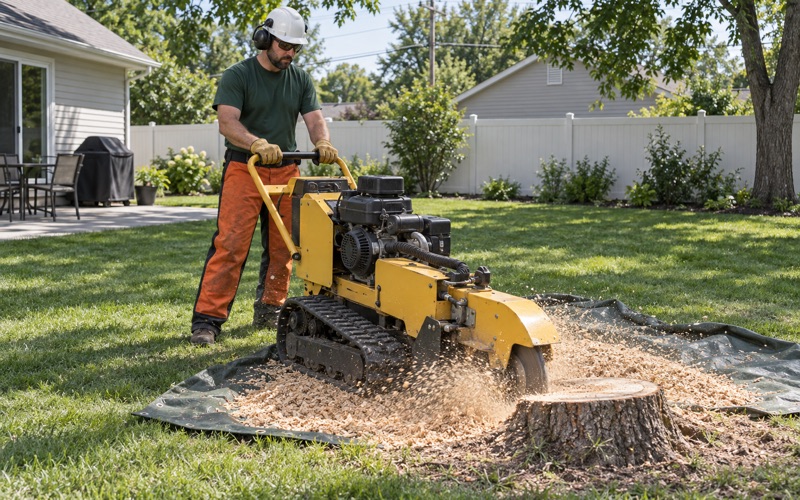
The city covers 75.280 square miles, and neither the housing nor the soil holds still across it. On the newest subdivisions the material under a stump is not the mapped residuum at all but imported fill and compacted subgrade, which the soil survey does not describe and which changes both the grinding and the shape of the root plate. On older residual ground in eastern Kansas the constraint runs the other way, with a shallow solum over interbedded limestone and shale, where the stump grinder tooth wheel reaches rock before it finishes the cut. Kansas 811, at 811 or 1-800-DIG-SAFE, goes in ahead of any of it.
Where the debris goes in a city that runs no gate at all
Overland Park operates no city trash or yard waste collection and no city gate. It permits haulers and leaves the rest to the contract, and its published requirement on yard waste is two sentences long: “Yard waste must be bundled in lawn bags; plastic bags will not be picked up,” and “Haulers collect yard waste at least 40 weeks per year.” Read literally, that second sentence allows up to twelve weeks a year with no yard-waste collection at all. The city sets no diameter cap on what goes out either; the hauler does, in paperwork a homeowner has to dig out of a drawer rather than look up in a public rule, and reported residential rates inside the same city limits run from $18 to $44 a month.
The hauler permit, and the sentence to read twice
Overland Park Municipal Code 7.36.110 provides that “No Person shall engage in the business of the Collection of Solid Waste or Recyclables within the City without first obtaining a Hauler Permit, and a separate” Hauler Vehicle Permit, with the fee schedule for both “fixed by the City Manager” and fees “paid in full upon application.” An applicant must also hold the applicable county license under the Johnson County Solid Waste Regulations, and the city permit is void if that license is revoked.
Then comes the exemption: “Hauler and Hauler Vehicle Permits shall not be required for the Collection or Disposal of Bulky Waste, Construction and Demolition Waste, or earth and rock material from grading or excavation activities.” Which side of that sentence a load of limbs, trunk rounds and stumps falls on turns on definitions we have not read, so we publish no answer to it — but any contractor quoting work in this city ought to settle the question before the truck rolls.
The outlets, and why we grind
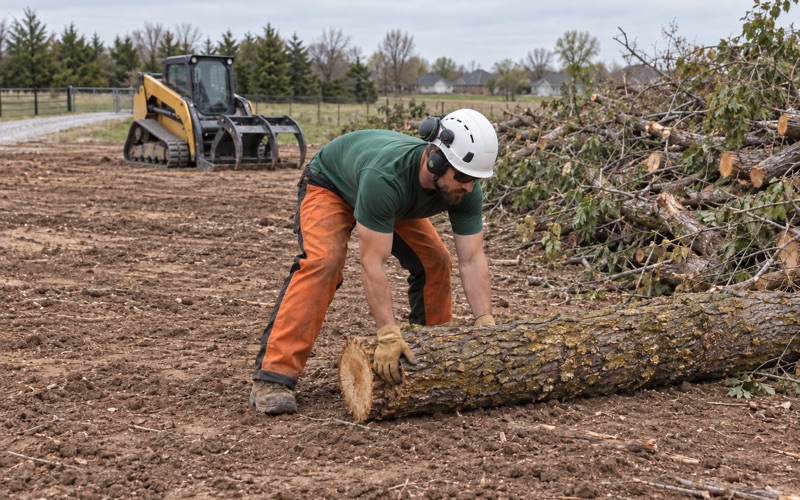
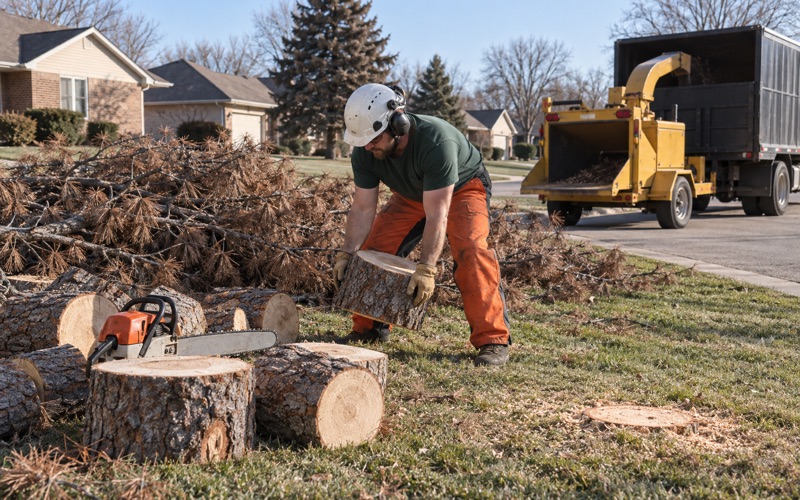
Johnson County runs no county-wide public yard-waste gate. The county landfill caps landscape waste at 3 inches in diameter, which excludes most of what a removal produces, and the Olathe compost site is stated by the county to be for Olathe residents only. The drop-off the county points Overland Park residents toward is the WM customer convenience center at 17955 Holliday Drive in Shawnee. Missouri Organic Recycling takes brush at $10.00 per cubic yard and lawn debris at $7.00 per cubic yard and accepts logs up to 40 inches in diameter if they are under 5 feet in length, and it refuses “Stumps with dirt.”
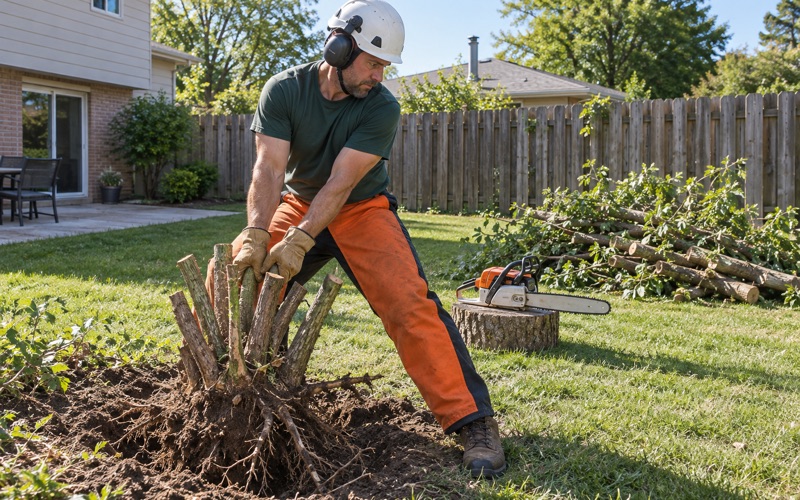
That last refusal is the whole economic argument for grinding a stump here rather than pulling one: a pulled stump comes out of the ground already disqualified from the nearest place that would take it. The grindings stay or go as you prefer, and the tree itself leaves on our trucks, so nothing is stacked at a curb no city vehicle is coming for. Our proof of insurance reaches you before the crew does.
- 20+ Years in Johnson County
- Insured, Proof Sent First
- Free On-Site Assessment