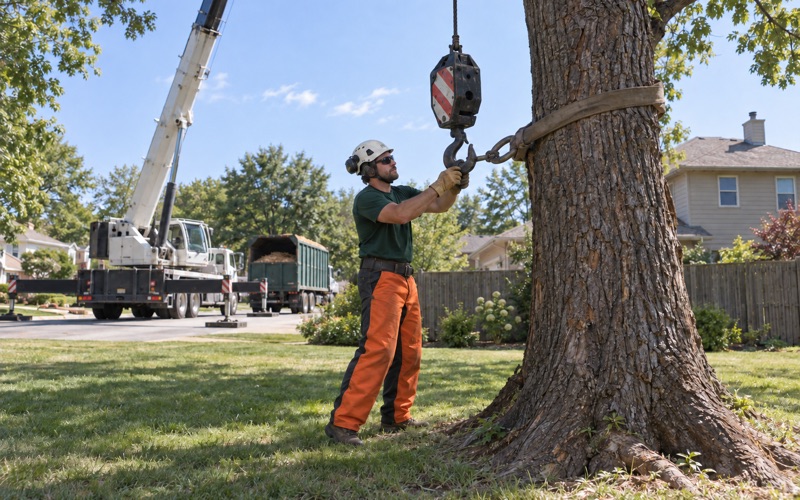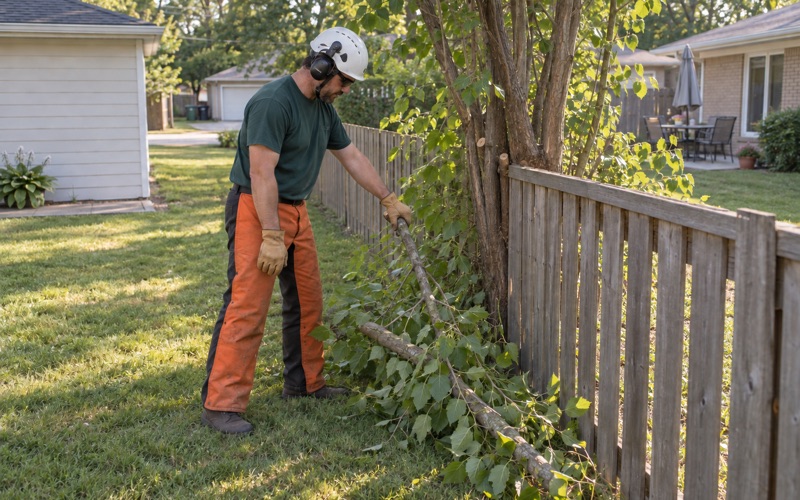
Shawnee Tree Removal has been handling tree removal in Parkville for more than twenty years, and what separates a job here from one across the state line is not the saw work. It is who has to say yes. In this city, in almost every case, the only person who has to say yes is you.
The tenure numbers say it plainly: 82.32 percent of Parkville’s occupied homes are owner-occupied, and there are only 522 renter-occupied units in the entire city. The person living under the tree is almost always the person deciding about it and the person paying for it, which makes this a homeowner conversation rather than a chain of calls between a property manager, an owner out of state and a code officer.
That runs both ways. Nobody is going to force the schedule for you, so the work happens when you decide the risk has earned the money. Our on-site assessment is free, the number we quote is the number you get in writing, and proof of insurance reaches you before a crew sets foot on the property.
The decision is yours, and so is the bill
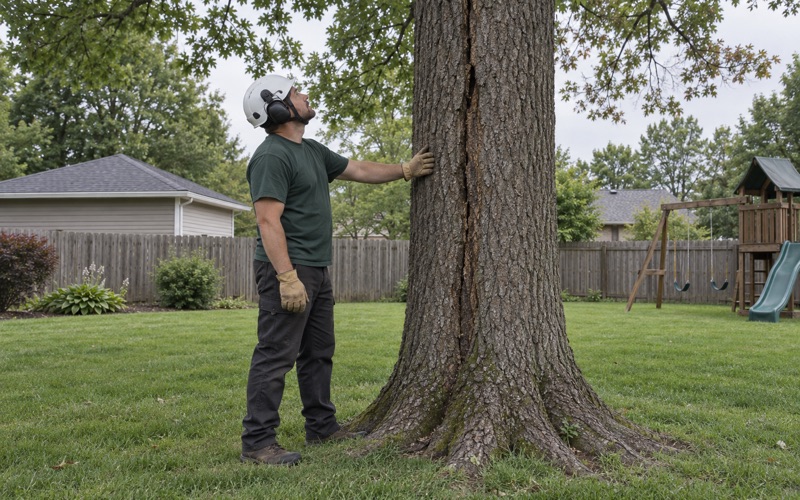
When one household owns the decision rather than a company, what people want out of the visit changes. They are not after a letter that satisfies an inspector; they want to know whether the tree is genuinely a problem, what solving it costs, and what happens to the mess afterward. So you get a written condition assessment setting out what we saw and why we would take the tree or leave it standing, something you can hand to a neighbor or an insurance adjuster rather than a figure scribbled on the back of a card.
It also means we tell you when the answer is not a removal. If cabling and bracing or a round of structural pruning buys the tree another twenty years, we say so and price that instead. We do not top trees, and when somebody else offers to, we will show you what it does to the wood a few years on.
The neighbor’s tree, under Missouri law
Kansas and Missouri do not answer this question the same way, and after two decades working both sides of State Line Road we can tell you which answer governs at your address. On this side, Missouri follows the Massachusetts rule: no cause of action against a neighbor over a healthy tree, and the complaining owner’s remedy is self-help back to the property line at that owner’s own cost.
The other half of the statute is what makes the line worth respecting. RSMo 537.340.1 gives treble damages against anyone who cuts down, injures, destroys or carries away a tree placed or growing for use, shade or ornament, and the claimant need not prove negligence or intent to collect them. Trimming to the line is your right; the cut that lands past it is expensive in a way most people never see coming.
Where the wood goes
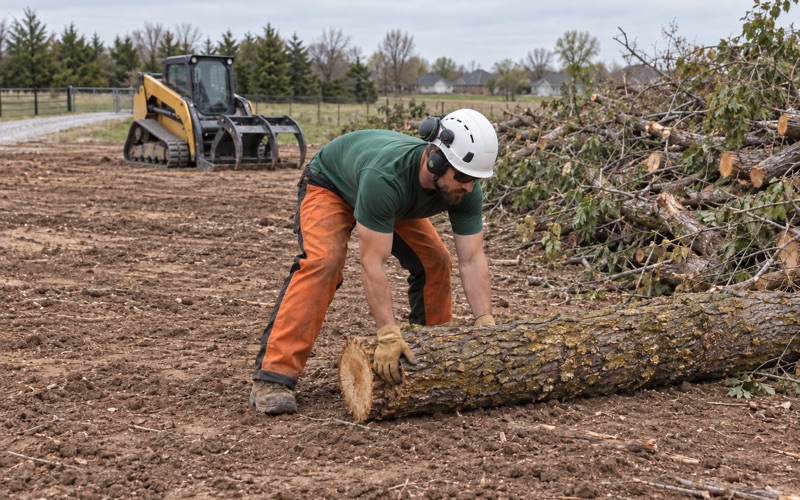
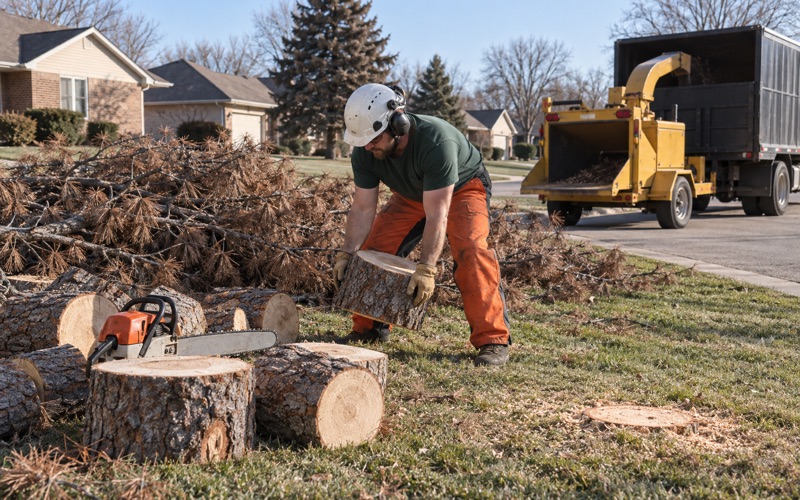
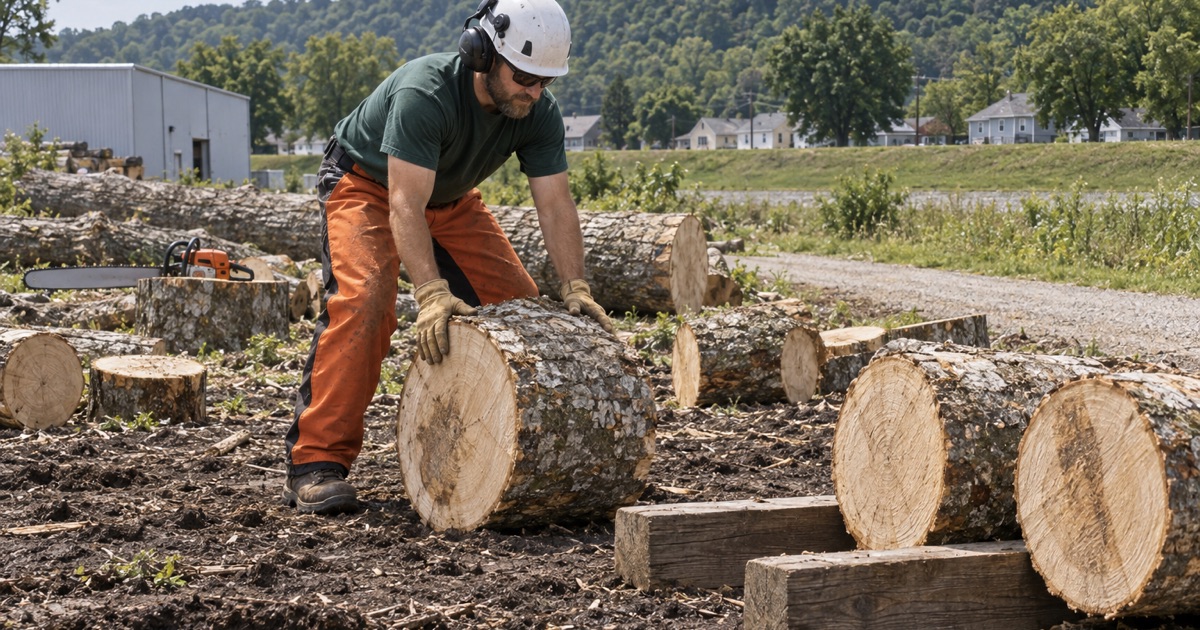
We tell you where the wood and the grindings are going before the saw comes out of the truck, and every stick leaves with us. That is not merely a courtesy here. The free yard-waste drop-off the city runs for its own residents states plainly that businesses are not accepted, so a working crew has no local gate at all and the disposal leg gets priced into the quote and driven elsewhere.
The city’s curbside pickup caps limbs at four feet, which no part of a mature trunk is ever going to meet. RSMo 260.250 separately keeps yard waste out of a Missouri solid waste disposal area, which is why every outlet within reach of this address is a composter rather than a landfill.
Looking for tree-removal closer to North Kansas City? See Tree-Removal Services in North Kansas City.
What the city’s rules reach, and what they do not
Trees appear in Parkville’s code in two places, and neither of them is your back yard. The first is the city parks chapter, whose stated purpose is to promote the planting, maintenance, restoration and survival of desirable park trees, shrubs and other plants on public park land, and to protect residents from injury and property damage caused by improper removal of them. That same chapter puts the power to take down an unsafe park tree with the Director of Parks and Recreation. Public park ground is the whole scope of it, and the distinction is the point.
The second is Chapter 407, Site and Landscape Design Standards, in Title IV, comprehensively updated by Ordinance No. 3246. It is a development-side standard, concerned with where trees sit on a site plan relative to a curb, a driveway or a parking area, which is a question asked at the design stage rather than fifteen years later when a homeowner wants one out.
So the architecture is public land and the site plan. Nothing we found reaches a homeowner removing a tree in their own back yard, and we will not put that the other way round in stronger words than these: we have not read the full text of the code ourselves, so what we found settles nothing in either direction. Code questions route through the city’s Communications Director at 816-741-7676.
Burning, and where the state rule flips at the city limit
Missouri’s open burning rule, 10 CSR 10-6.045, applies statewide and counts tree trunks, limbs, trimmings, vegetation and yard waste as vegetative waste, while prohibiting trade waste and construction or demolition debris other than untreated wood. A homeowner burning their own yard waste on a residential premises of four units or fewer is not caught by the rule’s prohibitions at all.
A contractor inside a city limit is a different matter. A commercial land clearing burn within the limit, or within 200 yards of an occupied structure, is conditioned on burning only between sunrise and sunset, staying at least 200 yards from the nearest structure, supervision at all times, and notifying the local fire control authority beforehand, which here is the Southern Platte Fire Protection District. On an in-town lot that setback is not a condition anyone can actually meet, which is another reason the brush leaves on a truck.
The utility right that does not attach here
Parkville does not own its electric system. The city’s own utility contacts page names Evergy at 888-471-5275, and that single fact does more legal work than most homeowners expect.
Missouri gives property owners real leverage over utility tree work, but the statute is written to bind an electric supplier, and it defines the term narrowly. RSMo 537.340.3 reaches a chapter 394 rural electric cooperative, an electrical corporation required by its bylaws to run on the not-for-profit cooperative plan while serving a majority of its customers in third-classification counties, a chapter 91 municipally owned or operated electric power system, and a municipally owned utility whose service area is fixed by statute, service agreement or other authority. Evergy is an investor-owned electrical corporation, and on the face of that definition it matches no limb of it.
Two rights people assume they hold therefore do not attach at a Parkville address. One is the fourteen days’ notice a supplier owes before a removal, emergencies aside. The other is the written request an owner may make when a partially trimmed tree dies within three months, the one that puts the removal on the supplier’s expense with ninety days to respond.
A homeowner on cooperative line elsewhere in this county has both of those. A homeowner here has neither, which is precisely why nobody should describe this metro as having one utility answer. It changes with the address, and getting it wrong costs somebody a right they never knew to ask for.
What you can read instead
What does apply on the investor-owned side is the Missouri Public Service Commission’s vegetation management rule, 20 CSR 4240-23.030, and its useful feature is paperwork. The utility files an annual report under it, so the trim cycle, the miles scheduled and the clearance guideline are public record you can read before anyone argues with you about a limb.
That is a Missouri-side advantage worth using. The same homeowner across the state line has no equivalent filing to pull, so at this address we point people at the report rather than at a phone queue.
Back yards, drop zones and who to call first
More than half of Parkville’s housing, 54.25 percent of it, was built in 2000 or later, and 29.16 percent since 2010, against 2.34 percent standing before 1950. The trees coming out of those subdivisions were planted with the houses, so most of this is first-removal-cycle work: pear cultivars splitting at the unions they were bred to grow, and screen conifers set on centers far tighter than their mature spread ever allowed for. On the conifers the usual endings are pine wilt in Scotch and Austrian pine and Rhizosphaera needle cast in Colorado blue spruce.
That is not the whole city. The historic downtown was platted in 1844 and Park University has been on its ground since 1875, so genuinely old trees exist here too, and a blanket claim about the age of this canopy would be wrong in one direction or the other. We quote the tree in front of us.
The constraint is the back yard, not the curb
At 76.56 percent one-unit detached and roughly 214 housing units to the square mile, this is a large-lot pattern rather than an alley-and-fence one. The tight spot is almost never the street. It is the gate, the side yard and whatever the drop zone behind the house has to clear.
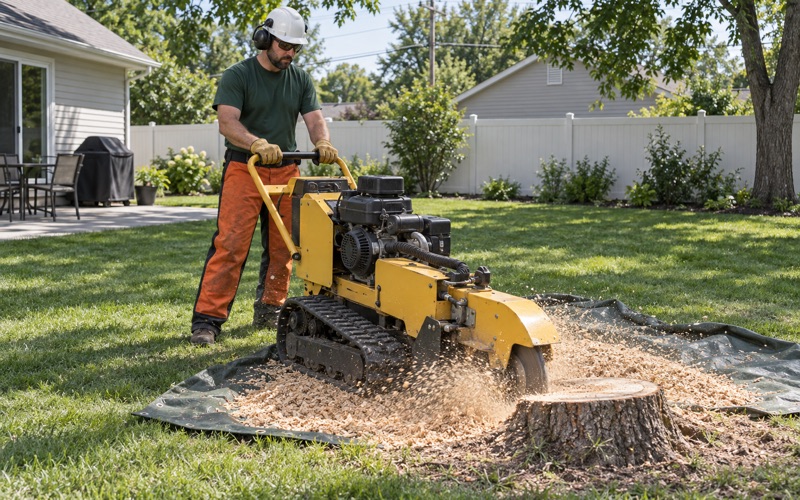
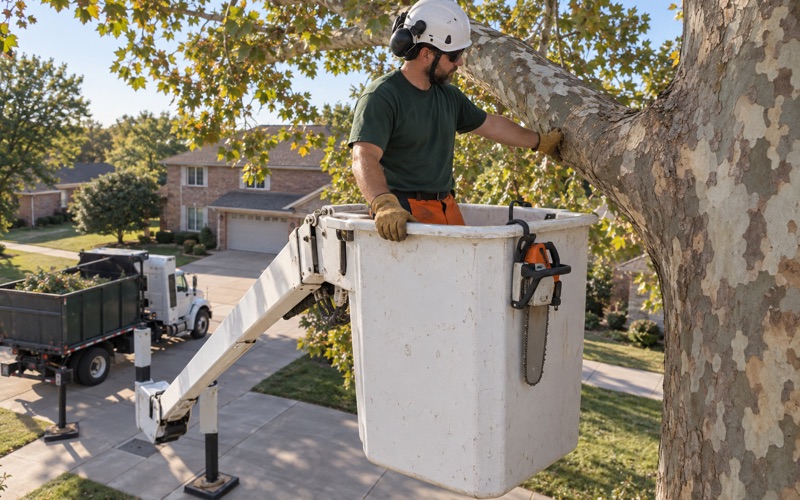
What binds there is machine width and brush handling rather than horsepower. Compact grinders and tracked lifts are built for gates in the 25-to-35-inch class, while a chipper, seven to eight feet wide and around ten thousand pounds, never goes through a gate at all, so the brush travels to the machine instead.
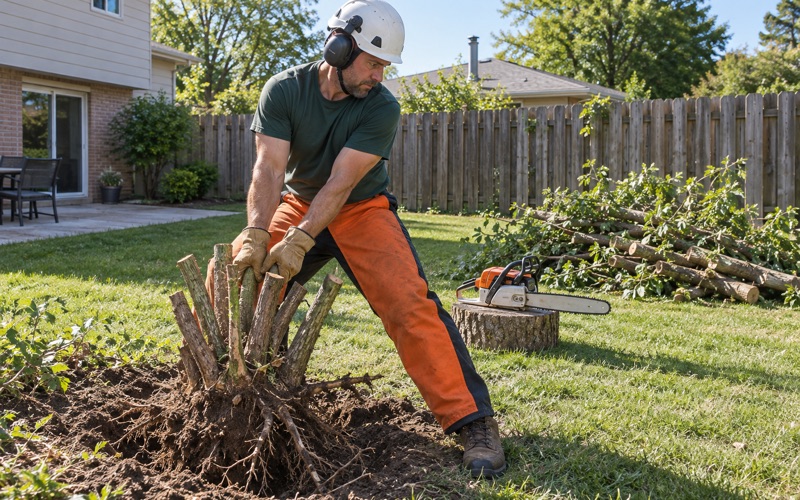
Width and cutting reach are not coupled either, which is where quotes go wrong. Some 35-inch machines still reach 25 inches beneath the surface, and a dual-wheel option takes that same machine to 56, so the honest way to quote is by the machine as it will be configured on the day. We will not name a depth for a stump we have not stood next to.
Check the plat rather than the age of the street. A 2004 subdivision can have a twenty-eight-inch side gate and a 1960s street can be wide open, and guessing from the era is how a crew shows up with the wrong machine on the trailer. Before anything goes into the ground for a stump, the call is Missouri One Call at 1-800-344-7483.
Storms, and the order to call in
Parkville sits in NWS forecast zone MOZ028, Platte County zone MOC165, under the Kansas City/Pleasant Hill forecast office. That is a different zone from the Clay County cities east of here, and the boundary is operational: a warning can be issued for one county and not the other. Nobody works near energized conductors during a thunderstorm, high wind, snow or ice, because the Z133 safety standard is flat about it, and we hold to that even when the phone is ringing.
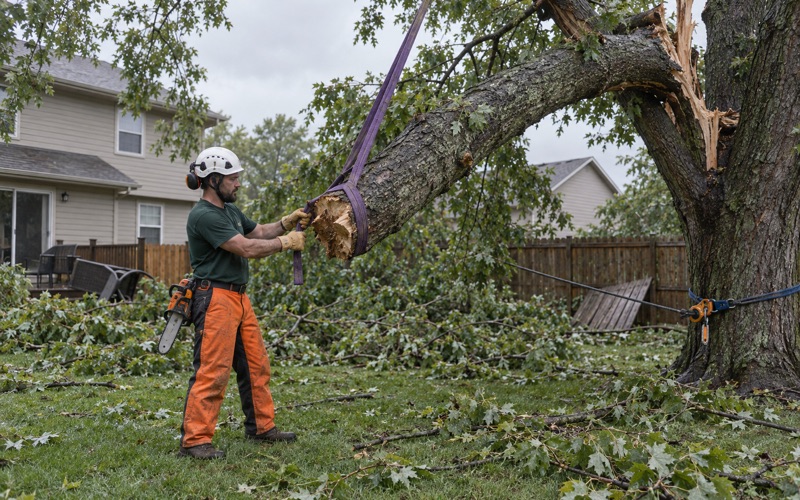
Once the weather has passed, the order of the calls matters. A downed conductor or a downed pole is Evergy’s outage line, since City Hall does not operate the electric system and cannot de-energize anything. A fire, a burning tree or a burn notification is the Southern Platte Fire Protection District. A tree on public park ground belongs to the Director of Parks and Recreation, and a code or ordinance question to the Communications Director at 816-741-7676.
For the tree itself, on a roof, on a car or across a service drop, we respond the same day. Everything we take down leaves with us, so what you are left with the following morning is a cleared yard rather than a pile waiting on somebody else’s schedule.
- 20+ Years in Johnson County
- Insured, Proof Sent First
- Free On-Site Assessment