Shawnee Tree Removal has been doing tree removal in Platte City for more than twenty years, and most of what we take down here is not an emergency. It is a tree somebody has been watching for two seasons and finally wants a straight answer about. We remove, we grind stumps, and we say so plainly when a removal is not the right call and cabling or a crown reduction would buy the tree another decade.
The straight answer in this city has an unusual shape. There is no permit counter to visit before a crew starts a removal on ordinary private ground; the pressure runs the other direction, out of the nuisance chapter, and it reaches a tree that is still alive and still leafing out. A homeowner who knows that reads a letter from the city very differently than one who does not.
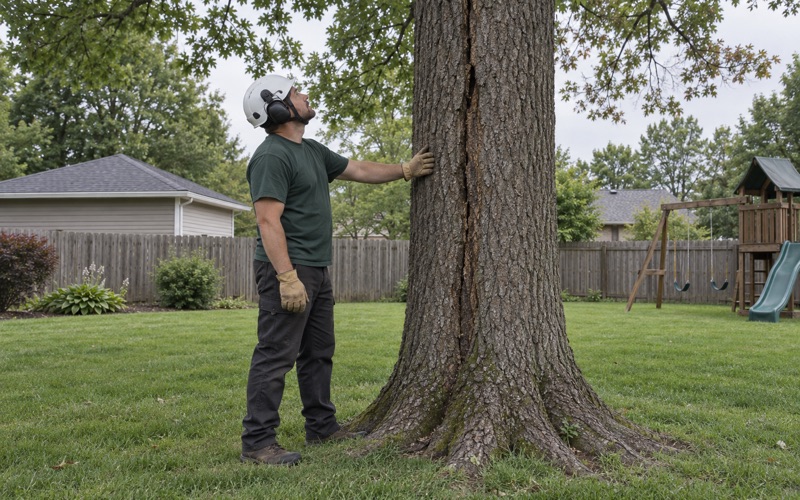
So we quote the way that situation demands. The on-site look is free, the figure we put on paper is the figure you pay, and you get a written condition assessment describing what we found in the trunk, the root flare and the unions — a document you can hand to a landlord, a manager or an adjuster. Proof of insurance reaches you before anyone parks on the property.
A living tree can already be a violation here
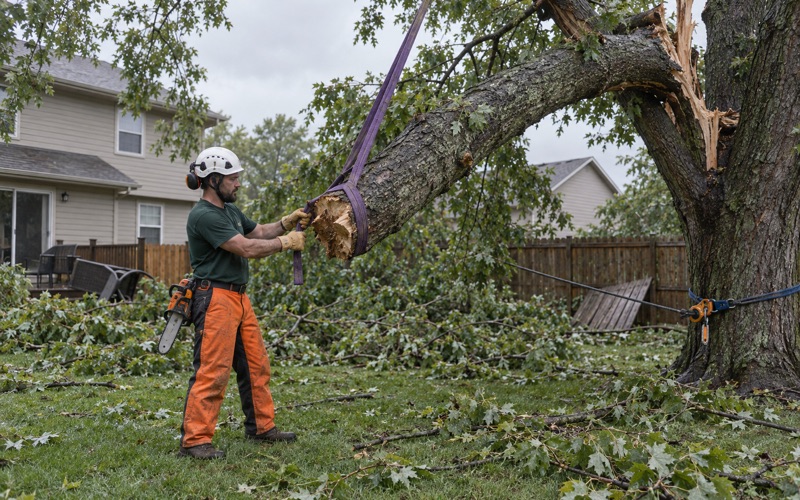
Platte City Code Section 215.050(A) reads: “A live or dead tree which constitutes a hazard to the safety of persons or of property, private or public, is hereby declared to be a nuisance and prohibited.” The word doing the work is live. Most municipal tree language waits for a tree to die before the condition becomes the city’s business, and this section does not wait at all. The same subsection lets city representatives enter private property at reasonable times to investigate a tree that has been reported as hazardous.
The sixty-day letter
Subsection B carries the mechanism for the dead or diseased tree. Where one on private land endangers life or property, or harbors insects or disease threatening other trees in the city, the Building Official notifies the owner in writing, and removal is at the owner’s own expense within sixty days of service. On a failure to act, the City removes the tree and charges the cost plus administrative fees against the owner’s property tax.
The lien standing behind the abatement
Chapter 215’s general abatement route is the one worth understanding before any letter arrives. The Codes Enforcement Officer serves written notice stating the facts constituting the nuisance, a hearing before the City Administrator follows no sooner than ten days after that notice, and an order to abate within a further ten days may issue from it.
If the City ends up doing the work, the Board of Aldermen levies the cost as a special tax against the lot, and Section 215.170 makes that bill a special lien on the property, payable within thirty days and drawing eight percent annual interest while it sits unpaid. The section adds that paying it “shall not render any person immune from prosecution for creating or maintaining a nuisance.” The money and the charge are two separate problems, and settling one does not close the other.
That sequence is why we date and photograph everything we assess. A hazard answered in week one is a removal quote you control; the same tree answered in month four can be a hearing, a lien and a bill priced by somebody else.
Looking for tree-removal closer to Smithville? See Tree-Removal Services in Smithville.
Who the notice actually lands on in a renter-majority town
This is a rental town by a narrow margin, and the margin changes who we end up talking to. Of 2,041 occupied units, 1,066 are renter-occupied against 975 owner-occupied, and only 1,000 units — 43.74 percent of the stock — are one-unit detached houses. The person standing under the leaning tree is frequently not the person the letter is addressed to.
Run the numbers further and the addressable owner-occupier pool is 878 owner-occupied single-family detached homes. Everything past that is a decision chain: a landlord living somewhere else, a management company with a work-order system, an approval that arrives as a purchase order rather than a handshake. We work comfortably in both worlds, but they are not the same job and they should not be quoted as though they were.
Working on managed ground
On apartment, townhome and rental property the constraint is almost never a back-yard gate. It is a parking lot that has to keep functioning, a shared drive, and a window the manager can give tenants notice about. We schedule against those and we say where the trunk wood, the brush and the grindings will end up before the first cut, because on managed ground somebody always has to answer that question in writing.
The one credential anybody here can verify
Neither Missouri nor Platte County licenses tree work, so a contractor advertising a license for this trade is describing something that does not exist. What does exist is Section 605.010(A): “Every person, partnership, corporation or association engaged in any business, occupation, pursuit, profession or trade within the City limits of the City of Platte City shall purchase an occupational license.” Subsection D reaches non-residents doing lawn care and construction contracting, so an out-of-town crew working inside the limits sits inside that scheme rather than outside it.
The fee for a business not on the enumerated list is thirty-four dollars a year, due February 1 and delinquent after March 1. It is a small number attached to a dated, first-party municipal record, which makes it the strongest verification a homeowner or a property manager has — a phone call rather than a logo on a truck door.
Two planting waves, not one canopy
The housing stock splits the work into two streams. Some 797 units went up in the 1960s and 1970s, and the yard trees planted with those houses are reaching failure age together, in the same storms, on the same blocks. A second wave of 512 units dates from 2000 to 2009, where the work is first-cycle instead: pear cultivars splitting at unions of included bark, co-dominant stems that were never structurally pruned, screen conifers set on centers far tighter than their mature spread. At roughly 576 units per square mile, one wind event produces both calls in the same afternoon.
Ten, thirteen, fourteen feet: clearance you can measure
Section 240.110 puts the right-of-way tree on the abutting property owner, and it hands that owner three numbers settled with a tape measure rather than an argument: ten feet of clearance over sidewalks, thirteen feet over streets, and fourteen feet over improved thoroughfares and truck routes. The same section bars branches from obstructing the light of a street lamp or the view of an intersection.
The duty attached to those figures is broader than clearance alone. An abutting owner must keep trees and shrubs healthy, keep them from obstructing the right-of-way or interfering with traffic, and prune the branches and remove all dead, diseased or dangerous trees and broken or decayed limbs. Crown raising to a measured height is the cheapest item on that list and the one most often deferred until it has become a removal.
Topping is an offense here, not merely bad practice
Section 240.120 makes it “unlawful as a normal practice for any person, firm, or City department to top any street tree, park tree, or other tree on public property,” with a Tree Board exception for storm-damaged trees and for trees under utility wires where other pruning is impractical. Section 240.020 then defines the offense numerically: severe cutting back of limbs to stubs larger than three inches in diameter inside the crown, to a degree that removes the normal canopy and disfigures the tree.
We do not top trees on any property, and in this city the ordinance says the quiet part out loud. When somebody offers to top a street tree for less than we quoted, we will open that section with you, then price the crown reduction or the removal the tree actually needs, cut at the branch collar the way natural target pruning requires.
How an order arrives, and how long it gives you
Chapter 240’s enforcement route runs through the City Building Official, who investigates complaints and orders removal. The order is served on the property owner — or on the abutting owner where the tree stands in the right-of-way — with a removal date not earlier than seven calendar days after mailing, and it states the right of appeal to the City Tree Board, which delays removal until the Board has decided.
Where the vegetation poses an immediate threat of harm, the official may shorten that period, but must then barricade and mark the hazardous condition. Note that two officers work two different chapters: nuisance abatement through the Codes Enforcement Officer, tree removal orders through the Building Official. Calling the wrong one costs days a shortened notice period may not leave you.
Where the wood goes, and why it is in the price
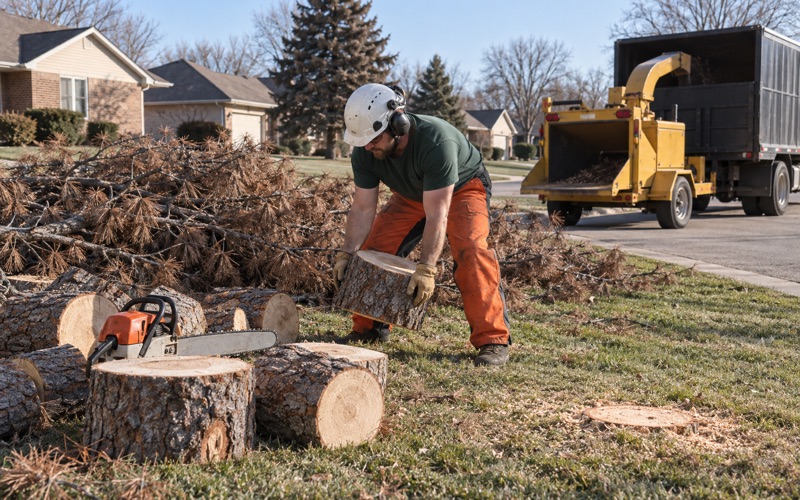
Disposal shapes a Platte City quote more than the cutting does. Section 230.055 establishes a city yard waste facility near the wastewater treatment plant, open seven days a week from March 1 through November 30, with December through February left to the Public Works Director’s discretion. It accepts grass clippings, leaves, and tree, flower and shrub brush, along with paper bags holding them, and plastic bags only if they are emptied and carried back out by the user.
It refuses garbage, tires, metals, construction debris, furniture, appliances, plastics and anything not on its list. For residents it is metered rather than free: twenty dollars for the annual card, five dollars for an additional one, fifty uses per household per year, and twenty dollars for each further fifty-use increment. A homeowner clearing a fence line is spending against an allowance, not dumping for nothing.
Then comes the clause that decides the economics of this trade inside the city limits: “Contractors are prohibited from using the site regardless of residency and regardless of the origin of the yard waste to be dumped.” That second half closes the door a resident-fronted load would otherwise open. A crew working here has no local outlet at any price, so the haul is a real line in the cost — and a quote that does not carry it is a quote hiding it.
Statewide, RSMo 260.250 bars yard waste from a Missouri solid waste disposal area outright, which is why every outlet within reach of this city is a composter rather than a landfill. We name the destination for the wood, the brush and the grindings as part of the estimate, and every stick leaves with the crew. Nothing gets stacked at a curb the city will not collect.
Stumps, and what is underneath them
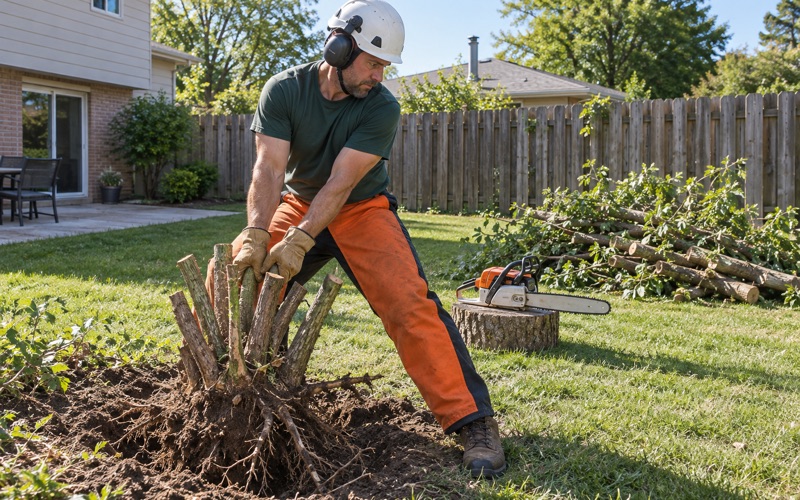
Missouri One Call at 1-800-344-7483 comes before the grinder on every job, including one on a lot that was located last year, because irrigation lines, invisible fence and low-voltage lighting are what actually turn up in a residential stump. Where the stump belongs to a street or park tree, Section 240.130 already sets the standard the City expects: it must come out below the surface of the ground so that its top does not project above it.
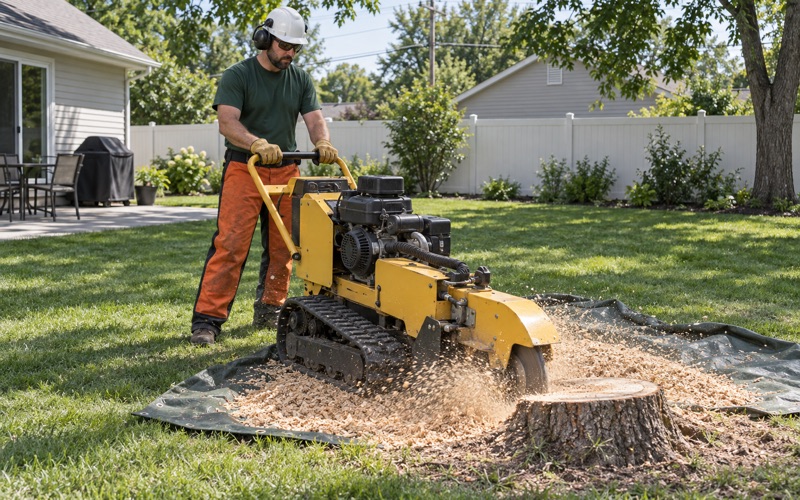
We quote grinding by the machine as configured rather than by a depth promised over the phone. A compact grinder narrow enough for a gate carries a different tooth wheel and a different reach than the same machine widened on dual wheels in an open drive, and the honest number comes from measuring the flare, the access and the diameter at breast height on site.
- 20+ Years in Johnson County
- Insured, Proof Sent First
- Free On-Site Assessment