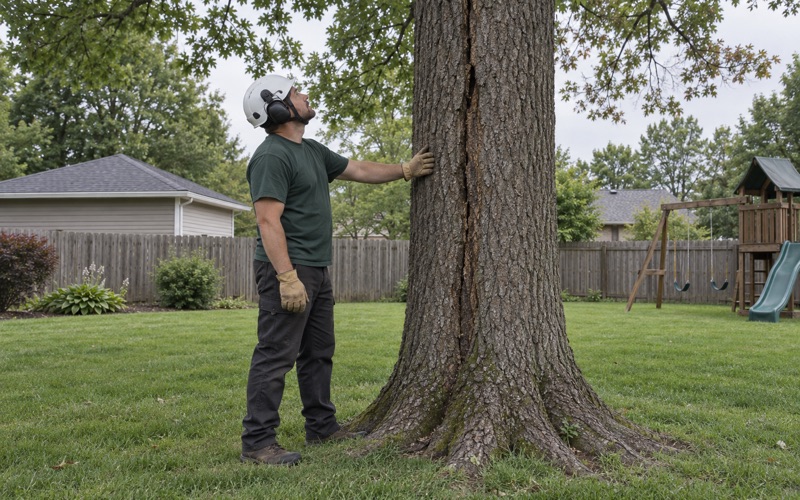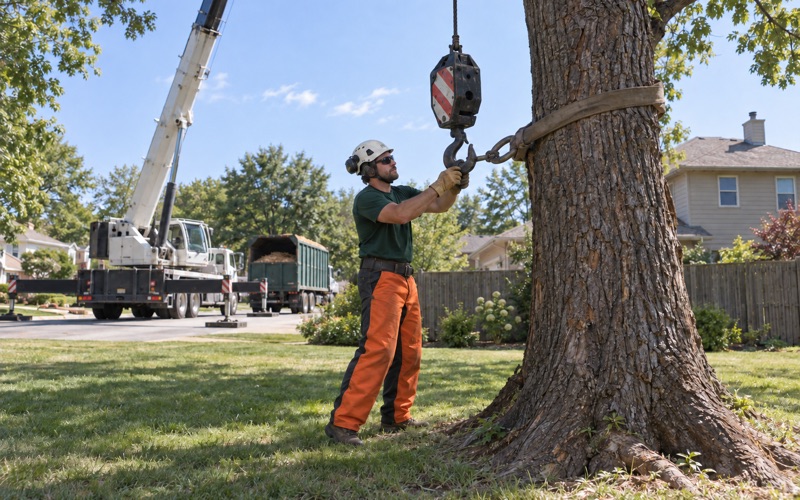
Shawnee Tree Removal has handled tree removal in Prairie Village for more than twenty years, and on a Prairie Village lot the first thing we do is not look at the tree. We walk to the trunk and work out exactly where it is standing, because this city sorts its trees into four protection areas by position, and the area a trunk falls in settles the rule before anyone has said a word about the tree’s condition.
That sorting is done in caliper inches rather than the diameter-at-breast-height figure most homeowners have heard of, and the two are read with the tape in different places on the trunk. Use the wrong unit and you can talk yourself into a removal the code prohibits, or pay for permission on a tree that never needed any.
So we quote a job here in two halves: what the work costs, and which of the city’s four areas your tree sits in and what that means for it. The on-site assessment is free, the figure we give you is the figure you get in writing, and proof of insurance reaches you before a crew sets foot on the property.
Where the trunk stands settles it before the saw does
Prairie Village’s tree rules arrived as Ordinance No. 2446, passed by the Governing Body on March 15, 2021 and effective June 1, 2021, which added Section 19.47.060, Tree Protection, to Chapter 19.47 of the municipal code. The ordinance does not treat every tree on a lot alike. It sorts them by where the trunk stands relative to the right-of-way, the front lot line and the building setbacks, and each of those positions carries its own threshold and its own replacement math.
Worth saying once and then setting aside: Section 19.47.060(a) switches the whole scheme on in only three situations, and the one that reaches a finished, occupied lot is any removal of a tree in the public right-of-way. The city’s own Tree Board packet puts that plainly, saying back yard tree removal permits are not required, only the right of way trees. Everything below is what happens once you are inside the ordinance, because that is where the measuring starts.
Caliper, not DBH, and the tape goes somewhere else
Every threshold in Table 19-47-D is stated in caliper inches. Diameter at breast height turns up in this ordinance in only two places, the protective-fencing table and the Section 19.02.168 definition added by the same ordinance, which fixes breast height at four and one-half feet above natural grade. Restating a Table 19-47-D number as a DBH figure moves the tape up the trunk and changes the answer, which is how competitor pages quoting these thresholds as DBH get Prairie Village wrong even when the digits look familiar.
There is also a drafting slip in the adopted text worth knowing about before you go hunting for the table. Section 19.47.060(c) sends the reader to Table 19-57-D while the table it means is captioned Table 19-47-D, and a second cross-reference points at the landscape standards in Section 19.47.010 (B) when that section’s own subsections are numbered 1 and 2 with no lettering at all. Cite 19-47-D, and expect the internal references to need a second read.
Looking for arborist closer to Olathe? See Arborist in Olathe.
The four areas, walked from the curb inward
Table 19-47-D reads most easily as a walk from the street toward the house, since that is the order the four areas come in. Each one names a trunk position, a protected range, a point above which removal is prohibited outright, and the replacement planting it costs.
Street trees and frontage trees
Area 1 covers street trees, meaning any tree in the public right-of-way, and it carries no size floor whatsoever: all of them are prohibited from removal, with mitigation set at one tree for each 6 inches of caliper removed, to a maximum of three. Area 2 covers frontage trees, any tree of 3 inches caliper or more on private property and within 20 feet of the front lot line. From 3 to 6 inches a frontage tree is protected and replaced one for one; at 6 inches and above it crosses into the prohibited column, with that same one-per-6-inches mitigation capped at three.
Lot trees and buildable area trees
Area 3, lot trees, picks up any tree of 6 inches caliper or more on private property sitting outside both the frontage strip and the buildable area. It is protected from 6 to 20 inches, prohibited from removal at 20 inches and above, and its mitigation runs one tree for each 12 inches of caliper removed. Area 4, buildable area trees, uses the same 6-inch entry point inside the buildable area that the zoning setbacks for the principal building define, protects from 6 to 30 inches, prohibits removal at 30 and above, and mitigates at one tree per 15 inches of caliper.
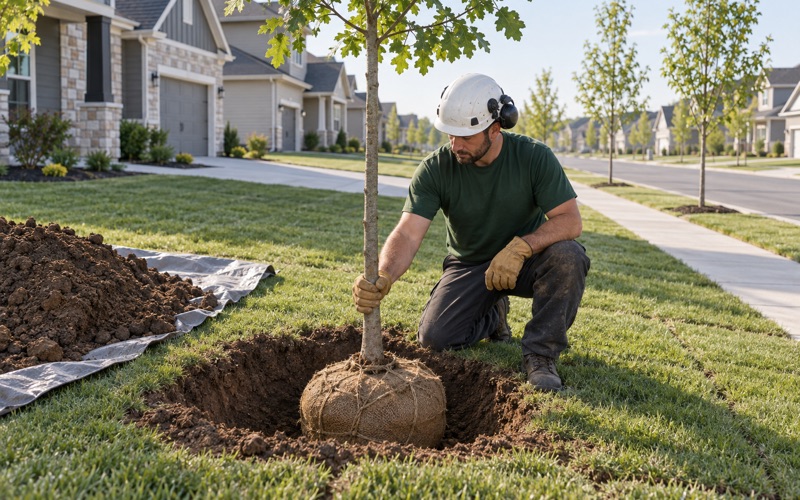
Two details ride along with all of it. Replacement trees must be at least 2 inches caliper under Section 19.47.030(B), which makes mitigation a planting bill rather than a line on a form, and the same chapter credits existing vegetation one for one where a tree is already 3 inches caliper or better. We measure caliper on site and tell you which column a tree lands in before we price anything.
The register the city borrowed, and the way back out
One prohibition in Table 19-47-D reaches all four areas at once, and Prairie Village does not keep the list for it. Section 19.02.293, added by Ordinance No. 2446, defines it this way: Kansas Champion Tree means a tree of unique distinction, representing the largest tree of a species, located in the state of Kansas and recognized by the Kansas Forest Service. Such trees may be located on public and/or private property within Prairie Village.
That is a state register borrowed into a city code, not a plaque list kept at City Hall, so the body that answers whether a particular tree is on it is the Kansas Forest Service rather than the building counter. Where one is involved, removal is prohibited in every area, with mitigation of one tree for each 6 inches of caliper removed to a maximum of three.
The exception runs through the Building Official
Section 19.47.060(e) puts exceptions with the Prairie Village Building Official, on a written request identifying the specific tree with documentation justifying its removal. The exception is generally granted where the tree is dead, where it is diseased or dying and constitutes a threat to healthy trees, property or public safety, or where removal is necessary for construction under a three-part test covering comparable alternative designs, undue financial burden, and any other reasonable accommodation including adjustments to the otherwise allowable building footprint. The Building Official may seek advice from the Prairie Village Tree Board, other staff or departments, or a third-party consultant, and an authorization lasts for the duration of the permit it attaches to.
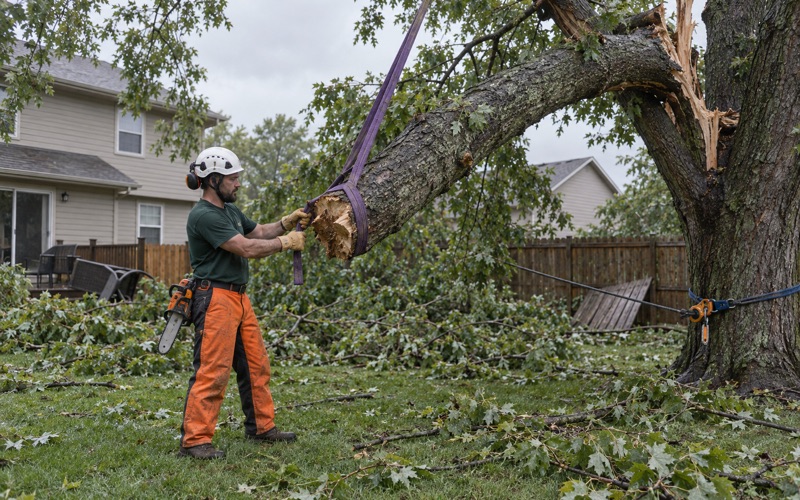
In practice the dead-or-dying route is a documentation purchase: somebody has to write down what is wrong with the tree. That is what the written condition assessment we leave with you is for, and it is the same document you can hand to a neighbor or an adjuster. If cabling and bracing or a pruning cycle would hold the tree instead, we say so and price that rather than the removal, and we do not top trees to make a problem look solved.
Enforcement counts trees, not jobs
Section 19.47.060(f) makes removal, damage or impairment of a protected tree a violation and states that each tree shall be considered a separate incident. Fines sit on top of the mitigation planting rather than in place of it. The ordinance itself names no dollar amount and the general penalty lives elsewhere in the code, so any specific figure you have seen quoted comes from the city’s own Tree Board page and news coverage rather than from Ordinance No. 2446.
Small lots, protective fencing, and a canopy that ages together
The radius the Director can relax
Where a protected tree stays and work goes on around it, Table 19-47-E sets the protective fencing, and this is the table written in DBH. The radius runs 20 feet from the center of the tree above 28 inches, 15 feet from 20 to 28 inches, and 10 feet below 20 inches, or the area protecting at least 75 percent of the drip line, whichever is lesser, with a 5-foot minimum in all cases and fences at least 4 feet high.
Its footnote is the number that actually governs most lots here: on lots less than 10,000 square feet, the Director may approve fences 15 feet from the center of tree for trees over 28 inches measured at breast height, and 10 feet from the center of tree for trees up to that size. The adopted text prints that second “from” as “form”, a typo we mention only so you are not thrown by it. Prairie Village was platted in 1941 on a 65-foot street frontage its developer called smaller than usual, so a great many lots land under the 10,000-square-foot line and the relaxed radius is the working one.
Inside the fenced area, grade changes and cut or fill in excess of 2 inches are prohibited. That matters more than it sounds, because what actually kills a protected tree on a tight lot is usually a machine track and a few inches of fill over the root plate, not a saw.
A 1950s canopy arriving all at once
45.37 percent of Prairie Village’s entire housing stock was built between 1950 and 1959, and 83.08 percent of it predates 1980. Trees planted alongside those houses reach the same age in the same decade, so the structural failures on a given street tend to arrive as a wave rather than one tree at a time.
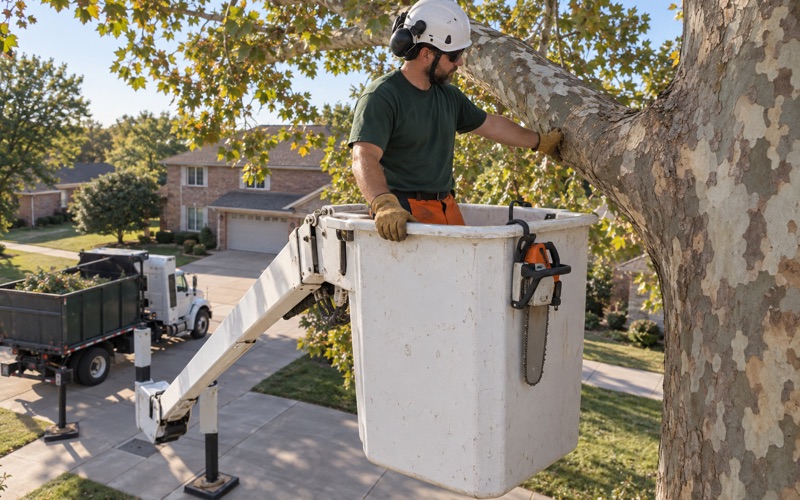
That turns the useful conversation into a sequence rather than a single job. At 84.37 percent one-unit detached and 1,656 housing units to the square mile, we are usually working a narrow lot where crane reach and gate width bind at the same moment, so we would rather stage two or three removals across a couple of seasons than crowd them into one week.
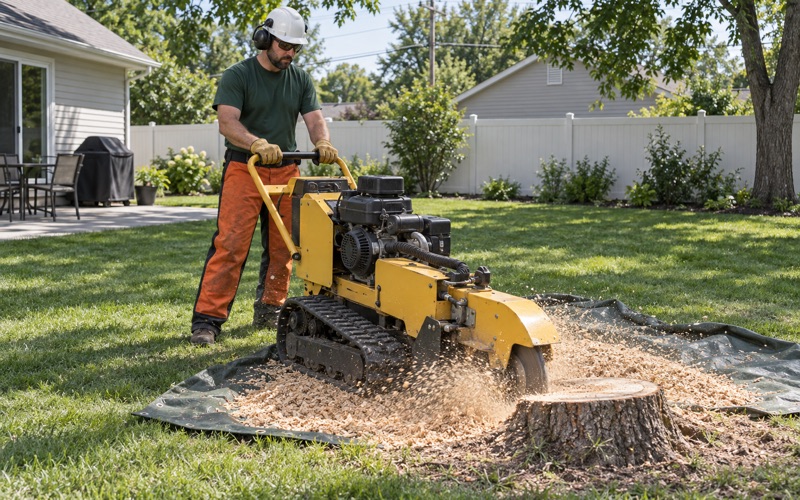
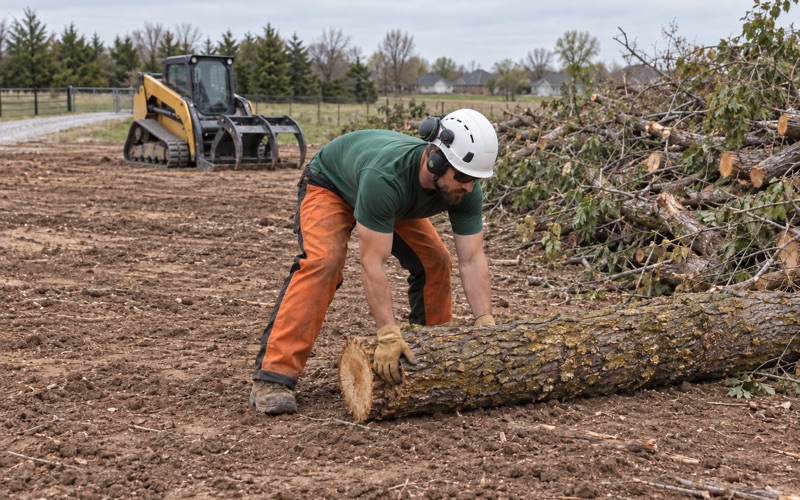
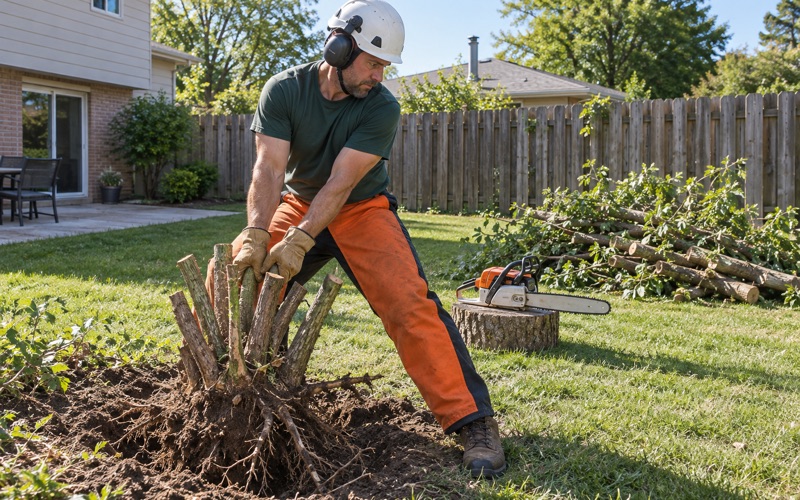
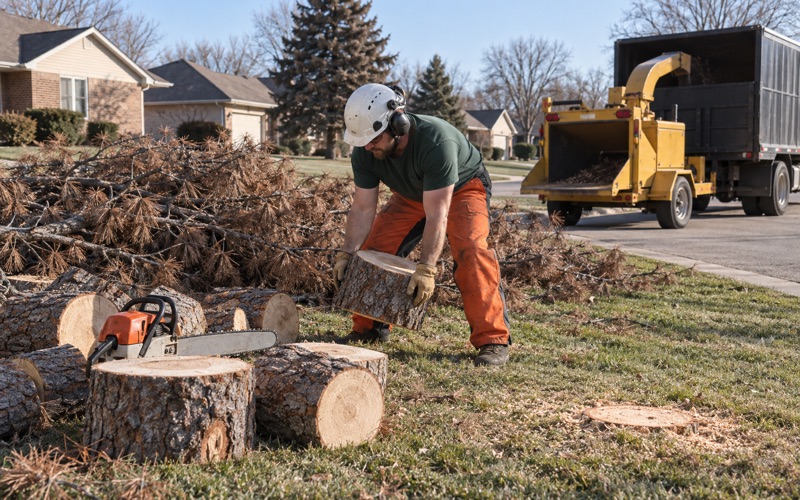
Where the wood and the grindings are going is settled before the saw comes out of the truck, because the curb here will not take a removal. Residents get 12 yard waste items a week, bundles have to run four feet long, under 24 inches in circumference and under 50 pounds, no individual branch inside a bundle may exceed 3 inches in diameter, and logs are not accepted at all. Every stick leaves with us, and we call 811 before a stump grinder touches ground on a 1941 plat with services sitting close to the curb.
- 20+ Years in Johnson County
- Insured, Proof Sent First
- Free On-Site Assessment