Shawnee Tree Removal handles neighbor and property line tree removal across Shawnee, KS, and this is the single service on which our location matters most. Shawnee sits a few miles from State Line Road, and Kansas and Missouri answer the neighbor’s tree question through opposite legal rules. A national blog post about overhanging branches is not merely vague here; depending on which side of the line your address is on, it is likely to be wrong.
Kansas took the nuisance approach in Pierce v. Casady, a 1985 case of first impression, which holds that a landowner may trim overhanging branches but may not enter the neighbor’s land, and that where a tree does substantial harm or creates imminent danger one landowner may compel his neighbor to abate that nuisance or seek damages. Missouri, in Hasapopoulos v. Murphy, decided the same year, adopted the Massachusetts rule: no cause of action for damage from the encroaching roots or branches of a healthy tree, and self-help to the property line at the complaining owner’s own cost.
That difference decides what is worth doing before you spend anything. We tell you which rule applies at your address, put the tree’s actual condition in writing, and do the work that is genuinely yours to do.
The Rule That Applies at Your Address
The Kansas Side: Nuisance and Abatement
Under the Kansas approach, a neighbor’s tree can become the neighbor’s problem, but only when it crosses a real threshold. Substantial harm or imminent danger is the language, and it is not satisfied by leaves in a gutter, shade over a garden, or a tree somebody simply dislikes. Building the case means documenting the defect, the target it sits over, and why failure is likely rather than merely possible.
The Missouri Side: Self-Help to the Line
On the Missouri side, a healthy neighboring tree gives you no claim however far it reaches over your yard. Your remedy is self-help: cut what overhangs your property, at your own expense, and stop at the line. Knowing that in advance saves a great deal of wasted effort, because the conversation people expect to have with a neighbor is one the law does not support there.
Boundary Trees Belong to Both of You
Where the trunk itself straddles the line, the tree is jointly owned and neither party may unilaterally remove it. This is the situation that produces the worst outcomes, because an owner who acts alone has usually created liability that dwarfs whatever the tree was doing. The route through it is a joint decision informed by an independent assessment of condition.
Where the Trim Right Ends
Cutting to the Line, and Not Past It
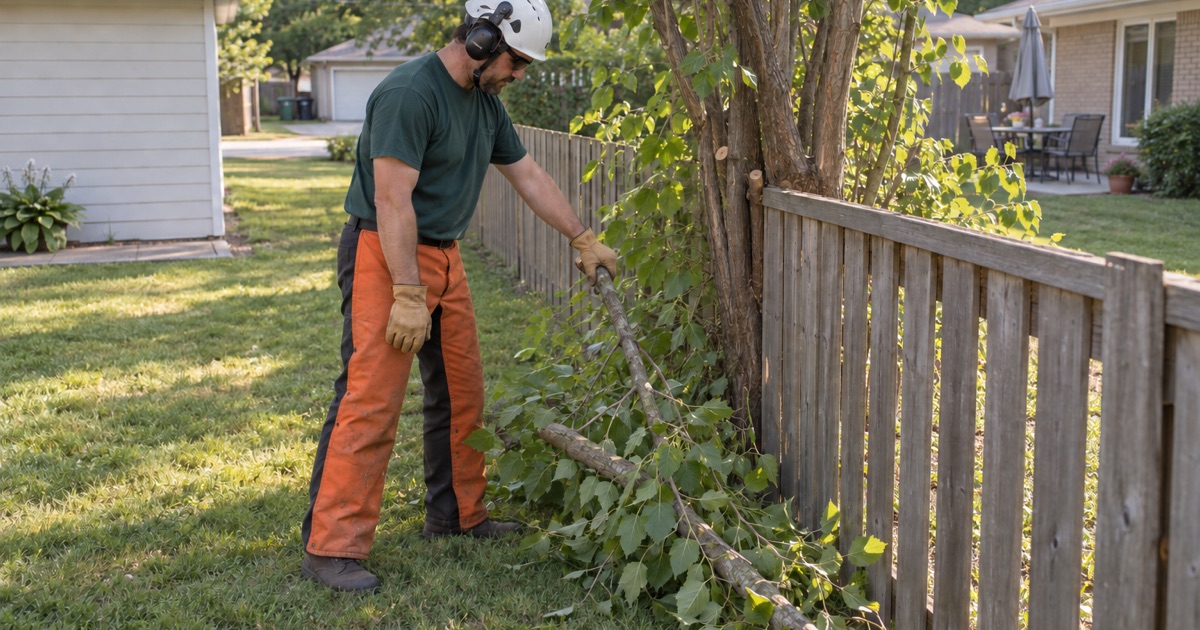
Both states let you cut what is on your side. Neither lets you cross the boundary, reach over with a pole saw and take something that is not overhanging, or enter to work from the better side. We work to the line and we say in advance where we will stop, which is the only defensible way to do this job for one of two neighbors.
The Limit Nobody Warns You About
A trim right is not a license to kill the tree, and this is where lawful self-help most often turns into a claim. Removing so much of a canopy or so many roots on your side that the tree declines or destabilizes exposes you to a damage claim from the owner. Pruning that respects the tree’s structure while achieving your clearance is not just better practice — it is the version that does not end up in a dispute.
Roots, Fences and Hardscape
Roots raise the same question underground and it is easier to get wrong, because there is no visible line to work to. Severing major structural roots on your side can destabilize a tree standing on your neighbor’s, and ANSI A300 treats root damage within six times the trunk diameter as significant. Where a neighbor’s tree is lifting your drive or your fence, the assessment covers what can be cut without transferring the problem to you.
Documentation That Actually Resolves It
The Written Condition Assessment
What moves these situations is a dated, specific written opinion: the tree, the defect observed, what it stands over, the likelihood of failure, and the recommendation. Delivered to the owner, it also establishes knowledge, which is exactly the factor that separates an act of nature from a question of negligence if the tree later fails.
Licensing, Insurance and What to Check on Any Bidder
Neither Kansas nor Missouri issues an arborist or tree-work license, so a bidder claiming to be state licensed is describing something that does not exist. The one local exception is Wyandotte County, where the Unified Government requires an annual arborist license under its own code, carrying $1,000,000 bodily injury and $500,000 property damage cover, to engage in the business of pruning, treating or removing trees. Elsewhere, the document worth asking for is a current certificate of insurance.
Doing the Work Without Making It Worse
Once the position is clear, the job itself is ordinary tree work done carefully at a boundary: rigging planned so nothing swings over the neighbor’s ground, debris kept entirely on the paying side, and access arranged without stepping across. Every stick leaves with us. Where the right answer is that you should not do the work at all, we will tell you that before we quote it.
- 20+ Years in Johnson County
- Insured, Proof Sent First
- Free On-Site Assessment