Shawnee Tree Removal has handled tree removal in Riverside for more than twenty years, and this is one of the few places in the metro where nothing official ever pushes the job forward. The city publishes the list of violations its code enforcement actually pursues, and there is no tree anywhere on it.
That leaves the decision entirely with whoever owns the ground. Nothing arrives in the mail carrying a deadline, which sounds like relief right up until a limb comes down across a driveway and it turns out the only party ever going to force the issue was the tree.
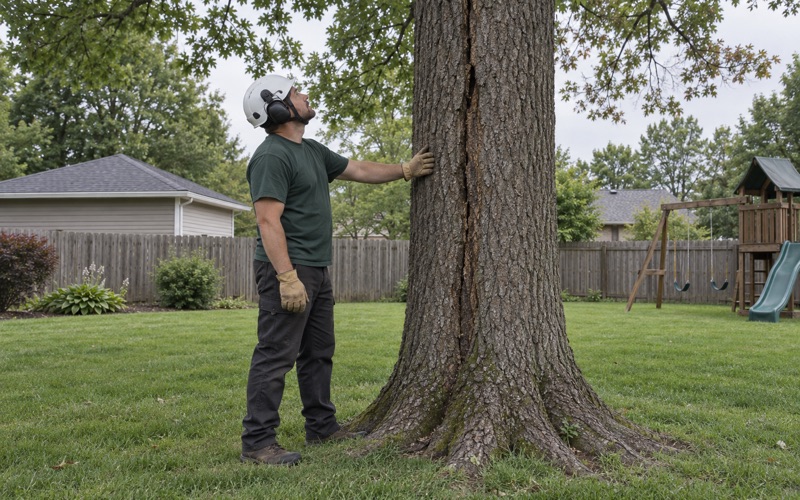
So we work the way that situation deserves. The on-site assessment is free, what we find goes into a written condition assessment you can hand to an adjuster or a neighbor, and the figure we quote is the figure that appears in writing.
Nothing on Riverside’s violation list is a tree
The city sets out what code enforcement pursues in plain terms: property littered with trash or debris, illegal dumping, tall grass or weeds in excess of 10 inches, inoperable, abandoned or unregistered vehicles and those with expired tags, parking on unimproved surfaces, outdoor storage of equipment or appliances, excessive animal waste, deteriorated buildings, dead animals and garbage, flooding and pool and pond maintenance, and infestation. Read it twice and the absence is the finding. No dead tree, no fallen tree, no limb, no brush pile, no overhanging branch and no clearance height appears anywhere on it.
That runs opposite to the way several nearby Missouri cities write their nuisance regimes, where a dead tree is a letter with an abatement power standing behind it. Here a dead tree behind a house is not, on the published list, the city’s business at all. Code enforcement is reached at 816-741-3993 or through the city’s online reporting form, and City Hall sits at 2950 NW Vivion Road.
The one vegetation number the city publishes
The 10-inch grass and weed height is the only vegetation dimension anywhere in that enforcement list. It is worth knowing precisely for what it does not reach: not a sapling thicket, not a brush pile left over from somebody else’s storm cleanup, not a stump. Where we clear overgrowth the woody material leaves with us rather than sitting in a heap that satisfies nothing.
The two duties that live with Public Works instead
Public Works, not code enforcement, publishes the obligations that actually touch vegetation here. Property owners must maintain the adjacent sidewalk, keeping it at the established grade, in good working order and free of ice, snow, earth and obstructions. Owners must also make sure trees and bushes do not obstruct drivers’ views.
Both are stated as duties with no numbers attached: no measured distance, no published height, nothing you could check a branch against with a tape. We will tell you what a limb is doing to a driver’s view and what it would take to clear it, and we will not invent a dimension this city has never published.
Looking for tree-removal closer to Parkville? See Tree-Removal in Parkville.
So what actually starts the call here
With no municipal trigger, three things do that work instead: an insurer, a sale, or visible failure. The insurance one is the least understood and by far the most common, so it is worth setting out how the coverage is actually written before a tree makes the question urgent.
The Missouri Department of Commerce and Insurance puts removal on the homeowners side only conditionally, covered “if the tree damages your home or other insured property,” with a debris-removal example the state states as “for instance, $500.” It adds that a neighbor’s tree falling onto your property is covered regardless of who owned it. What none of that says is that a policy pays to take down a tree that is merely dead, and you should hear that from us before a claim rather than after one.
A tree on a car is an auto claim, not a home claim
The same guidance is explicit that “comprehensive coverage will cover cars damaged by falling trees.” Comprehensive is the non-collision physical damage section of an auto policy, so a trunk across a parked vehicle is settled by the auto carrier under the auto deductible, no matter whose driveway it happened in. Callers open the wrong claim on this constantly and lose a week to it.
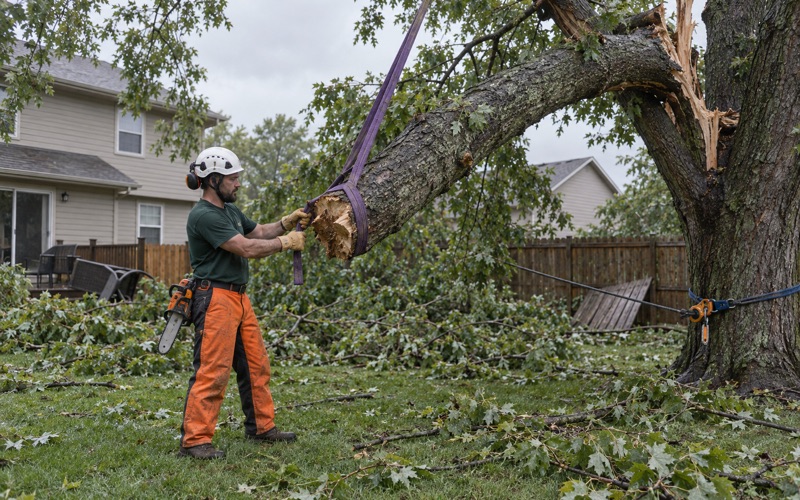
We respond the same day when a tree is on a roof, a car or a service line, and we photograph the failure before anything is cut. That record is exactly what an adjuster asks for, and it stops existing the moment a crew starts clearing.
An underwriting letter is a removal order in everything but name
The other insurance trigger carries no claim at all. A notice from an underwriter asking that limbs overhanging the dwelling be trimmed comes with a deadline and a policy behind it, which makes it the nearest thing to enforcement this city produces. Where a prune answers the letter we price the prune, and where cabling and bracing keeps a sound tree standing we say so instead of quoting a removal.
We do not top trees, whatever a letter appears to ask for, and we will show you why when somebody else offers to.
Is it your tree or the city’s? Riverside answers that in feet
Public Works defines the right-of-way as a city-owned strip of land running from the edge of the street back about 3 to 10 feet, used for street, curb, gutter, storm sewer and utility maintenance. That plain-language range is more than most cities around here will commit to, and it happens to be the first question most callers ask. We measure from the street edge during the assessment rather than reasoning backward from a fence line.
The utility half of the answer is unusual too. The city states on its own utilities page that “The City of Riverside does not have its own utilities,” and then names who does: Evergy for electric, Spire for gas, Missouri-American Water for water.
What that one sentence costs a property owner
Missouri hands some customers real statutory rights against a utility that trims their trees: fourteen days’ notice before a removal, and a written demand to have a partially trimmed tree removed at the supplier’s expense if it dies within three months. Those rights run against an “electric supplier” as the statute defines the term, meaning rural electric cooperatives, certain not-for-profit corporations, and municipally owned or operated systems. Evergy is an investor-owned electrical corporation and this city operates no municipal system, so neither right attaches at an address inside these limits.
What does exist here is paperwork. Missouri regulates investor-owned vegetation management by rule and the utility files an annual report, so the trim cycle, the miles scheduled and the clearance guideline are public record anyone can read, which is not true on the Kansas side of this metro. For a downed conductor or a leaning pole, Evergy at 816-471-5275 comes first; City Hall does not run the electric system and cannot de-energize anything.
Where the wood goes, since the city takes none of it
The hauler under contract here provides free curbside trash and recycling to every single-family household in Riverside. Trash and recycling is the whole of it. No yard waste stream is part of that arrangement, and there is no leaf collection, no limb pickup, no brush service and no drop-off site anywhere inside the city.
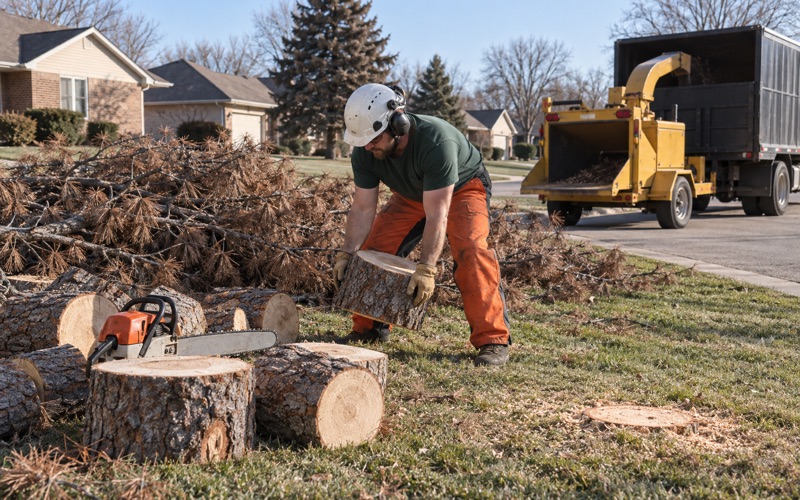
So the disposal leg of a removal is a priced haul out of town on every job, for a property owner and a contractor alike. RSMo 260.250 bars yard waste from a Missouri solid waste disposal area outright, which is why every outlet within reach is a composter rather than a landfill, and why nobody makes a trunk quietly disappear into a dumpster.
Diameter caps decide which gate takes the trunk
Composters price brush by the cubic yard and set their own limits on what may arrive. The diameter caps across this market run a wide ladder, so the same trunk section is accepted at one gate and refused at another, and stumps with dirt still attached are commonly turned away. We confirm the cap before anything is loaded, and we tell you where the wood and the grindings are going before the saw comes out of the truck.
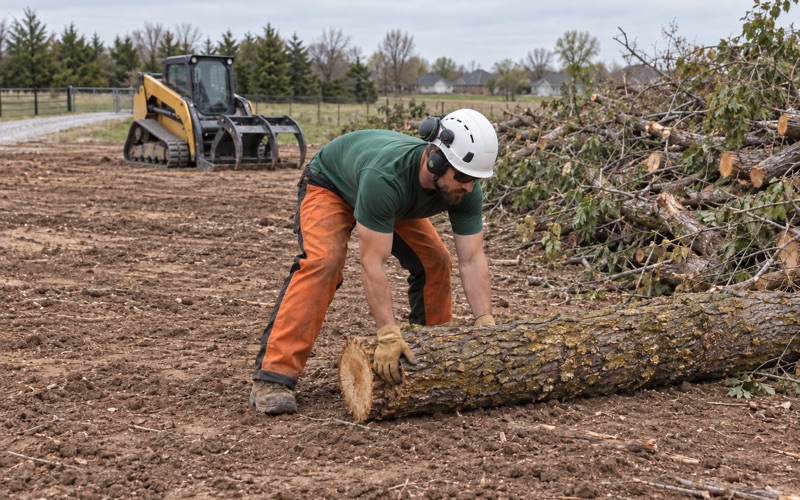
Every stick leaves with us. Nothing gets stacked at a curb this city has no service to collect it from.
Burning is not the alternative it looks like
Missouri’s open burning rule reaches the entire state and treats tree trunks, tree limbs, trimmings, vegetation and yard waste as vegetative waste. A commercial land-clearing burn inside the city limits, or less than 200 yards from the nearest occupied structure, has to meet a fixed set of conditions: sunrise to sunset only, at least 200 yards from the nearest structure, supervised at all times, and the local fire control authority notified before it begins. That authority here is the Southern Platte Fire Protection District, and in a city of roughly five and a half square miles essentially no lot can meet the setback in the first place.
Read alongside the missing brush service, that leaves a contractor working here with neither a local gate nor a legal burn. A quote with no haul line in it has left something out.
There is no license to check, so check the coverage
Neither Missouri nor Kansas licenses tree work, so no state card exists for anyone in this trade to hold up. What stands in for one is ISA certification on the technical side and, on the business side, general liability and workers’ compensation coverage you can verify before anybody climbs. Proof of insurance reaches you before our crew sets foot on the property.
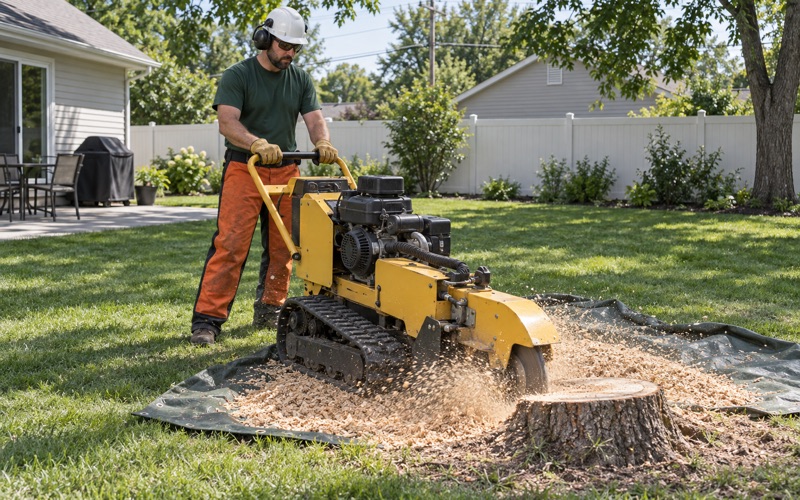
We also place a Missouri One Call locate at 1-800-344-7483 before a stump wheel turns. In a strip that narrow, carrying street, curb, storm sewer and utility work all at once, what is underground is rarely where memory puts it.
- 20+ Years in Johnson County
- Insured, Proof Sent First
- Free On-Site Assessment