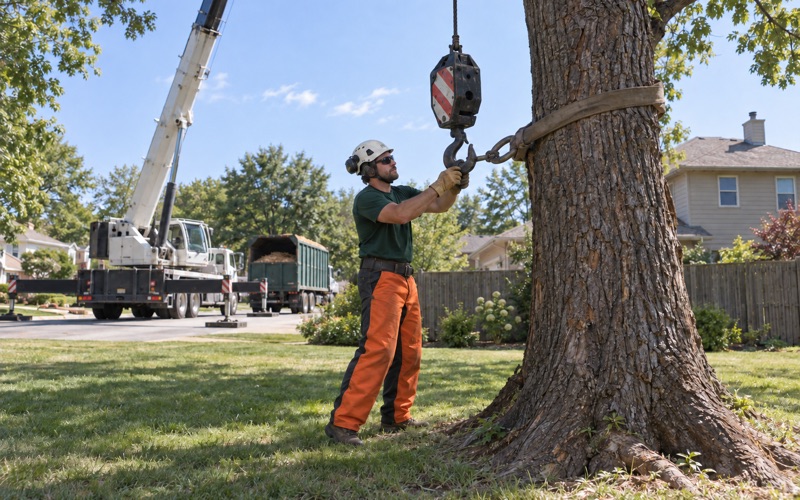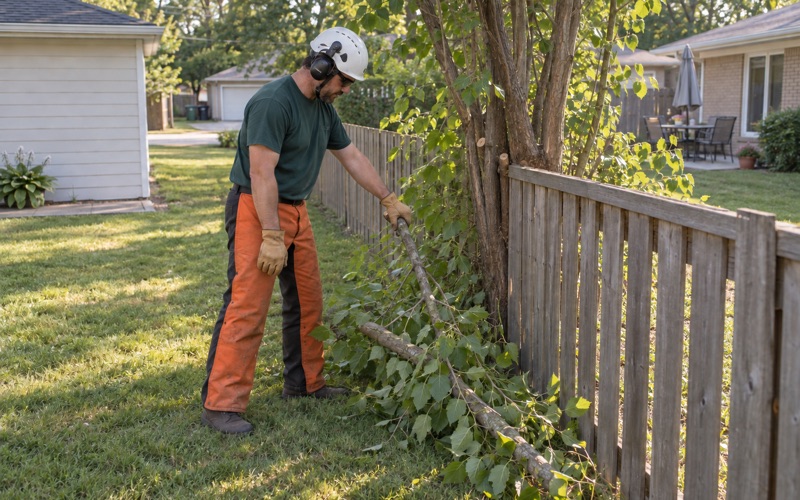
Shawnee Tree Removal has spent more than twenty years taking trees down across Johnson County, and tree removal in Roeland Park carries one rule that changes the arithmetic of a job before a rope is ever thrown: material from a diseased tree may not stay on the property it came from. Most homeowners here have never read that sentence, and it is the sentence that decides what the removal costs.
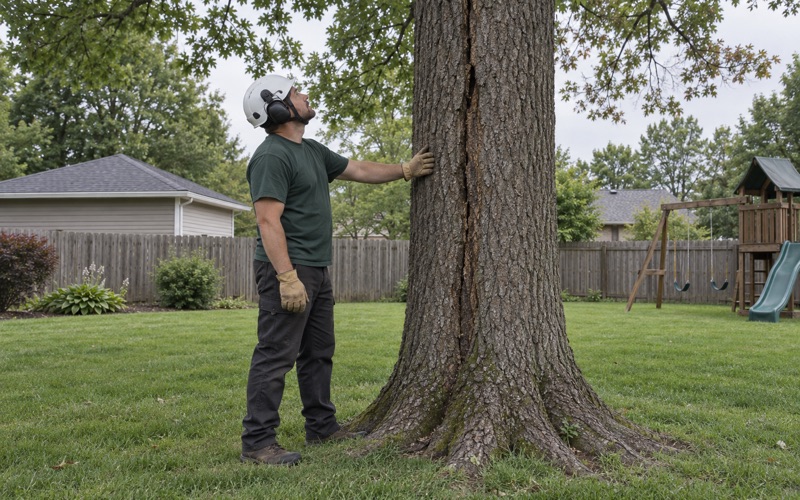
We start with a free on-site look and hand back a written condition assessment, the kind you can put in front of a neighbor or an insurance adjuster, rather than a number on the back of a card. The figure we say out loud is the figure that appears in writing, and proof of insurance reaches you before a crew is on the property.
We will also tell you when the answer is not a removal. Topping is not something we do, and if another outfit offers it we will show you the decay and the epicormic sprouts that follow. Where cabling and bracing or a season of structural pruning keeps a tree standing, we price that work instead.
Sec. 13-504 and the wood you cannot keep
Roeland Park rewrote its tree law recently enough that a good deal of the advice online predates it. Ordinance No. 1062, passed by the Governing Body on September 16, 2024 and effective December 16, 2024, amended Chapter 13, Article 5, “Trees Shrubs and Growth,” which now runs from Sec. 13-501 through Sec. 13-512.
Sec. 13-504, “Diseased or Infected Trees Upon Private Property,” reads: “It shall be unlawful to harbor any tree or plant or shrubs infected or infested with disease or insect pest or larvae. It shall also be unlawful to store or otherwise harbor on any property in the City, the material from any diseased or infected trees.” Failure to remove the tree routes the property to nuisance abatement under Article 3 of Chapter 8.
Read that second sentence on its own. It is a debris rule written at ordinance grade rather than a line in a hauler’s terms of service, and the difference is reach: a hauler’s rule stops at the curb, while this one covers the rack beside the garage and the rounds stacked behind the shed.
Disease is the trigger, not the species
What pulls a job under Sec. 13-504 is the condition of the tree rather than what species it happens to be. Sec. 13-505 then saves work aimed at “the suppression of pests or disease, including the Dutch Elm disease,” so the article is plainly built to speed a disease removal along rather than to slow it down.
That has a practical consequence at the estimate. Once disease is the reason a tree is coming out, the disposal plan stops being a preference and becomes part of the job we are quoting.
Looking for tree-removal closer to Prairie Village? See Prairie Village Tree-Removal.
The firewood credit, and the moment it disappears
The firewood credit is real and it runs both directions. Leaving the rounds on site brings the price down, hauling them takes it up, and what actually moves the number is the walk from the drop zone to the truck rather than whether the wood is oak or hackberry.
It is a line item, not a favor. On one job bid three separate ways at $12,400, $7,500 and $4,700, every bidder priced the wood haul at $3,000, which is three companies disagreeing about nearly everything else and agreeing about that.
The handshake that becomes a violation
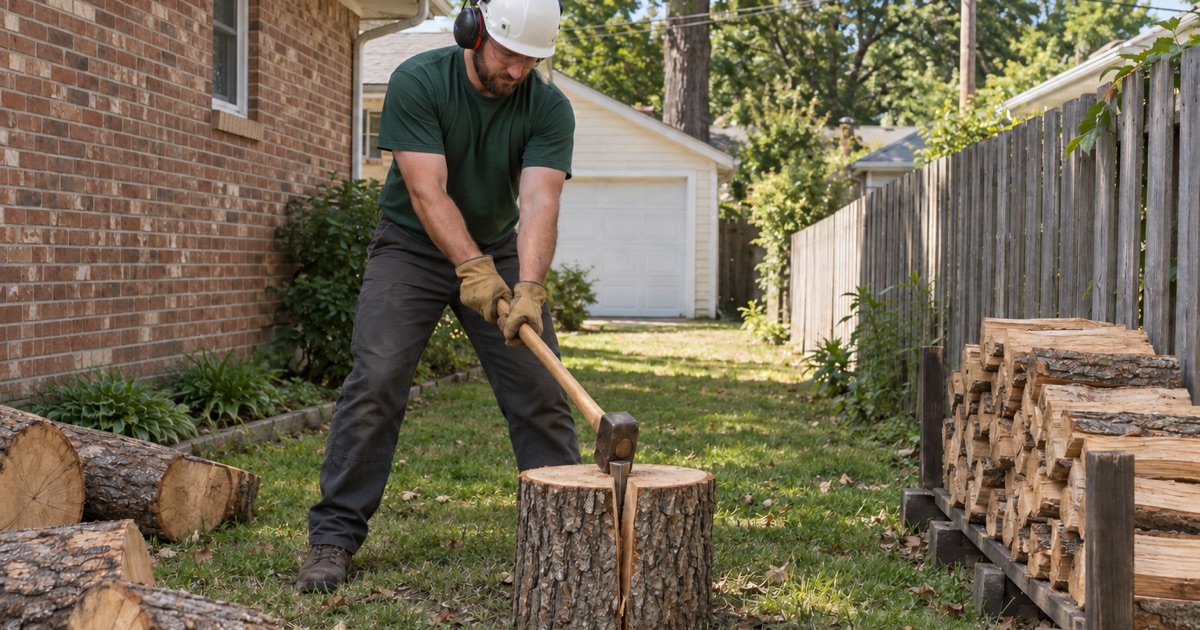
Here is the collision, said out loud: in Roeland Park, offering to leave the rounds on a diseased removal is an offer to leave unlawfully stored material on the customer’s property. The crew drives away, the price came down, and the homeowner is the one left holding a code problem in the side yard.
So we do not put that trade on the table for a diseased tree in this city, and we say why while we are still standing in the yard. On a healthy removal, one coming out for clearance or a failed root plate, the credit is available and we will price the job both ways.
What goes in the quote instead
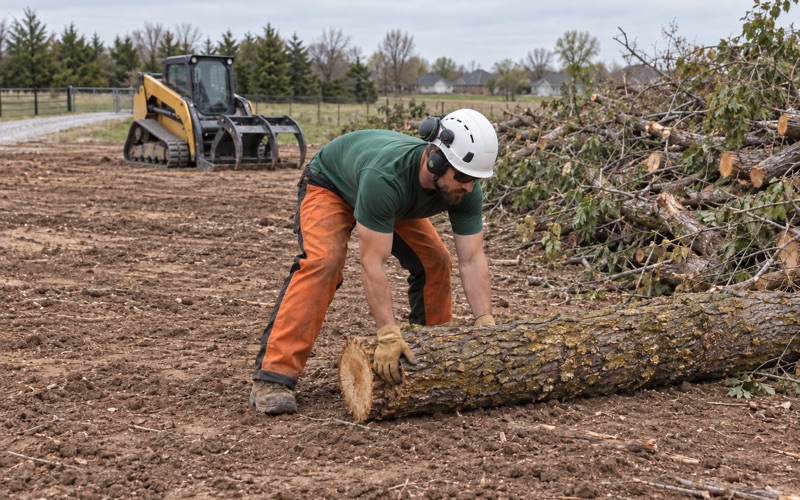
You hear where the wood and the grindings are going before the saw comes out of the truck, and the haul shows up as its own figure so you can see what you are paying for. Every stick leaves with us, and nothing is stacked at a curb the city was never going to collect from.
Pine wilt runs against a calendar
Pine wilt is the one removal in this trade with a deadline attached to it, and in this metro it takes Scotch and Austrian pine. Needles go gray-green, then yellow, then brown, and a mature tree can be dead in a matter of weeks; the symptoms turn up between August and December. The agent is the pinewood nematode and the pine sawyer beetle carries it from tree to tree, a wilted pine usually shows reduced or absent resin, and the brown needles hang on the dead tree for up to a year.
Once those symptoms are there, nothing reverses them, so what is left is a decision about timing. K-State Research and Extension publication L722 makes that decision specific: cut the tree down “as soon as possible, or by May 1 at the latest,” and “April 1 is a better deadline.” The beetle is the reason for the date, because it leaves the dead wood in spring and carries the nematode to the next pine on the block.
What L722 asks for, and what the code requires
L722 does not stop at the felling. It says “Cut the tree to the ground – do not leave a stump,” it says “Chip or burn the wood immediately,” and it says “Do not save the wood for firewood.” Inside this city Sec. 13-504 turns that last piece of horticultural advice into a municipal prohibition.
The same publication records that “Scots pine plantings in eastern Kansas have been devastated” and that Austrian pines have been “affected in recent years.” Both species sit on the not-recommended list in the Johnson County Extension Master Gardeners brochure for this metro, and the disease is a large part of why.
Why so many of them stand in Roeland Park yards
About 37.1 percent of the housing here went up in the 1940s, on a tight plat where the canopy was planted at the same time as the houses. Conifers went in along property lines as screens, and those screens have now reached the age at which pine wilt collects them.
The other conifer failing across this metro is Colorado blue spruce carrying Rhizosphaera needle cast, which thins from the ground up and from the branch inward on a lag of fifteen to eighteen months between infection and visible loss. It is a slower conversation than pine wilt and it ends in the same place often enough that we look at the spruces while we are on the property.
Where the wood goes, and what the city may pay toward it
The curb caps a limb at two inches
Curbside yard waste here runs through GFL, and the published rules are narrow. Acceptable material is grass clippings, weeds and leaves, brush and branches must be securely bundled at no longer than 4 feet, the bundle may be no more than 18 inches across, and an individual limb diameter “may not be larger than 2 inches.”
The rest is arithmetic: 10 bags or bundles per week, nothing over 50 pounds per bag, drum or bundle, tied with twine or string rather than tape or plastic, and yard waste set out in plastic garbage bags is not picked up. Nothing that comes off a removal fits inside those numbers.
There is no county gate behind it
Johnson County runs no public yard-waste site of its own, and its landfill will not take landscape waste over 3 inches in diameter. Olathe’s compost facility verifies residency and states that businesses and landscape companies are not permitted to use it, and Wyandotte County’s free gate is for Wyandotte residents and refuses limbs or stumps over 12 inches in diameter or 4 feet long.
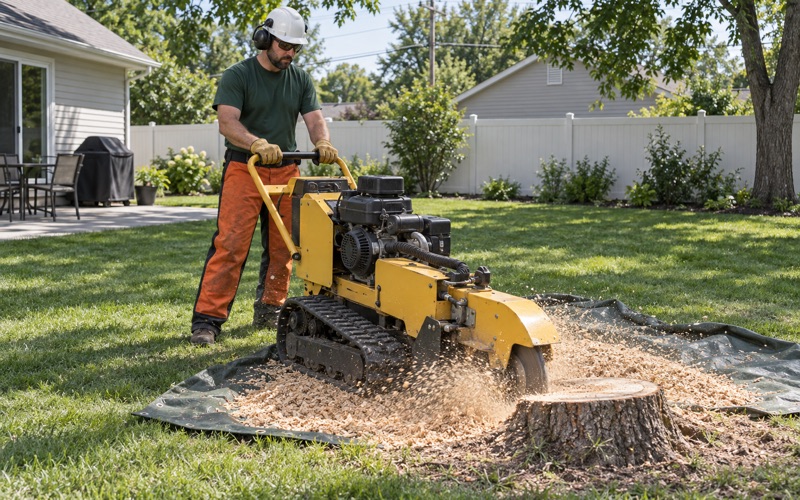
That leaves the state line. Missouri Organic Recycling in Kansas City, Missouri takes brush at $10.00 per cubic yard and lawn debris at $7.00, accepts logs up to 40 inches in diameter if they are under 5 feet long, and turns away stumps with dirt still on them. Getting a stump clean enough to be accepted there is part of what the disposal figure covers, and an 811 utility locate goes in before the tooth wheel turns.
The fee the city waives, and the fund you can ask
For a healthy protected tree the city’s tree protection policy asks an owner either to plant an approved replacement or to pay a $500 mitigation fee into the Tree Fund. The ordinance itself names no amount and sends the figure to the City Council’s fee schedule, which is worth knowing before anyone quotes you a number for it.
A diseased removal is handled differently, and Sec. 13-510 says so directly: “Any tree that is authorized for removal due to disease or health of the tree, or other public safety reason(s), shall have the Mitigation fee waived. The property owner may request reimbursement of the cost of removing said tree from the City Council. The decision to use Tree Fund resources to cover the removal costs of said tree shall be based upon the property owner’s ability to pay.”
A city fund that can be asked to carry part of a hazard removal on an ability-to-pay basis is unusual, and it is worth an ask before you assume the whole cost is yours. The written assessment we leave behind is built to be read by someone who never stood under the tree, because a council member or an adjuster is working from paper.
If a tree is already down at midnight, Sec. 13-507 carries the sentence to hold on to: “The administrative fine stated herein shall not be imposed in special circumstances, including but not limited to emergency tree removal and removal by a utility.” We answer the same day when a tree is on a roof, a car or a service line, and the city’s fine schedule is not the thing standing in the way of clearing it.
- 20+ Years in Johnson County
- Insured, Proof Sent First
- Free On-Site Assessment