Shawnee Tree Removal handles shrub, hedge and brush removal across Shawnee, KS, and it is a service people generally call about a year later than they should. Woody material that has been left alone does not stay the same size — it compounds, and a hedge that needed a weekend five years ago now needs equipment, disposal capacity and somewhere for several truckloads of material to go.
The disposal question is the one that catches Shawnee homeowners in particular. The city licenses competing private haulers rather than running one municipal yard-waste program, so what your neighbor’s subscription accepts may not be what yours does, and the city’s own bundle standard caps trimmings at two inches in diameter. Essentially nothing off a real shrub or hedge job qualifies as curbside material, which is why a pile stacked at the street after a weekend of cutting tends to still be there a month later.
We clear it and we take it, and we settle the root question up front — because on almost everything woody, cutting without dealing with the base is a decision to do the job again in two seasons.
What We Clear
Overgrown Foundation and Bed Plantings
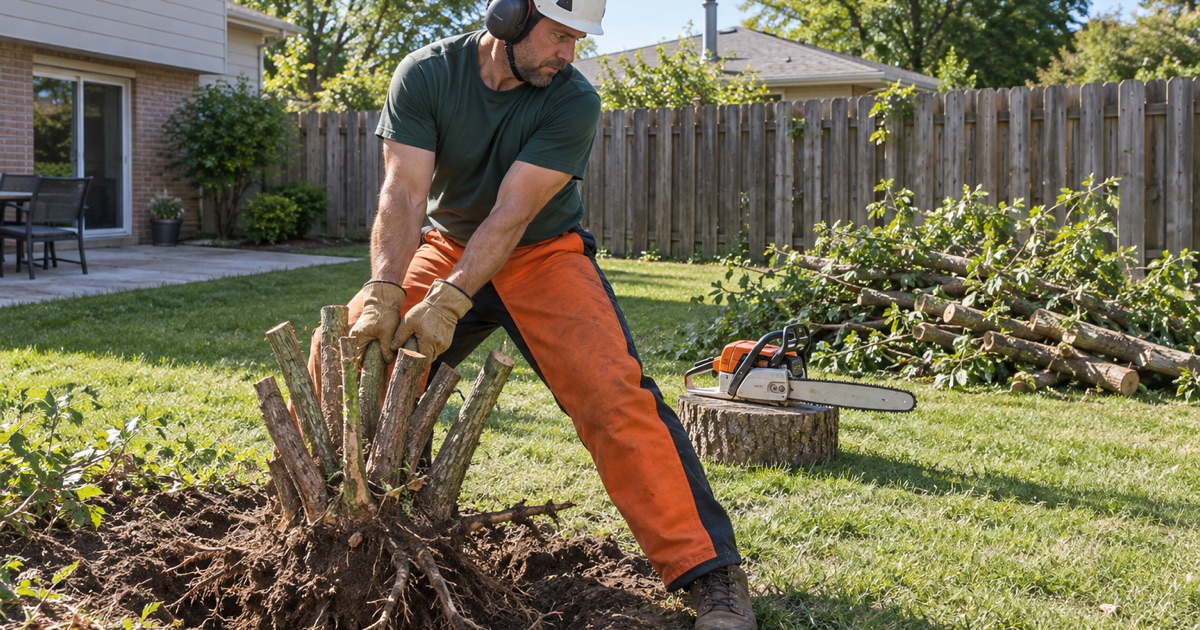
The shrubs planted with a house in the 1980s are now four decades old, well past the size they were chosen for, and frequently holding moisture against siding and blocking windows. Removing them properly means getting the root crowns out from against a foundation, walkways and utility runs without damaging what they have grown around. We work them out rather than pulling and hoping.
Hedges, Screens and Property Line Growth
A hedge line that has gone unmaintained becomes a wall of stems with dead interior wood and no way back to a controlled shape. Either it is renovated hard, accepting a bare year, or it comes out and something appropriately sized replaces it. On a property line the work stops at the line, because neither Kansas nor Missouri gives you the right to step onto the neighbor’s ground to reach the other side.
Volunteer Growth and Fence Line Reclamation
Fence lines and the backs of lots collect volunteers — mulberry, elm, honeysuckle, and whatever the birds brought — and by the time anyone looks, several of them have real trunk diameters. This is the work where a small tree service is genuinely different from a landscaper, because half of what is standing there needs a saw and a rigging plan rather than loppers.
Invasive Brush and What Actually Kills It
Bush Honeysuckle
Bush honeysuckle leafs out earlier and holds its leaves later than anything native, which is precisely how it shades out an understory and takes over a wooded property line. It is the dominant invasive brush problem on this side of the metro. Cutting alone brings it back thicker from the stump, so clearing that holds means taking the stems out, dealing with the cut crowns, and timing the work so regrowth does not simply reclaim the ground next season.
Osage Orange and Old Hedge Rows
The hedge rows planted across eastern Kansas as living fence are still out there on the older parcels, dense and thorny and interlocked at the base. The wood is famously heavy and hard on equipment, and the hedge balls foul a mower for years afterward. A hedge row is cleared as a linear job priced by the row and the number of passes, not shrub by shrub.
Callery Pear and Other Escaped Ornamentals
The Bradford pear that split in a storm rarely dies quietly — Callery pear reproduces readily from the rootstock and from seedlings, and abandoned corners of properties around this metro are filling with thorny thickets of it. The Johnson County extension brochure names the cultivar as one to avoid outright. Clearing it is stump work as much as cutting work, for the same reason honeysuckle is.
Method, Access and Disposal
Cut and Haul Against Forestry Mulching
On a residential lot with neighbors close, brush is cut, chipped where a chipper can be positioned, and hauled. On acreage or an open back parcel, forestry mulching grinds standing material in place and leaves a mat, which is faster and produces no haul bill at all. Which one suits your property is decided by space and by whether a mulch layer is welcome where the work is.
Access Decides the Price More Than Volume Does
Carry distance is the hidden cost on brush work. A chipper positioned at the work is a different job from one parked on the drive with everything hand-carried a hundred feet, and a full-size towed chipper at over seven feet wide does not pass a gate at all. We measure the route before quoting so the figure reflects the property rather than an average.
Where the Material Goes
Every stick leaves with us to a gate documented to accept it. The free residential routes in this county are not available to a contractor hauling your material — Shawnee’s landfill voucher is one per household per year and restricted to residents showing proof of residency, and the Olathe compost site is posted for Olathe residents only. That is why disposal is a real line on the quote rather than something absorbed silently.
- 20+ Years in Johnson County
- Insured, Proof Sent First
- Free On-Site Assessment