Shawnee Tree Removal has worked tree removal in Smithville for more than twenty years, and this city puts a question in front of us that hardly any other address in the metro does: which electric company feeds the meter? The city’s own resident guide answers with two names, not one.
That is not a billing curiosity. Missouri’s tree statute attaches real rights to some electric suppliers and not to others, which means two neighbors facing each other across a Smithville street can stand on different legal ground over the same limb in the same kind of line.
We work both sides of State Line Road, and Kansas and Missouri do not answer the neighbor’s-tree question the same way, so a job here starts with us already clear on which body of law is in play. That never changes how the tree itself gets judged: where cabling and bracing or a season of structural pruning keeps a sound stem standing, we price that and say so rather than writing up a removal.
Which company feeds your meter is the first thing to settle
The City of Smithville’s resident guide lists two electric providers for the city: Evergy at 1-888-471-5275 and Platte/Clay Electric Cooperative at 816-628-3121. One is an investor-owned electrical corporation and the other is a rural electric cooperative, and both appear on the same first-party municipal page for the same municipality. Most cities in this metro publish a single name there.
Nothing we have seen assigns a street, a subdivision or a side of town to either supplier, so we will not tell you which one is yours, and no contractor bidding your tree should either. The answer is on your bill and at the numbers above, and it is one phone call. Settle it before you assume anything about what a utility owes you, because everything below turns on it.
The cooperative half of the split
Platte-Clay Electric Cooperative is member-owned and was founded in 1938. It reports more than 26,500 active services over 3,100 miles of energized line across Buchanan, Caldwell, Clay, Clinton, DeKalb, Platte and Ray Counties, run from a main office in Kearney with a district office in Platte City. In the eyes of the Missouri statute a cooperative of that shape is a different animal from an investor-owned utility, and that difference is the next section.
Looking for tree-removal closer to Lenexa? See Tree-Removal in Lenexa.
What the statute hands one neighbor and not the other
RSMo 537.340.3 defines an electric supplier narrowly. The term reaches a chapter 394 rural electric cooperative, a cooperative-plan electrical corporation serving a majority of its customers in third-classification counties, a chapter 91 municipally owned or operated electric power system, and a municipally owned utility whose service area is fixed by statute or agreement. Read on the face of that list, a rural electric cooperative matches the first limb and an investor-owned electrical corporation matches none of them.
Two things are attached to that definition. Subsection 2 calls for notice at least fourteen days before a utility removal, emergencies excepted. Subsection 2(7) lets an owner ask in writing that a partially trimmed tree which dies within three months be removed at the electric supplier’s expense, with a ninety-day obligation to respond.
We report that as a reading of the statutory language and nothing more. We have not found it confirmed by the Missouri Public Service Commission or by a court, and whether either right reaches a particular property is a question for the supplier and, if the tree is worth it, for a lawyer. What is certain is that the question is live in this city in a way it simply is not in a town served by one line.
Where the line is investor-owned, the trim plan is on the record
An investor-owned electrical corporation in Missouri manages vegetation under 20 CSR 4240-23.030, which requires an annual filing. The practical effect for a property owner is that the trim cycle, the miles scheduled and the clearance guideline are public record rather than a decision announced by a door hanger. Ask for it before a line-clearance crew works over your tree, not after.
That is a genuinely different position from the Kansas side of this metro, where the clearance standard is adopted by reference and no comparable plan is published. Smithville is unusual in holding both worlds inside one city limit. Whichever one you land in, the written condition assessment we leave after the on-site look belongs to you, and it is built to be handed to a neighbor, an adjuster or a utility without translation.
One town, two counties, two weather warning zones
The city limit crosses the Clay-Platte county line, with the majority of Smithville in Clay County and a portion in Platte. That one piece of geography changes more answers than most residents expect, and the National Weather Service is where it bites hardest.
Zones in this area are built on county lines. The Clay County portion sits in forecast zone MOZ029 and county zone MOC047; the Platte County portion sits in MOZ028 and MOC165. Both are served by the Kansas City/Pleasant Hill office and the KEAX radar, and both can be treated separately, so a warning can cover one half of this city and not the other while a resident watches a county-shaped graphic that is not their half of town.
The same line splits quieter things. Smithville R-II School District serves the Clay County portion and Platte County R-III the Platte County portion, and the county tax, recorder and assessor answers differ by address as well. If you are pulling a deed or a plat before an argument about a boundary-line tree, establish which county your parcel records live in first.
The trees this city planted together are failing together
The housing stock here is young. Of 4,176 units, 1,226 went up in the 1990s, 29.36 percent of the entire city, with another 923 in the 2000s at 22.10 percent, and 68.27 percent of the stock dates from 1990 or later against only 23.28 percent predating 1980. Trees planted alongside those houses are a single cohort, and a cohort reaches failure age on roughly one schedule.
What that produces is first-removal-cycle work rather than veteran takedowns: Callery pear cultivars coming apart at the co-dominant unions they were bred to grow, screen conifers set six to eight feet apart against species that mature at seventy feet, and included bark opening up in stems nobody ever structurally pruned. Johnson County K-State Extension is blunt about one of them in its regional planting guidance, advising “DO NOT plant Bradford cultivar; severe splitting occurs on 10-15 year old trees” - and the Bradfords standing here are well past that window.
Blanket talk about a mature canopy would be false across roughly three quarters of this city, though not all of it. The pre-1950 core around downtown holds 246 units built in 1939 or earlier, and the wooded ground near the reservoir carries genuinely old trees, so both populations exist inside one municipality. At 258 units per square mile with 75.50 percent of the stock detached houses and 84.22 percent owner-occupied, the person deciding is almost always the person living under the tree, and the hard part of the job is the back yard, the fence line and the drop zone rather than anything at the curb. When a tree is on a roof, a car or a service line, we come the same day.
A stump is not yard waste here, and the city says so in its own definitions
Section 245.010 sets the term out plainly: “YARD WASTE: Leaves, grass clippings, yard and garden vegetation and Christmas trees. This term does not include stumps, roots or shrubs with intact root balls.” A ground stump, a pulled stump and a balled shrub are outside the yard-waste stream by the city’s own words, which is precisely where the argument between a homeowner and a crew usually starts.
Curbside is narrower still. Yard waste runs as an opt-in service under the city’s contract with GFL Environmental, so a resident has to call 816-380-5595 to enroll, and it is collected weekly on the regular trash day from about mid-March to mid-December, in paper bags or in bundles no larger than 18 inches by 36 inches tied with twine, nothing taped, at a 50-pound maximum per item. The operative number for this trade is the diameter cap: the city collects “tree limbs less than 2 inches in diameter,” and essentially nothing a removal produces passes it.
One caution on the bag count. The 2025 Yard Waste Collection Guidelines print “Up to 10 bags and/or bundles per collection day” while the city’s trash and recycling page prints five bags or bundles weekly, so confirm the current figure with the city or with GFL rather than trusting either one. It is academic on a removal anyway - every stick leaves on our truck, and we tell you where the wood and the grindings are going before the saw comes out of it.
Burning brush here: only wood that grew on the property
The Smithville Area Fire Protection District issues the open burning permit, and its standard conditions close the loophole a contractor might otherwise reach for. Condition 4 reads: “Only tree trunks, tree limbs, leaves, and brush originating from the site may be burned.” Brush cannot be trucked to a burn, so a burn pile is never the disposal plan for somebody else’s job.
The remaining conditions are equally practical. Burning runs between dawn and dusk, a representative of the permittee has to be present throughout and make certain the fire is out, and condition 10 requires the fire department to be notified at 816-532-4902 each day before any burning starts - each day, not once when the permit issues. Missouri’s statewide open burning rule sits behind all of it and conditions a commercial land-clearing burn inside city limits on sunrise-to-sunset timing, a 200-yard setback from the nearest structure and supervision at all times, which on an ordinary lot in this city is not something anyone can meet.
Before the grinder turns, and before a crew arrives
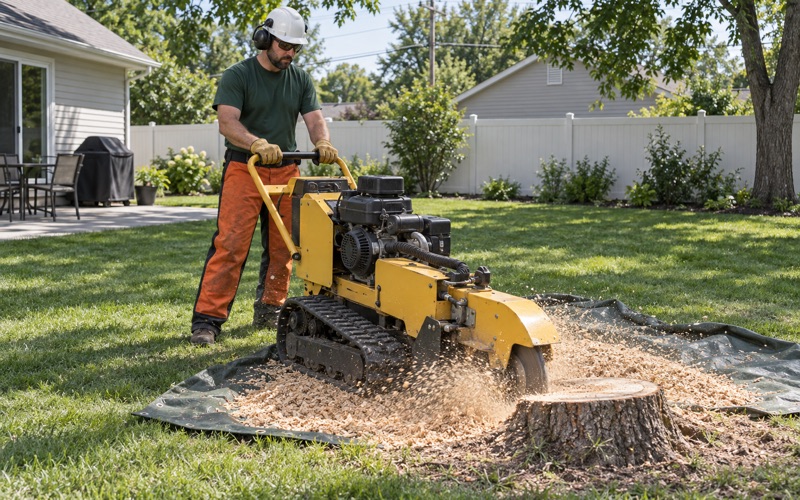
We place a Missouri One Call locate at 1-800-344-7483 ahead of any stump grinding. On subdivision ground graded and filled within the last thirty years, what is buried is frequently not where memory puts it, and a stump grinder tooth wheel finds it at the worst possible moment.
The credential question has an unusual answer in this city. Neither Missouri nor Clay County licenses tree work, and the code carries no general business or occupational license chapter, so the nearest locally checkable standard is the insurance floor the city sets for solid waste haulers under Section 245.060: at least one million dollars for a person injured or killed, two million for multiple persons in one accident, and one million for property damage. That is a published local number you can hold any bid against. Our proof of insurance reaches you before anyone sets foot on the property, the on-site assessment costs nothing, and the figure we quote is the figure that arrives in writing.
- 20+ Years in Johnson County
- Insured, Proof Sent First
- Free On-Site Assessment