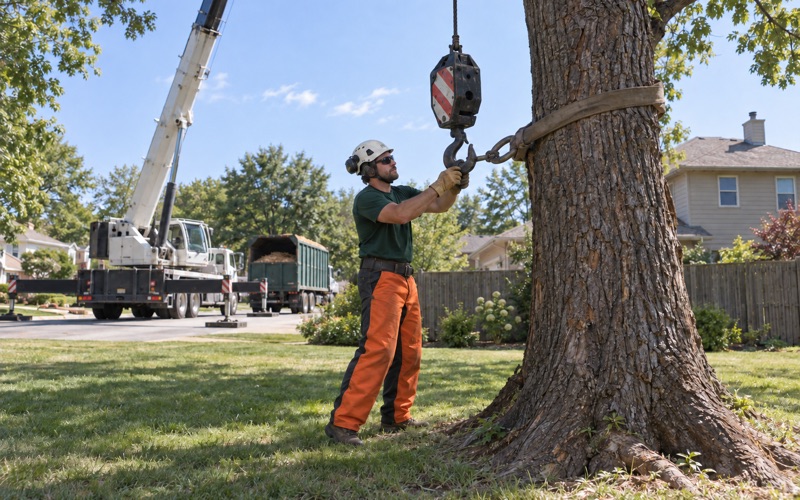
Shawnee Tree Removal has been taking trees down for more than twenty years, and tree removal in Spring Hill starts with a question no other town we work in forces us to ask first: which county is the tree standing in? The city limits here cross the Johnson-Miami county line, so one set of city limits holds two counties’ worth of answers.
That is not trivia to file away. Which half of town an address sits in decides where the brush can lawfully be tipped, which of Evergy’s two Kansas utilities owns the wire over the yard, which district court a special assessment lands in, and whether a warning issued during a storm covers the property at all.
So we settle the address before we plan the tree. The on-site assessment costs nothing, the figure we quote is the figure we put in writing, and proof of insurance reaches you before a crew steps onto the property. You also get a written condition assessment for a neighbor or an adjuster, and we tell you where the wood and the grindings are going before the saw comes out of the truck.
Which county your address is in, and how the city itself answers
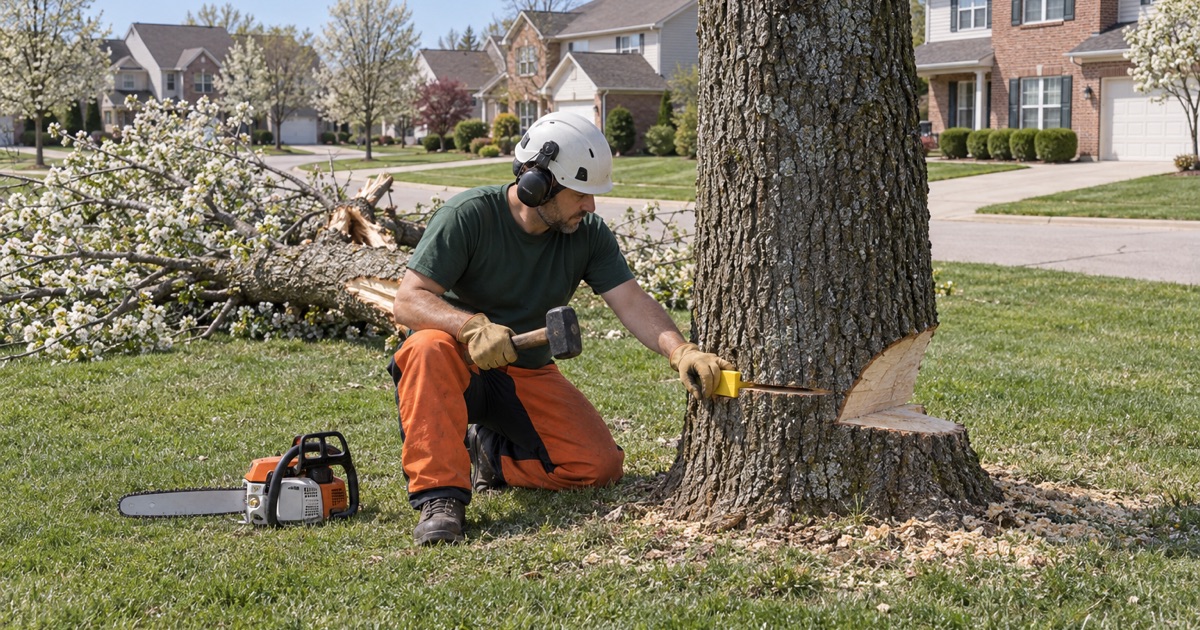
The split shows up in Spring Hill’s own ordinances rather than on a sign. Municipal Code 7-306(m) provides for collecting unpaid special assessments “by bringing an action in the Johnson County or Miami County District Courts,” and 17-101 requires the planning commission to seat one member from the unincorporated area of Miami County and one from the unincorporated area of Johnson County. A city sitting wholly in one county never has to write either sentence.
The Census counts the place in two parts for the same reason: 2,032 occupied housing units on the Johnson County side and 1,245 on the Miami County side, summing exactly to the 3,277 occupied units in town. Roughly two-fifths of this city answers to a different county than the rest of it.
A warning that covers half of Spring Hill
Point queries against the National Weather Service return forecast zone KSZ105 with county zone KSC091 at the north end of the city and forecast zone KSZ057 with county zone KSC121 at the south end, both reporting the location as Spring Hill, Kansas, and both under the Kansas City/Pleasant Hill forecast office. A severe thunderstorm warning can therefore be issued for part of this city and not the rest of it.
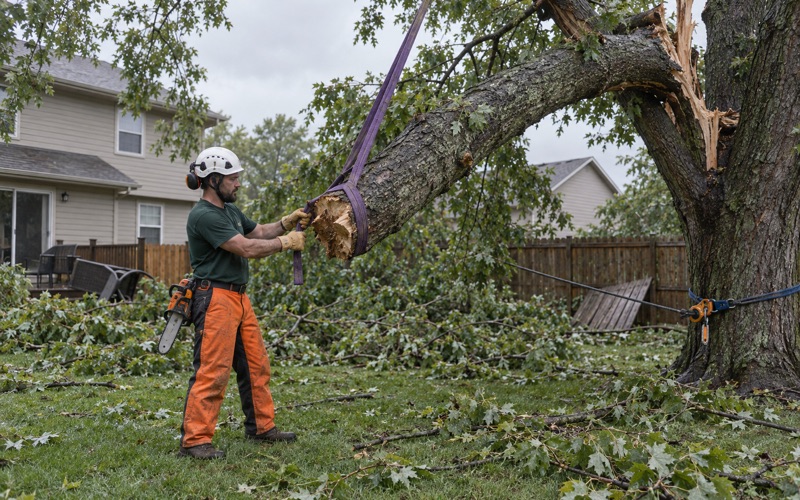
That office’s local wind record is convective rather than seasonal: 89 mph measured in the July 14, 2023 wind storm, with about 200,000 customers out and roughly 60,000 still out the following day, and 1/8 to 1/4 inch of ice accretion in the February 5-7, 2019 ice storm. When a tree comes down on a roof, a car or a service line, we respond the same day.
The brush route changes at the county line too
Curbside collection is Waste Management under contract to the City, and Municipal Code 7-202 makes it unlawful for anyone else to collect refuse inside the corporate limits. The city’s published yard-waste rule is specific: brush tied into bundles 18 inches by 48 inches long with rope or twine rather than wire, eight bags or bundles each collection week, and no single bag over 50 pounds.
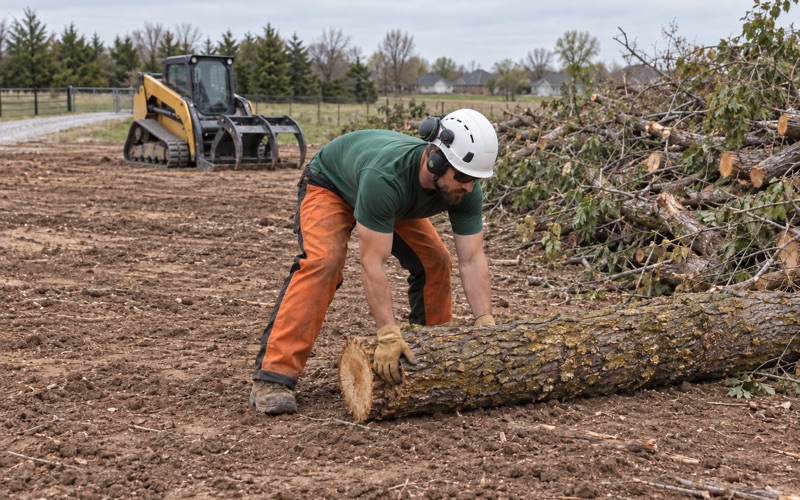
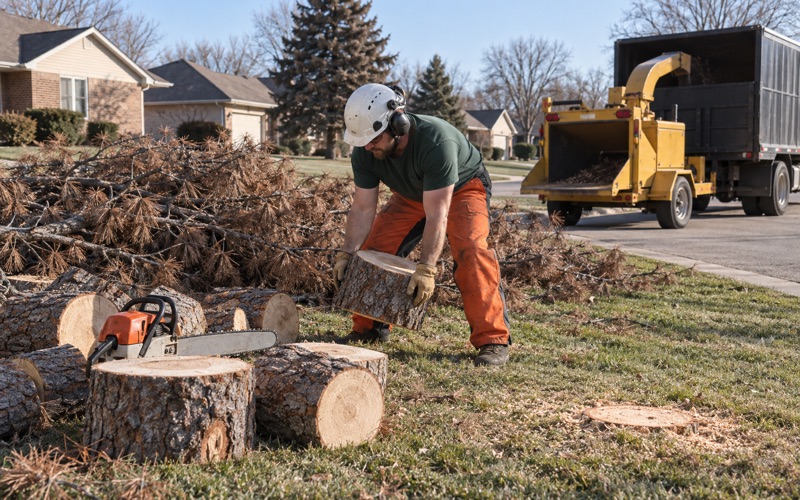
Behind the curb the city points residents at both counties, and the two answer the trunk question differently. Johnson County operates no public yard-waste gate at all and its landfill caps landscape waste at 3 inches in diameter, while the Miami County Transfer Station at Paola takes brush at $51.77 per ton with a $17.76 minimum for 1,000 pounds or less, on pricing effective 01/01/26. Removal wood clears none of the curbside gates, so the haul is in our quote; every stick leaves with us rather than sitting at a curb the rules were never going to accept.
Looking for tree-removal closer to Raytown? See Tree-Removal in Raytown.
Two Evergy companies serve one city
Evergy serves Spring Hill, but Evergy operates two separate Kansas utilities and this city has customers in both the Evergy Kansas Central and the Evergy Metro service areas. “Call Evergy” is a complete instruction two towns north. Here it is half of one, because a homeowner usually cannot tell which entity owns the right-of-way over their tree without reading their own bill.
We establish it before scheduling anything near a conductor. The two rate areas are administered separately, and the answer decides whose crew we are waiting on.
What the utility will do, and what it leaves lying there
Evergy’s published posture across its territory is that requests are evaluated by inspection, that clearance runs ten feet at 600 to 50,000 volts, and that on an assist it removes all limbs within ten feet of energized conductors while any debris is left at the worksite. Removal of anything over four inches needs signed owner permission, and notice of planned work runs anywhere from seven to ninety days.
Two things follow from that for a homeowner. A line-clearance visit manufactures a cleanup job rather than finishing one, and the scheduling belongs to the utility rather than to us. The cycle runs about four years urban and six rural, and on this side of the state line none of it is public: Kansas adopts the National Electrical Safety Code by reference and publishes no vegetation-management plan, while Missouri requires an annual one.
The line from the pole to your meter is yours
The service drop is the customer’s responsibility under Evergy’s own published terms, and it is the piece homeowners most often assume belongs to the utility. A limb resting on that span is private work, and so is everything left after a line crew has cut its ten feet and driven off.
Where a conductor is down or a tree is against a primary line, nobody touches it and the utility goes first. The ANSI Z133 safety standard is flat about work near energized conductors during thunderstorms, high wind, snow or ice, and Evergy’s ten-foot figure sets the standoff. We follow behind with the rest of the tree.
The sixty-day notice is the clock that reaches your yard
Spring Hill requires no permit to take down a tree standing on private property, and no diameter triggers one. The only permit in the city’s tree article runs the other way: 7-506 requires permission from the Director of Public Works to plant a street tree, or any other tree, in the public right-of-way, with the Green Board notified by the City Administrator once that permission is granted.
What does reach a private tree is Municipal Code 7-509. The City shall remove or cause to be removed any dead or diseased tree within the city limits, with diseased trees defined as those that may constitute a hazard to life and property or harbor insects or disease representing a potential threat to other trees in the city. The Code Enforcement Officer notifies the owner in writing, and removal shall be accomplished within sixty days of notification.
If the owner does not act, the City has the authority to remove the tree, assess the costs, and charge the cost of removal plus an administrative fee to the property owner on the property tax notice. That is the commercially important sentence in this code: nobody’s permission is needed to take a tree down, but a written notice starts a sixty-day obligation that ends on a tax statement. The definition is broad enough to reach a tree that is merely harboring something.
Topping, defined here with a number
Municipal Code 7-507 makes it unlawful as a normal practice for any person, firm or city department to top any street tree, park tree or other tree on public property, and it defines the term: severe cutting back of limbs to stubs larger than three inches in diameter within the tree’s crown, to a degree that removes the normal canopy and disfigures the tree. Storm-damaged trees, and certain trees under utility wires where other pruning is impractical, may be exempted at the determination of the Director of Public Works.
That provision reaches street and park trees, not the maple behind your house, so no ordinance stops somebody topping a back-yard tree here. We do not top trees, and a city that has already written down what a three-inch stub does to a crown is a useful thing to read aloud when a competitor offers to.
Eight feet over the walk, twelve over the street
Municipal Code 7-508 puts clearance over streets and walkways on the abutting property owner: eight feet over walkways and twelve feet over streets, with owners responsible for trees on the public way abutting their property as well as for trees on their own. The City keeps its own right under 7-505 to prune or remove a right-of-way tree in an unsafe condition, while stating that abutting owners may perform normal tree care on street trees.
So the limb hanging over the sidewalk is a homeowner’s duty with a published number attached to it, and it is cheaper booked as crown raising than argued about later. Neither Kansas nor either county licenses tree work, so a written scope, a certificate of insurance and a crew that can explain each cut are what there is to screen on.
Two housing stories inside one set of city limits
Of the 3,352 housing units here, 85.08 percent are one-unit detached, at 359 housing units per square mile. That is low-density detached ground, where gate width rarely limits a removal and the drop zone almost always does. The chipper is the machine that will not fit: a Bandit Intimidator 19XPC stands 7 feet 9 inches wide at 10,500 pounds, while a narrow-access grinder passes a 35-inch gate.
Ownership differs sharply between the halves, too. The Johnson County side is 17.27 percent renter-occupied against 32.77 percent on the Miami County side, so in one part of town the person who opens the door usually decides about the tree, and in the other there is a fair chance the decision sits with someone who is not standing in the yard. That is part of why the condition assessment goes out in writing.
The tree that arrived with the house
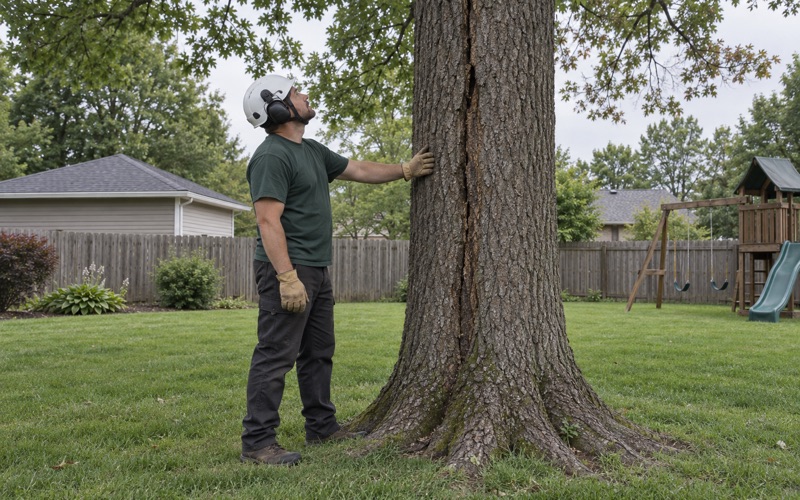
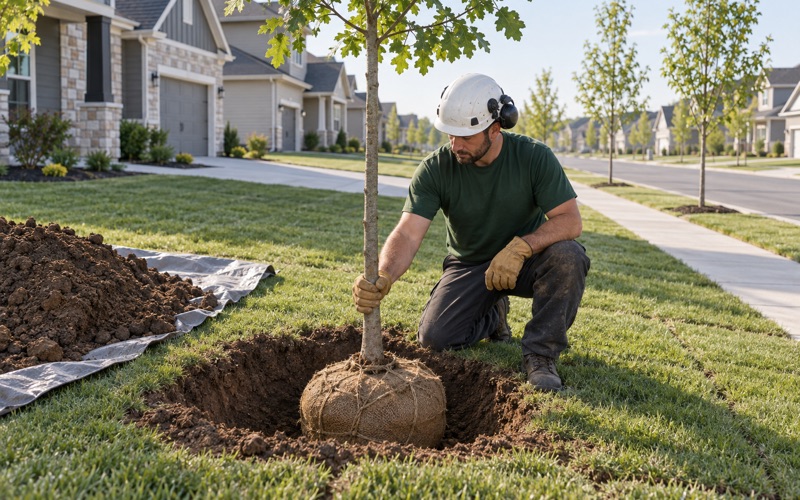
43.38 percent of the stock went up in 2010 or later and 68.29 percent in 2000 or later, so across most of this city the tree coming down is the tree planted with the house. That means Bradford and Callery pear now past the window the Johnson County K-State Research and Extension Master Gardeners named in print, verbatim: “DO NOT plant Bradford cultivar; severe splitting occurs on 10-15 year old trees.” What that splitting looks like on the stem is a pair of co-dominant stems with included bark packed between them.
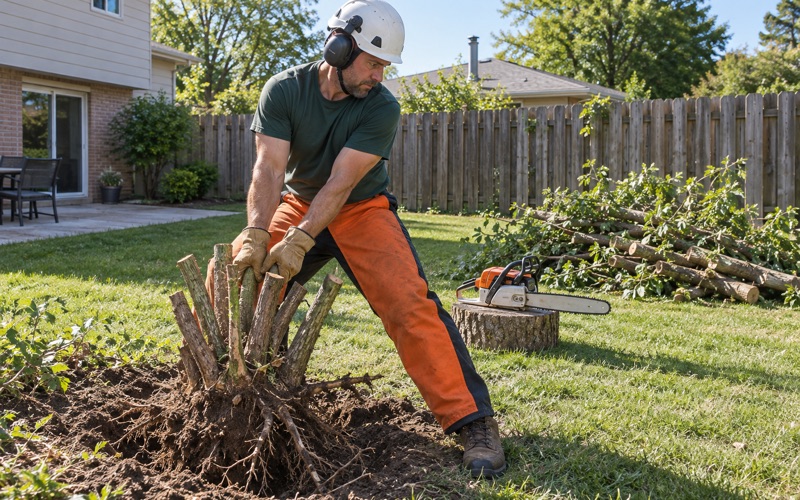
Callery pear resprouts from lateral roots when only the stump is ground, so a removal that stops at the stump returns as a thicket, and the Kansas Department of Agriculture’s Callery pear quarantine takes effect January 1, 2027, prohibiting the sale and the movement of all seeds, plants or parts. Where extra-high-strength cable and a properly set eyebolt termination will hold a split leader, we price the cabling and say so instead of selling the removal.
The old core, where the constraints invert
144 units in this city predate 1939, and on that older ground everything runs the other way: mature trees over a pre-war plat, tighter setbacks, and the rigging or crane-assisted work the newer subdivisions have not started generating yet. Sections come out on a bull rope through a Port-a-Wrap friction device rather than on the ground under a wedge. Both descriptions are true of Spring Hill, in different parts of it.
Kansas 811 before any grinder turns
A locate goes in ahead of every stump, without exception. The Kansas Underground Utility Damage Prevention Act, K.S.A. 66-1801 through 66-1814, requires notice at least two full working days before excavation begins and not more than 20 calendar days ahead of it, so a locate left too long has to be called again.
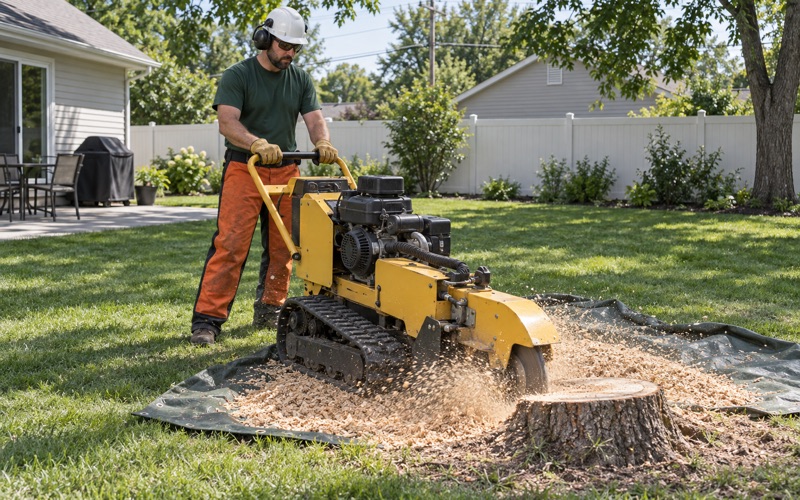
We do not quote a grinding depth from the street either. On a lot graded in the last fifteen years the wheel is working imported fill and compacted subgrade that no soil survey describes, and on shallower ground in this area, series such as Vinland at 10 to 20 inches and Sogn at 4 to 20 inches to rock will stop a machine before its own travel does. That is a question answered on site, with the grinder running.
- 20+ Years in Johnson County
- Insured, Proof Sent First
- Free On-Site Assessment