
Shawnee Tree Removal has been grinding stumps in Shawnee, KS for more than twenty years, serving surrounding cities including Lenexa, Edwardsville, Bonner Springs, Merriam and Mission. It is the part of a tree job that most quotes gloss over, and the part where two properties with identical stumps on them can carry genuinely different prices for reasons the customer cannot see from the driveway.
Those reasons are access and ground. Width, not power, decides whether a machine reaches your back yard, and the soil series under your lot decides whether the wheel meets its own depth stop or meets rock first. This is cuesta country — alternating limestone and shale benches — and Johnson County’s mapped series run from a few inches to a few feet of cover before anything hard. On top of that, roughly half of Shawnee’s housing stock went in between 1980 and 2009 on graded subdivision ground, where the working medium is imported fill the soil survey does not describe at all.
So we measure the gate, place the 811 utility locate, tell you the below-grade depth we expect to reach and what would stop us short of it, and settle the question of where the grindings go before the machine comes off the trailer. The figure we quote is the figure in writing, and the grinding line is separate from the removal line so you can see exactly what you are buying.
Residential and Commercial Stump Grinding
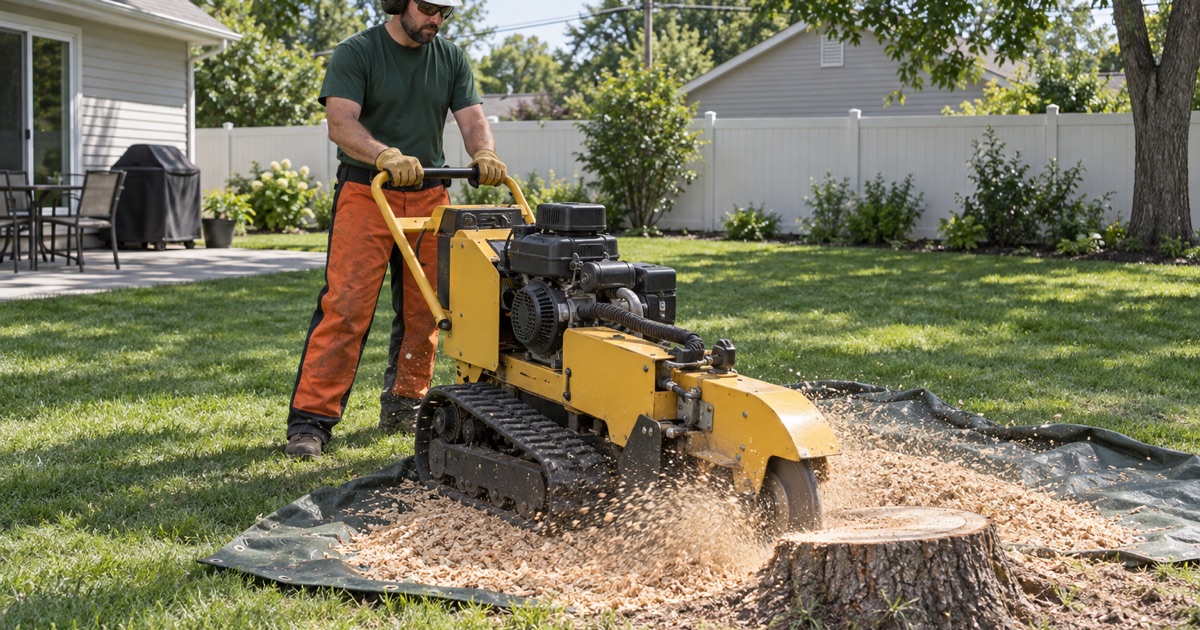
Yard and Back Yard Stumps
Most residential grinding follows a removal we did, but plenty of it is somebody else’s stump left behind years ago, or a hedge line the previous owner cut flush and forgot. An old stump is not necessarily easier: the wood hardens, the surrounding grade has usually changed, and the flare may now be buried under six inches of turf and soil that the wheel has to move first.
HOA, Commercial Grounds and Multi-Stump Jobs
Common areas, parking islands, retail frontage and apartment grounds usually mean several stumps in one visit, and the efficiency comes from routing rather than from equipment size. We price a multi-stump job as a schedule, sequence it so the machine is walked once, and coordinate around the hours a business or an association actually needs the area clear.
Right-of-Way and Street Tree Stumps
The strip between your sidewalk and the curb is a different legal animal, and in Shawnee it is your responsibility to maintain rather than the city’s. Work inside the right-of-way is regulated under the city’s own chapter for that corridor, with named permit types for excavation, and a grind inside that strip is excavation in a permitted corridor whatever the tree was. We raise that before the work is scheduled, not after.
What Decides Depth, Access and Price
Machine Width Against Your Narrowest Point
The narrowest point on the route sets the machine, full stop. A narrow-access grinder passes a thirty-five inch gate; a pedestrian-gate machine passes twenty-five inches; a full-size towed chipper at over seven feet wide goes through nothing and stays on the drive. We measure gates, side yards, gate posts and any step or slope on the way in, because a machine that fits on paper and not in practice turns a one-visit job into two.
Soil, Bedrock and What Actually Stops the Wheel
Against a rated cut of roughly twelve to twenty-five inches, only the shallowest Johnson County series put bedrock in reach of the machine. Everywhere else the machine’s stop is what ends the cut, and depth is a decision rather than a discovery. What depth does not describe is wear: a deep soil carrying angular chert lets the wheel chew rock the whole way down without ever hitting a bench, which costs teeth rather than inches.
Stump Diameter, Flare and Species
Price tracks the diameter at the flare rather than the diameter at the cut, because the flare is what the wheel has to sweep. Species matters too — hard, dense wood such as Osage orange grinds slowly and eats teeth, while a soft silver maple goes fast. A stump ground flush years ago by somebody else usually has a wider, shallower flare hidden under grade than a fresh one does.
Buried Utilities, Irrigation and Hardscape
Everything within the wheel’s reach is at risk if it is not located first: gas and electric services, cable, irrigation lateral lines, low-voltage lighting, and the edge of a patio or a retaining wall. We place the locate, honor the marks, and where a stump sits against hardscape we grind to a stated setback and say plainly what will be left rather than damaging the wall to get the last two inches.
Our Step-by-Step Stump Grinding Process
Free On-Site Assessment and Access Measurement
We come out, measure the gate and the route, look at the flare rather than the cut, and check what is around and under the stump. You get the scope, the expected depth, the grindings decision and the figure in writing before anything is scheduled. If the honest answer is that the access rules out grinding, you hear that at this visit instead of on the day.
Utility Locate and Site Protection
The 811 locate goes in and we work to the marks. Before the wheel turns, we screen the working area, because a grinder throws chips and small stone with real force and a neighbor’s siding or a parked car is not a risk worth taking. Irrigation heads and lighting near the stump get flagged or lifted.
Grinding to the Agreed Below-Grade Depth
The machine works the stump and the structural roots in passes, sweeping the wheel across the face and advancing as material comes away. We grind the flare and the surface roots out to the agreed limit, not just the visible plug, because a flare left in place is the thing that reappears as a hump in the lawn a year later.
Backfill, Cleanup and What We Leave
What happens next is whatever you chose at the assessment: grindings hauled and the hole backfilled with topsoil, or grindings raked back and mounded to allow for settlement. Either way the surrounding turf is cleared of throw, the hardscape is swept, and you get told honestly how much the fill is likely to drop over the following months.
Grindings, Backfill and What Comes Next
The Crater Is Bigger Than the Stump
Ground wood occupies several times the volume of the stump it came from, so a modest stump produces a surprising mound. That is normal and it is the single most common thing homeowners are not warned about. Deciding in advance whether that material leaves or stays is what keeps it from becoming an argument at the end of the day.
Seeding, Sod and Replanting Over a Ground Stump
Grindings are wood, not soil. They tie up nitrogen as they break down and they settle unevenly, so turf seeded straight into them comes in thin and dips. If the plan is seed, sod or a replacement tree, the grindings come out and soil goes in, and for a replanting we grind wider and deeper to give the new root ball uncontaminated ground to work into.
Trunk Rounds and Debris From the Original Removal
Grinding is the last step of a removal, and the trunk wood is usually still on site when it happens. Rounds are the heaviest thing on any job and the line item most quotes go quiet about. Ours names it: hauled away, stacked where you want it, or split out as firewood and credited against the disposal line so you can see the trade.
- 20+ Years in Johnson County
- Insured, Proof Sent First
- Free On-Site Assessment