Shawnee Tree Removal has been taking trees down in Tonganoxie for more than twenty years, and on a large share of the addresses here the tree is the easy part of the job. The hard part is finding a legal place to put the chipper.
More than a third of this city’s housing shares a wall or a drive with somebody else. In the current five-year ACS release, 35.50 percent of the stock is one-unit attached, duplex, or three-to-four-unit, and there is not one structure of five units or more anywhere in Tonganoxie. That mix is unusual for a city this size, and it changes the arithmetic of a removal completely.
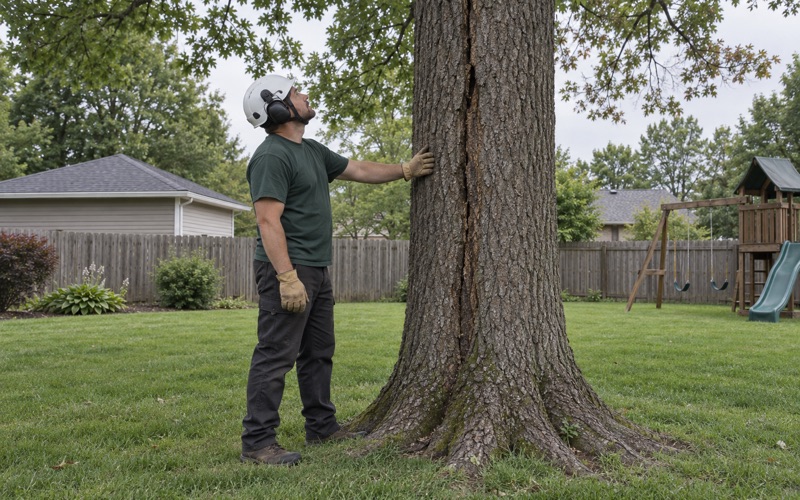
On a townhome or duplex address, the price is set by where a chipper can legally sit and how far the brush has to be carried to reach it, not by the diameter of the trunk. We walk that route before we quote anything. The assessment costs nothing, and the number we hand you at the end of the walk is the number that goes in writing.
Removals on a shared drive or a party line
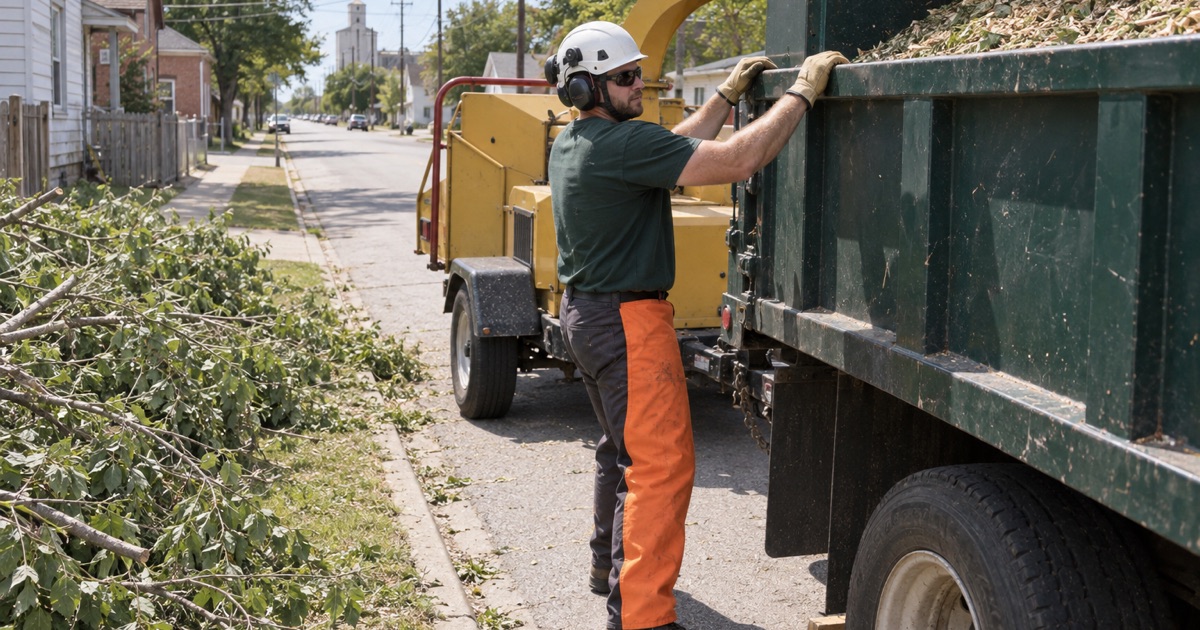
A shared drive is not a driveway anyone can occupy for six hours. Somebody else on that pavement leaves for work, comes home at noon, or has a delivery arriving, and a chip truck parked across it turns a routine morning into an argument between neighbors who still have to live next to each other. We stage the work so the drive opens and closes through the day rather than closing at eight and reopening at three.
Whose grass is the drop zone
The setback that puts two units close together also puts the only sensible landing area on the far side of a line nobody has ever had reason to think about. Before the climb starts we agree on where the wood is coming down, and when that ground belongs to the neighbor, that conversation happens first, in daylight, with both owners standing on it.
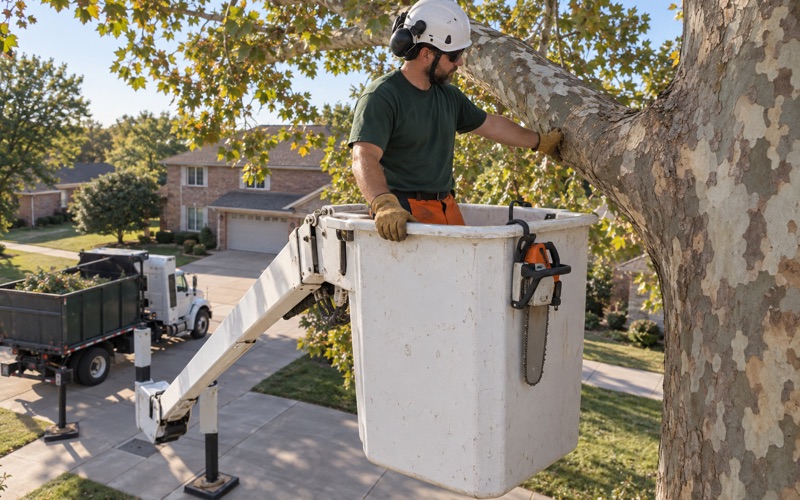
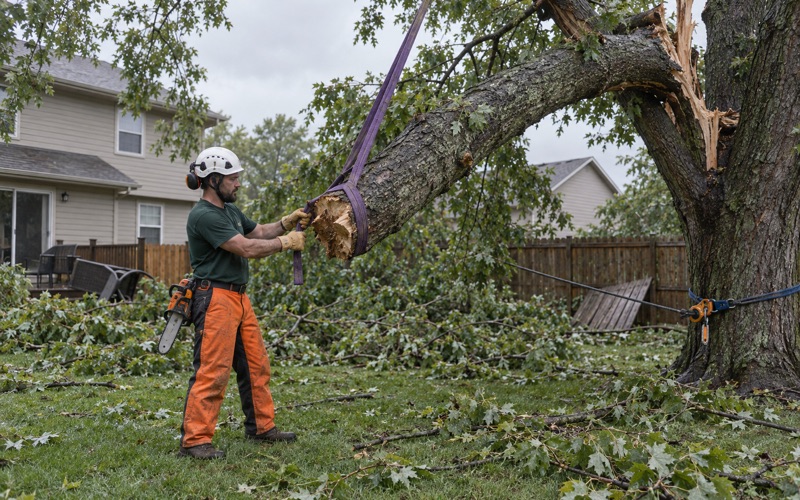
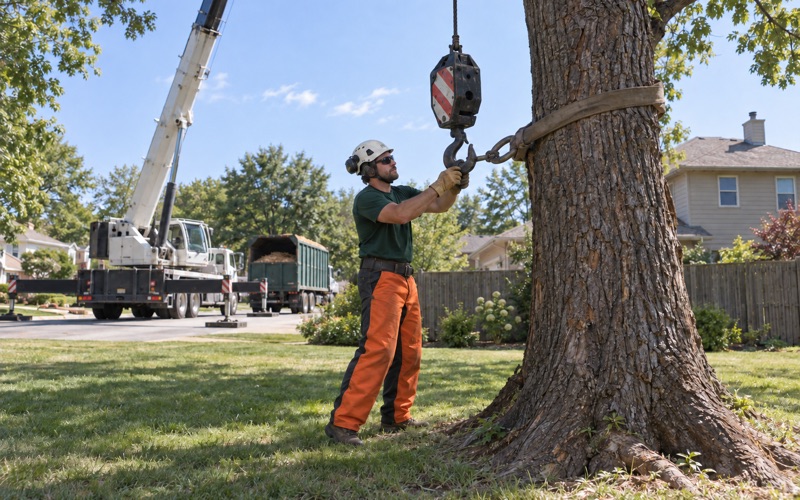
Where nothing can be dropped at all, the tree comes apart in controlled pieces on rigging, with a bull rope run through a Port-a-Wrap friction device and sized to a working load limit rather than to whatever happens to be on the truck. Lowering every piece is slower than felling one, and on this kind of ground it is usually the only method the site will allow.
Carry distance is the line item that moves
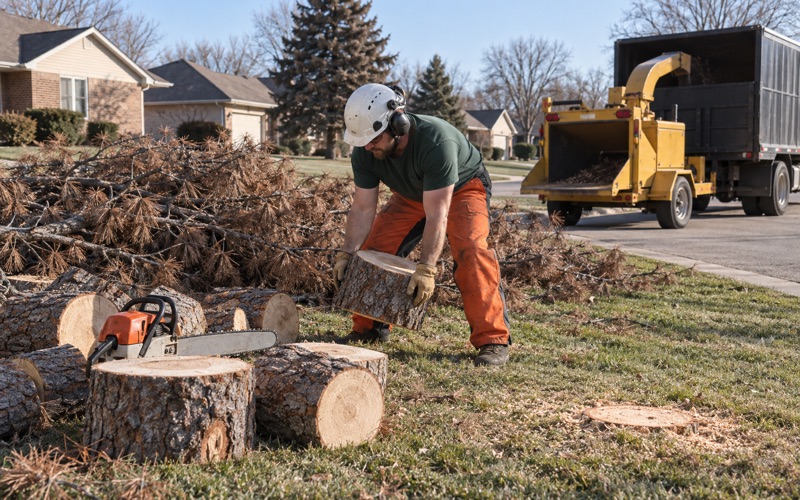
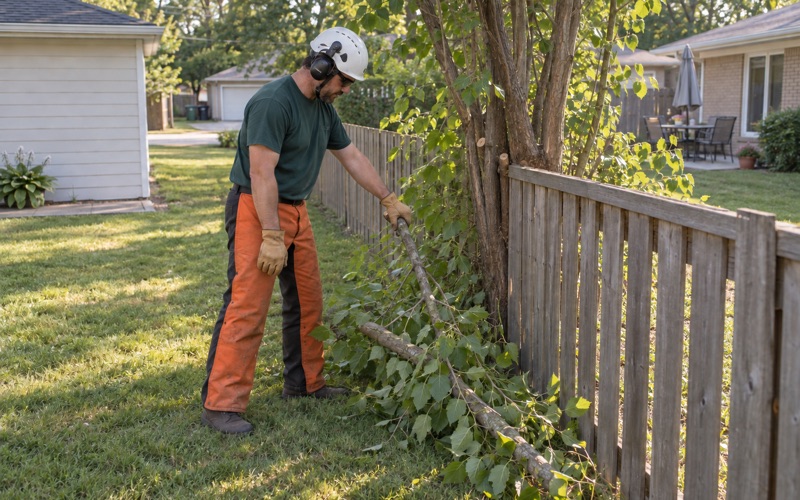
When the nearest legal spot for the chipper is the street and the tree stands behind the unit, every limb crosses that distance in somebody’s hands. Two removals with identical trunks can be priced very differently on the same block for that reason alone, and we show you where the difference came from instead of burying it inside a round number.
You also hear where the wood and the grindings are going before the saw comes out of the truck. What comes off the tree leaves on our truck the same day.
Looking for tree-removal closer to Lansing? See Lansing Tree-Removal.
What fits through the gate, and what fits at the curb
Width classes, measured at the narrowest point
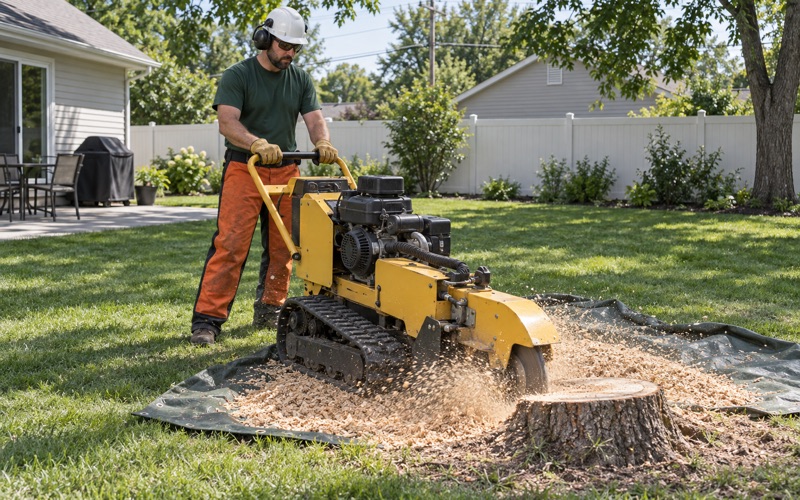
A compact stump grinder in the narrow-access class passes a 35-inch gate. A pedestrian-gate machine gets through 25 inches. A full-size towable chipper runs roughly 7 feet 9 inches wide at around 10,500 pounds and never goes through a gate at all, so it stays on the drive or the street and the brush is carried to it. Which of those three applies at your address is a tape-measure question, and it is the first measurement we take.
Width is a class of access, not a class of capability
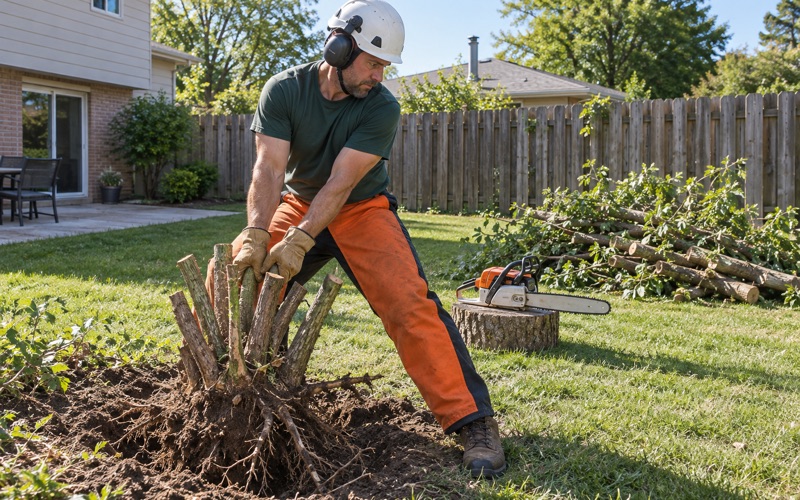
Two machines can share a width and still do completely different work. At an identical 35 inches, a Vermeer SC552 takes a stump 25 inches under the surface where a Rayco RG37 stops at 12, and the SC552’s dual-wheel option puts that same machine at 56 inches, which is a gate it no longer fits through. We match the machine to the opening first and then tell you what that machine can reach on your particular stump. We will not promise a cut depth on a stump we have not looked at.
Kansas 811 first, then the lines 811 does not locate
Kansas 811 gets called before any grinder turns, without exception. On subdivision ground the locate is only the start of it, because irrigation laterals, low-voltage lighting runs and invisible-fence wire are none of them locatable utilities, and the homeowner is often the only person who knows where any of it was trenched. We ask about all three before the tooth wheel drops.
The curb has a published size, and a trunk is not it
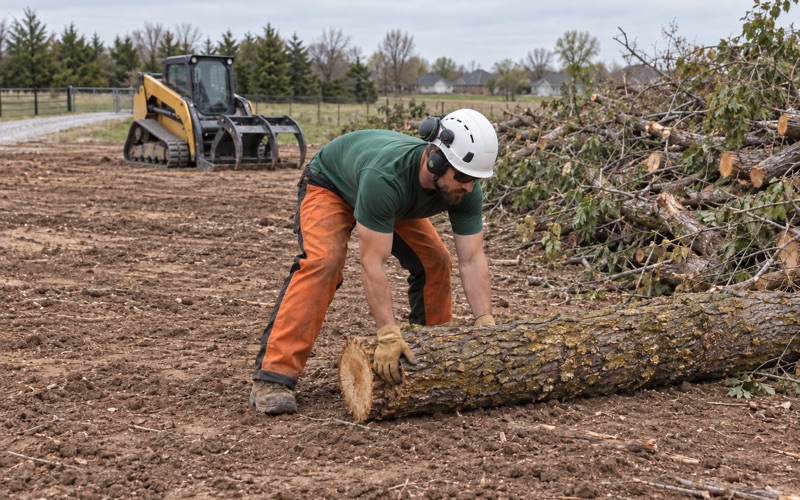
Solid waste collection here is contracted to Honey Creek Disposal Service, and the yard-waste rules are specific: leaves and brush go in kraft paper bags made for yard waste, plastic bags are prohibited, and bundles must be tied securely to no more than 18 inches in diameter, four feet in length, or 65 pounds. Set that against an actual removal and the conclusion is unavoidable, because a trunk section, a butt log or a root ball has no curbside route in this city at any size. Nothing we cut is left at your street waiting for a truck that is not coming for it.
The property line, and what the city asks you to file
Kansas does not answer the neighbor’s tree the way Missouri does
This question lands harder on attached ground, where a trunk can stand a few feet from a door that is not yours. In Kansas, under Pierce v. Casady, 11 Kan. App. 2d 23, 711 P.2d 766 (1985), a landowner can compel a neighbor to abate a tree that is doing substantial harm or creating imminent danger, while self-help stops at the property line and carries no right of entry. Missouri, under Hasapopoulos v. Murphy, 689 S.W.2d 118 (Mo. App. E.D. 1985), gives you self-help and nothing further, and only against a healthy tree.
Two decades of work on both sides of State Line Road is why we can tell you which of those rules governs at your address before you knock on a door. Where a boundary is in play you get a written condition assessment, something you can hand to a neighbor or to an adjuster, rather than a verbal opinion that evaporates the moment it is repeated.
The permit answer, stated as far as the record goes
The City of Tonganoxie publishes no tree removal permit for private property, and none appears among the seventeen items on its Licenses, Permits and Planning Applications page: business license, building permit, fireworks sales, lot split, manufactured home occupancy, plat, sign, site plan review and its checklist, solicitors, special event or parade, special use, temporary use, variance, zone change, vending, and the UTV checklist and waiver. No tree trimmer, arborist, contractor or right-of-way permit sits anywhere on that list, and because it is an enumeration rather than a search that came up empty, the negative carries real weight.
What we will not tell you is that the city code itself is silent, because we have not read it and the official code host has refused every request we made for it. City Hall answers at 913.845.2620 and is the right place to settle a question about a tree in the right-of-way. We also never claim a trade license for this work, since Kansas issues none for it, and a business license is a business license rather than a trade credential; what you do get is proof of insurance in hand before anybody unloads a saw.
Who owns the wire, Evergy or the cooperative
Tonganoxie sits in Leavenworth County at the northwestern edge of the Kansas City metropolitan area, and that puts two very different electric utilities inside one county line. Evergy Kansas Metro is the investor-owned company in this part of Kansas, and FreeState Electric Cooperative also operates here, formed on January 1, 2017 out of the consolidation of Leavenworth-Jefferson Electric Cooperative and Kaw Valley Electric Cooperative and headquartered at 507 North Union in McLouth. Which of them owns the pole at the end of your drive is an address question, and we check it rather than assume it.
A cooperative publishes its posture to its members
FreeState tells its members it trims trees up to the meter and that anything beyond the meter is the member’s own responsibility. It says it removes trees rather than trimming them to the point they look butchered, marks a tree for removal with a red ribbon, and leaves the property as clean as it can, with wood chips delivered to members who ask to be on the list. Right-of-way requests run through a member account coordinator and take two to three business days to process.
Read that meter boundary carefully, because it decides who you are calling. Everything past it, including the tree over the shared drive, the stump left behind and the cleanup after a line crew has finished its own part, is private work in either territory.
The line itself is nobody’s do-it-yourself project
The cooperative’s own language leaves no room to negotiate: never attempt to clear the lines yourself, never climb a tree with branches near lines, and never touch a power line. We hold the same rule from the other side of it, since nobody works near energized conductors during a thunderstorm, high wind, or a snow or ice storm, which is exactly what the Z133 safety standard requires. When a tree is on a roof, a car or a service line, you get us the same day, and the utility gets the call first whenever a conductor is involved.
Replanting where the easement and the drive are the same strip
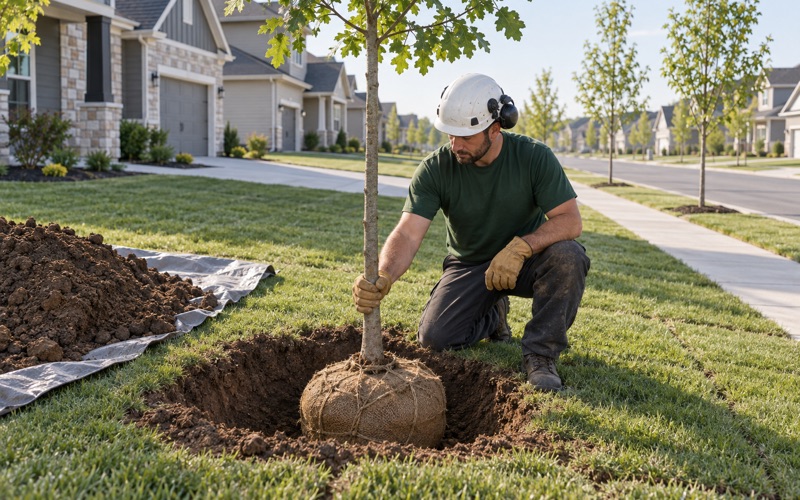
Preferred Trees for Northeast Kansas, published by the Kansas Forest Service with K-State Research and Extension and the Kansas Arborists Association among others, puts a usable number on the replacement: trees with a mature height of 20 feet or less can be used within 15 feet on either side of utility lines. That same guidance notes that multi-stemmed forms are more likely to be damaged from snow, ice, or wind, which is worth weighing on a strip where the wire, the drive and the only available planting space are all the same few feet of ground.
Not every tree on this ground has to come out, either. Where cabling and bracing or a properly made crown reduction keeps a sound tree standing, we price that instead and show you the reasoning, and we will not top a tree for anyone who asks us to.
- 20+ Years in Johnson County
- Insured, Proof Sent First
- Free On-Site Assessment