Shawnee Tree Removal has been trimming and pruning trees across Shawnee, KS for more than twenty years, serving surrounding cities including Lenexa, Edwardsville, Bonner Springs, Merriam and Mission. Trimming is the cheapest work we do and the work that prevents the most expensive calls, and it is also the work where the difference between a competent crew and a careless one is invisible on the day and obvious three years later.
The difference is whether the cuts are named before they are made. ANSI A300 describes pruning as specific types with specific objectives — crown cleaning, crown raising, crown reduction, crown thinning — each removing particular material for a particular reason. A crew working to that standard can tell you what it is taking and why. A crew that cannot will take whatever is easy to reach from where the truck happens to be parked.
Much of Shawnee’s canopy was planted with its houses, and more than half the city’s housing stock went in between 1980 and 2009. That means a lot of trees are now thirty to forty-five years old, in the window where the fast-growing suburban planting palette starts showing what it was always going to show: narrow crotch angles, included bark, and end weight the structure was never built to carry. Pruning is how that gets managed before it becomes a removal.
Residential and Commercial Tree Trimming
Yard Trees and Mature Canopy
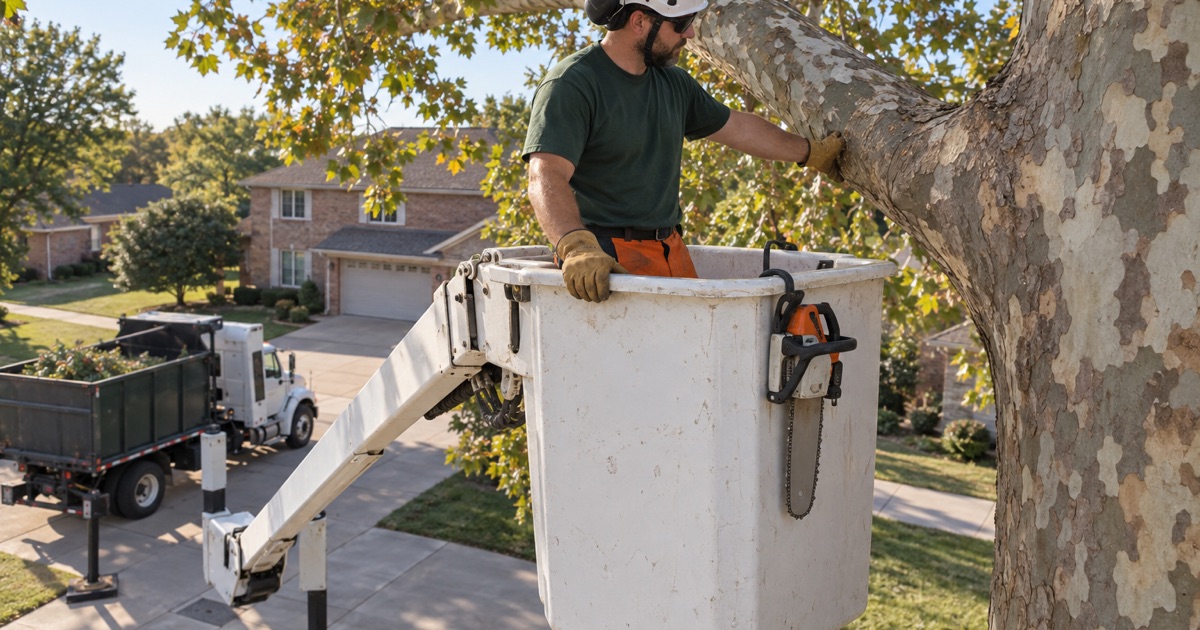
A homeowner’s pruning usually has one of three drivers: the tree is over the house, it has grown lopsided, or something in it died. We start by identifying the species and looking at the whole structure rather than the branch that prompted the call, because the branch you noticed is often not the one that matters. The recommendation is a named pruning type and a stated objective, not a vague tidy-up.
HOA Common Areas and Commercial Frontage
Associations and property managers need pruning that holds its shape between visits and documentation that shows the work was planned. We prune on a cycle rather than reactively, prioritize sightlines, walkways and parking, and leave a record of what was done to which tree. Where a common-area tree has a defect that pruning will not solve, that goes in the record too.
Young Tree Structural Pruning
The cheapest possible intervention on any tree is the one made in its first fifteen years. Structural pruning selects a single dominant leader, subordinates competing stems before included bark can form, and spaces the scaffold branches. Done on a young tree it costs a fraction of an hour; skipped, it is the reason a thirty-year-old tree needs a cable or a removal.
The ANSI A300 Pruning Types We Actually Use
Crown Cleaning
Crown cleaning removes dead, dying, diseased and broken branches, and nothing else. It is the least invasive of the pruning types and the one with the best return, because it takes out exactly the material that falls on a roof, a drive or a play set without opening up the canopy or reducing the leaf area the tree lives on. On most mature yard trees it is the only pruning genuinely required.
Crown Raising
Raising lifts the lower canopy to give clearance over a lawn, a walkway, a drive or a street. It is easy to overdo: strip too much off the bottom and the tree ends up with all its weight high, which is worse in wind and slower to correct than it was to cause. We raise to the clearance actually needed and keep the lower scaffold branches that hold the center of gravity down.
Crown Reduction
Reduction shortens the crown by cutting back to lateral branches large enough to assume the terminal role, which is the entire distinction between reduction and topping. It is the right answer for a tree with too much end weight on a weak union, a tree that has outgrown its clearance to a structure, or a storm-damaged crown that needs rebalancing. It is done in stages on a mature tree, not in one aggressive pass.
Crown Thinning
Thinning selectively removes live branches to reduce density, which improves light and air movement through the canopy and reduces the sail area a straight-line wind can push on. Used sparingly it is useful; used heavily it produces lion-tailing, where all the foliage ends up at the branch tips and the limb whips. We thin from throughout the crown rather than stripping interior growth off the branch length.
Our Step-by-Step Tree Trimming Process
Assessment and a Named Objective
The free on-site visit establishes the species, the structure, the defects and what you actually want to achieve. The output is a pruning type and an objective in writing — clearance to a stated distance, deadwood over a stated target, reduction of a stated stem — so there is no argument later about what was supposed to come off.
Access, Rigging Plan and Site Protection
How the crew gets into the tree is decided before anyone climbs. A bucket truck where the approach allows one, a climbing line where it does not, and a rigging plan with a bull rope and a Port-a-Wrap friction device for anything that cannot simply be dropped. Landscaping, fencing and hardscape under the work area are protected first.
Pruning to Natural Target Cuts
Every cut is made just outside the branch collar so the tree can compartmentalize the wound with its own defenses. Flush cuts remove that collar and leave a wound the tree cannot close properly; stub cuts leave dead wood that decays back into the stem. Natural target pruning is unglamorous and it is the whole difference between a wound that closes and one that becomes a cavity.
Cleanup, Chipping and Haul-Off
Brush is chipped on site and the chips leave with us unless you want them for beds. The work area is raked and blown, the drive and street are cleared, and nothing is left stacked at a curb your hauler will refuse. You get told what was removed and what we recommend watching before the next cycle.
Clearance Pruning: Roofs, Drives and Service Drops
Roof, Gutter and Siding Clearance
A limb resting on a roof abrades the shingles with every gust, and a canopy sitting over the gutter line keeps the roof surface damp and the gutters loaded. We cut back to laterals that give lasting clearance rather than heading the ends off, which only produces a dense flush of regrowth in the same spot within a season or two.
The Service Drop From Pole to Meter
Evergy states plainly that vegetation impacting the line running from a pole to your meter is the customer’s responsibility, which makes it one of the few power-line jobs a tree service can properly take. It is also one people leave until a storm takes the drop down with the limb. We handle the vegetation side of it and tell you when the situation needs the utility instead.
Street, Sidewalk and Sightline Clearance
Shawnee requires adjacent property owners to maintain the trees in the public right-of-way and to keep branches clear of the street and sidewalk for pedestrian, cyclist and driver sight distance, routing complaints to Code Enforcement. That is the opposite of what most owners assume, and the practical result is that the street tree in front of your house is normally your job and your bill. We prune it to the clearance the city is asking for.
- 20+ Years in Johnson County
- Insured, Proof Sent First
- Free On-Site Assessment